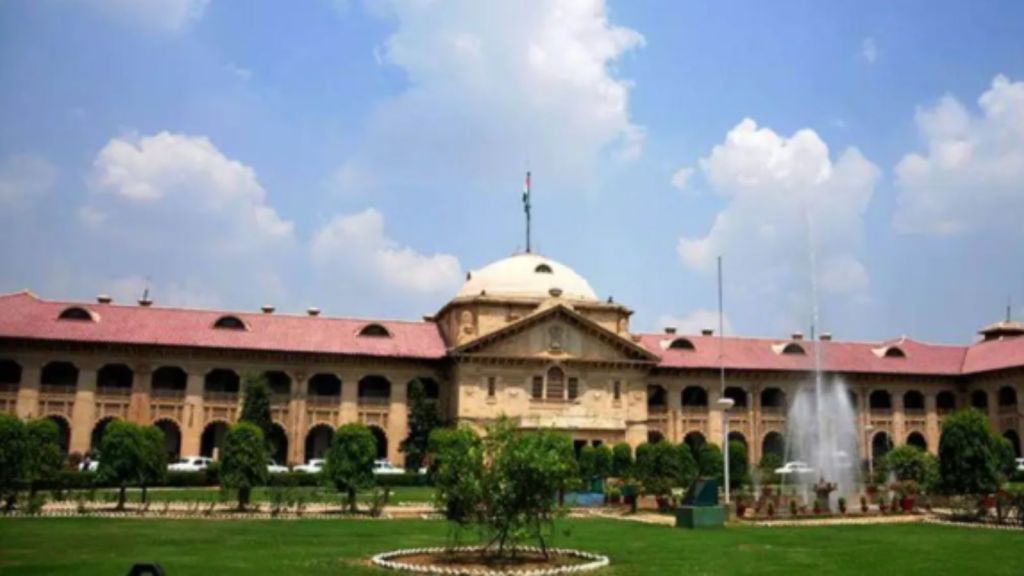
Cases pending for more than 20 years, some for over 40 years — a single bench of the Allahabad High Court observed that “even after centuries, the same frustration exists” in the familiar lament of tareekh pe tareekh (date after date).
In a September 28 order allowing four petitions that had remained pending in lower courts for years, Justice Vinod Diwakar said such prolonged pendency “does not reflect well on our institution”. “It is time that the institution addressed the issue with the urgency and promptitude it deserves,” the bench said, requesting the Chief Justice to take up the issue.
The order went beyond delays in individual cases. The bench made extensive observations on the administration of justice, judicial accountability and efficient functioning of courts.
Calling for a ‘recalibration’ of the Chief Justice-centric model of High Court administration, it emphasised the need for a more deliberative, institutionally balanced and participative approach, with stronger institutional accountability.
‘Judicial character’
The order delved into what it described as influences that can “corrupt or undermine” judicial character.
“‘Judicial Character’ requires… the removal of influences that corrupt or undermine it. Two such influences merit particular notice: the protection of dynastic privilege and nepotism, and the favouritism that arises from casteism and feudal patronage,” the bench observed.
“The judiciary has neither an army nor a purse. It possesses only the willingness of citizens to accept its decisions, and that willingness rests upon the belief that the institution belongs equally to all,” it said.
Story continues below this ad
Questions over High Court administration
The bench said in the order that the Supreme Court had envisaged a Chief Justice-centric system combining strong leadership with a “collaborative, participative & consultative approach, embedded with a spirit of fraternity”.
However, the order said, successive Chief Justices had not consistently followed the Allahabad High Court Rules, 1952. “… Today, there is little leeway of conscious and participative dialogue among Judges at the level of the High Court on matters related to the allocation of business,” the order stated.
It further said allocation of work is not linked to performance. “… There are no defined, codified and notified parameters governing consideration for elevation and promotion to the next level,” the order said.
The bench said administrative decisions were also not subject to independent audit, “so that accountability may be fixed in cases of proven favouritism, partisanship, or the operation of other extraneous considerations”.
Story continues below this ad
‘Who judges the judge?’
The order also raised the question of “who judges the judge” when judges exercise administrative powers and are alleged to have acted arbitrarily or discriminatorily.
Referring to administrative powers — including roster allocation, case listing, the functioning of High Court committees — the bench observed in the order that these are largely insulated from external and internal review on the ground that judicial independence must be protected from executive or legislative interference.
“In the absence of formal review structures, the burden of judging the judge shifts informally to the institution itself — through full-court deliberations, internal checks, and, increasingly, public scrutiny,” it added.
The bench further stated, “… The judiciary, being a self-regulated institution, must maintain effective checks and balances… to ensure that administrative discretion is never misused… This becomes all the more necessary in view of the criticism that civil society often directs at us — criticism rooted in concerns over dynastic privilege, nepotism, casteism, and feudal patronage influencing judicial appointments, compounded further by excessive ambition among judges themselves.”
Story continues below this ad
The bench observed further, “The prevailing Chief Justice-centric model of High Court administration requires recalibration in favour of a more deliberative and institutionally balanced approach. The marginal role of puisne judges in administrative matters runs counter to broader administrative theories that emphasise participatory decision-making and institutional accountability.”
‘Only 16 Full Court meetings in 10 years’
The bench cited the number of Full Court meetings held over the past decade as an example of what it described as the prevailing state of administrative functioning. “Over the past 10 years, only 16 Full Court meetings have been convened by the Hon’ble Chief Justice,” the order stated.
The High Court Rules require general policy matters, matters affecting the powers and status of the court, and the general annual report on the administration of justice to be placed before the Full Court at least quarterly, it said.
“… However, for the last 10 years no general policy matter… has ever been placed before the ‘Full Court’ meetings. Likewise, the general annual reports on the administration of justice have neither been laid before the Full Court nor forwarded to the government, as required under the Rules. This fact alone is sufficient to indicate the prevailing state of functioning, working, and administrative culture in the High Court,” the order stated.
Story continues below this ad
Concern over committee appointments
The bench, in the order, also referred to the distribution of committee responsibilities within the High Court.
It stated, “The chilling effect of the unstructured discretion vested in the office of the Chief Justice is that the learned senior most Judge of this Court was entrusted with the charge — as Chairman — of 18 out of 76 committees, who was subsequently elevated as Chief Justice of a High Court…”
“… The minutes of these Committees, or any of the Committees constituted by the Hon’ble Chief Justice, have never been communicated to the ‘Full Court’. Consequently, there exists no institutional forum within the High Court to raise such issues, except by addressing them through judicial orders. Otherwise, judges would be left to endure and lead a frustrating professional life in an environment that is neither conducive to judicial work nor reflective of the dignity of this great institution.”
Calls for wider institutional dialogue
The bench clarified in its order that its observations were not intended to cast aspersions on any individual or undermine the authority vested in the office of the Chief Justice, but to initiate a constructive dialogue.
Story continues below this ad
Concluding the order, the bench requested the Chief Justice to explore the necessity of convening Full Courts and of opening dialogue. “This is not something novel that this court is requesting,” the bench said.
“Given that resolving constitutional issues — constitutional morality and judicial character — is the primary task of the judges of this court, it must remain our court’s priority,” the bench requested.