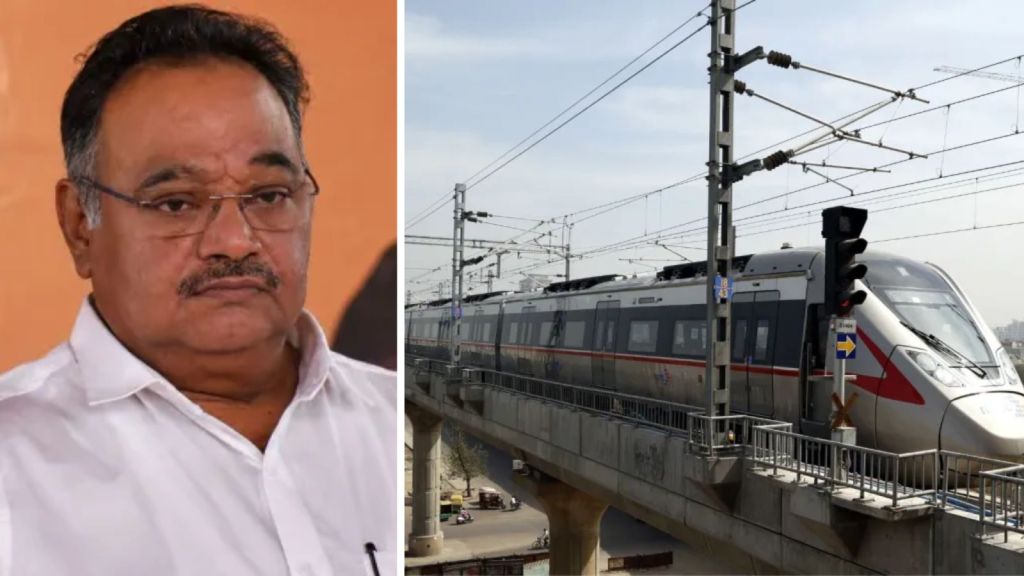
West Bengal BJP president Shamik Bhattacharya has written to Union Minister Manohar Lal Khattar requesting a Regional Rapid Transit System (RRTS), on the lines of Delhi’s Namo Bharat corridors, for the state. He has also submitted a detailed feasibility report and comprehensive study for the semi-high-speed rail network alongside his proposal.
In his letter, the MP also stated that West Bengal’s urban geography remains heavily centred on Kolkata, even though secondary cities such as Durgapur, Asansol, Kharagpur, Krishnanagar and Haldia have grown into significant industrial, educational, port and tourism hubs. Thus, the connectivity between these centres depends on conventional railways and highways that are congested and ill-suited to high-frequency commuter travel.
Bhattacharya stated that an RRTS network, on the lines of the National Capital Region Transport Corporation’s (NCRTC) Namo Bharat corridors, can address this gap through metro-like, high-speed regional connectivity.
Aligning corridors with existing highways
According to Bhattacharya, the proposal is designed to minimise land acquisition by aligning corridors along existing highways and railway corridors. “It also recommends a Special Purpose Vehicle (SPV), the West Bengal Rapid Transit Corporation (WBRTC), on the lines of NCRTC, with joint ownership between the Government of India and the Government of West Bengal, ” he said.
The letter further appealed to the Ministry to examine the proposal and, if found suitable, direct a detailed feasibility study, covering engineering, demand forecasting and financial analysis, in coordination with the state government.
3 lightweight stainless steel cars for each train
Story continues below this ad
According to the comprehensive study and the preliminary feasibility report presented initially, each train will consist of three lightweight stainless steel cars designed with an aerodynamic nose cone to minimise air resistance at high operating speeds. To deliver a high-capacity regional rapid transit service, the entire network is proposed to utilise standard gauge (1,435 mm) tracks with high-speed ballastless precast slab track technology on elevated and underground sections, and ballasted tracks for fenced at-grade and embankment stretches. Traction power will be supplied via a 25 kV AC 50 Hz overhead line system, using a flexible catenary for elevated segments and a rigid overhead catenary system inside the tunnels to minimise underground vertical clearance requirements.
Furthermore, the report stated, “The SPV may have a standardised 50-50 JV ownership structure between the Ministry of Housing and Urban Affairs – 25%, Ministry of Railways – 25%, and West Bengal Government (sourcing from different departments, preferably transport, industry, WBHIDCO) “.
The project is proposed to be implemented with Official Development Assistance (ODA) loans from players like JICA, ADB, World Bank, etc. Balance capital expenditure can be funded jointly by the Centre and the state, said the study.
A long-term vision for transforming mobility
Overall, the study suggests that the proposed West Bengal Regional Rapid Transit System (WB-RRTS) presents a long-term vision for transforming mobility, strengthening regional connectivity, and fostering balanced economic development across South Bengal.
Story continues below this ad
The study indicated that West Bengal possesses the key characteristics necessary for a successful Regional Rapid Transit System—a dominant metropolitan core, high population density, multiple emerging growth centres, and strong travel demand along well-defined development corridors.
Reshaping South Bengal’s urban geography
While conventional railways and highways will continue to remain the backbone of regional transport, an RRTS can provide the high-frequency, high-speed connectivity required to support the state””s next phase of economic and urban growth. The study stated that beyond improving transportation, the proposed WB-RRTS has the potential to reshape the urban geography of South Bengal. By enabling fast and reliable travel between Kolkata and surrounding cities, the network can encourage businesses, industries, educational institutions, and residents to expand beyond the metropolitan core, supporting the emergence of a ‘Greater South Bengal Region’ that functions as an integrated economic zone. The proposal further demonstrates that a carefully planned RRTS can be both economically and operationally viable.
According to the preliminary reports, “with phased implementation, institutional coordination, and integrated land-use planning, the West Bengal Regional Rapid Transit System can become one of the state””s most transformative infrastructure initiatives—connecting people to opportunities, cities to markets, and regions to prosperity. It has the potential to redefine mobility, stimulate sustainable development, and lay the foundation for a more competitive, resilient, and interconnected future for South Bengal.”