


Stay updated with the latest - Click here to follow us on Instagram
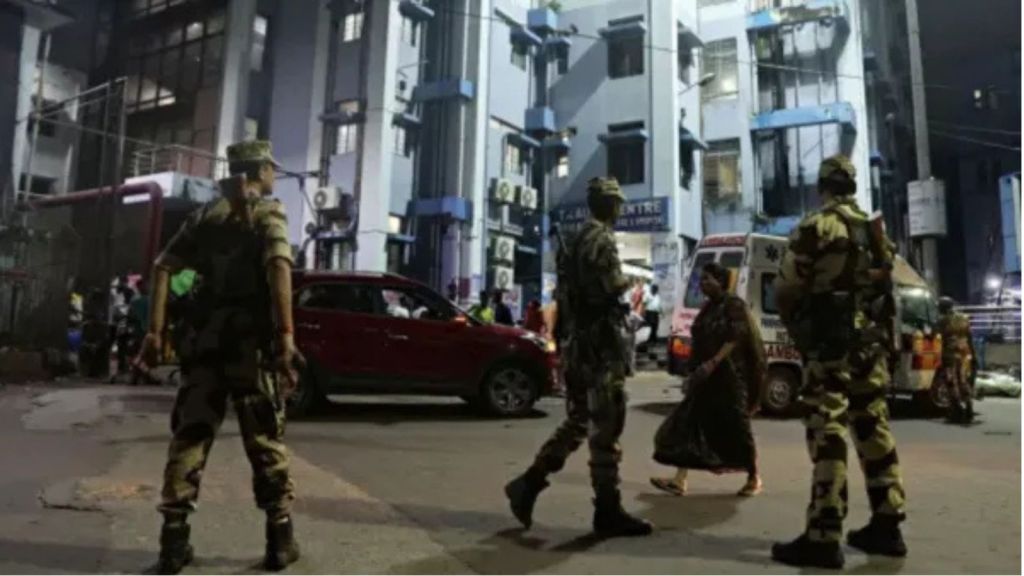 Under the new initiative, RG Kar Medical College and Hospital has been mapped with ILS Hospital in Salt Lake. (File Photo)
Critical patients arriving at Kolkata’s overcrowded government hospitals will no longer have to wander from one facility to another in search of an open bed. The state health department has introduced a new emergency system that will guarantee free care for such patients at nearby private medical centres.
Driven by a dedicated control room at Swasthya Bhawan, the headquarters of the health department, the new system will ensure that patients are fully stabilised and safely transported to a sister private hospital, free of cost.
Under this initiative, six prominent state-run medical colleges across Kolkata and its suburbs have been mapped to neighbouring private healthcare facilities.
Marking the completion of 100 days of the government, the model was initially rolled out as a pilot project linking SSKM Hospital, the flagship institution of the state’s public healthcare sector, with KPC Medical College in Jadavpur. Following a high-level meeting held at Swasthya Bhawan on Tuesday with medical superintendent-cum-vice-principals from key institutions, the framework has been expanded citywide.
Under the new protocol, when a critical patient arrives at the emergency room of a government medical college, the doctors will immediately provide initial care to stabilise their condition. If the government facility faces an acute bed shortage, hospital authorities will contact the Integrated Control Room (ICR) at Swasthya Bhawan.
The ICR, which receives live feeds from government hospitals and will soon integrate live feeds from private hospitals, will evaluate bed availability across the network.
The public hospital will submit a detailed case summary outlining the patient’s illness, symptoms, and required emergency interventions directly to the control room. The Swasthya Bhawan will then route the case summary to the nodal officer of the designated sister hospital to secure a bed.
Once confirmed, Swasthya Bhawan will alert the referring public hospital, and the patient will be transferred to the nearby private facility via government-provided ambulance transport at zero cost to the family.
The health department has mapped key government medical institutions with specific private sister facilities across Kolkata:
* SSKM Hospital and KPC Medical College, Jadavpur
* Calcutta National Medical College and Manipal Hospital, Dhakuria
* Kolkata Medical College and Hospital and Manipal Hospital, Salt Lake
* RG Kar Medical College and Hospital and ILS Hospital, Salt Lake
* Sagore Dutta Medical College and Zenith Hospital, Belgharia
* NRS Medical College and Hospital and Apollo Multispecialty Hospital (process currently underway)
Health Minister Sharadwat Mukherjee told The Indian Express that it was one of the most unique initiatives adopted by the state government. “We held a successful meeting with private hospitals recently. The former government gave these hospitals land at extremely subsidised rates, almost free of cost, so the hospitals should also give us beds,” he said.
Explaining how the system will work, Mukherjee said, “For example, if SSKM says ‘we don’t have a bed’, the ICR will connect to its sister hospital to confirm bed availability. Once it is done, the ICR will alert the government hospital to shift the patient once stabilised using our own transportation. We will have our ambulance, and since the sister hospital is in close vicinity, the patient will reach KPC Private Hospital.”
Mukherjee said that while this pairing serves as an immediate fix, long-term structural reforms are also underway.
Mukherjee said the long-term goal is to bring down referral numbers. “For this, we have conducted extensive meetings from the district level down to health centres and medical colleges. We are expanding beds in and around Kolkata. For instance, SSKM will get 100 more beds. We have appraised doctors on how to handle critical cases, drowning cases, maternal and child care, etc. Referral cases are coming down slowly… We are working on the infrastructure,” he added.
Swasthya Bhawan officials clarified that existing health coverage schemes, including Swasthya Sathi, Ayushman Bharat, or the Chief Minister’s Health Scheme, will be utilised to settle claims wherever applicable, ensuring that no out-of-pocket expenses fall on the patient’s family.
The medical community, however, remains divided over potential operational bottlenecks. A senior doctor from a private hospital raised questions regarding execution during peak emergency hours
“Transferring a patient to a private hospital due to a bed shortage is a time-consuming process. It is vital to clarify where the patient will be treated while waiting for a private bed to be confirmed. If a patient needs an emergency bed at night, will this service be available then? What happens if the private hospital also runs out of beds?” the doctor asked.
Rajiv Pandey, secretary, Association of Private Hospitals and Nursing Homes, said the government’s intention was to improve healthcare system facilities, including block primary health centres and rural health centres. “A lot of patients needing multidisciplinary care come from districts, but not all centres have every specialised department. In such a situation, if they are referred smoothly to a hospital capable of treating them, it is always a welcome step. It will lower the chaotic referral rate and buy time for the government to build its own infrastructure,” he added.
Stay updated with the latest - Click here to follow us on Instagram