


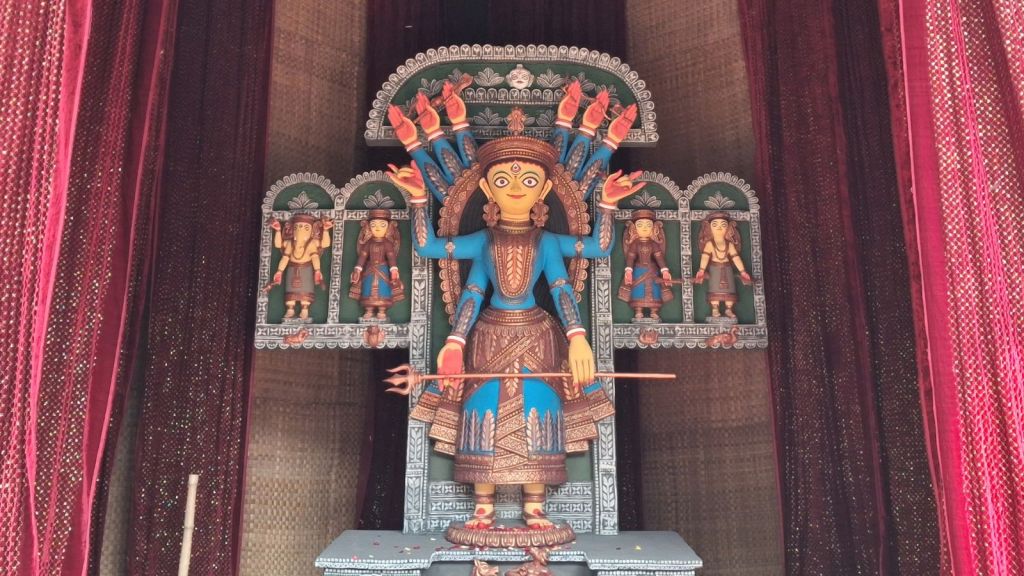
 Kolkata’s Durga Puja 2026 celebrations feature distinctive concept pandals, from Telipukur Nagerbazar’s underwater audio installation highlighting pond conservation to Dumdum Park Sarbojanin’s live puppet performances (Express photo by Partha Paul).
As Durga Puja sweeps across Kolkata, this year’s celebrations highlight a blend of artistic brilliance and social messaging. From Telipukur Nagerbazar’s immersive underwater audio installation promoting urban pond conservation to Dumdum Park Sarbojanin’s live puppet performances, pandals across the city are transforming into living art galleries.
Whether you are drawn to the historical grandeur of Bengal’s ancient trade routes at Dum Dum Park Tarun Sangha or the thought-provoking social commentary on women’s safety at Sadanga Durgotsav Samity, 2026 offers some of the city’s most creative concept pujas yet.
Navigating the festive rush to catch these artistic installations can be overwhelming. With metro connections, auto-rickshaw links, and walking routes, you can plan your pandal-hopping itinerary smoothly and hassle-free.
Telipukur Nagerbazar Yubak Sangha: A pond full of love
Conceptualised by artist Bhabatosh Sutar, ‘Ek Pukur Bhalobasha’ (a pond full of love) aims to raise awareness about the rapid disappearance and pollution of Kolkata’s urban ponds, highlighting their ecological importance and emotional bond with local families.
Conceived around a historic local pond, the installation showcases its role in everyday life, from weddings and rituals to relaxation, alongside human-induced pollution. A video shot inside the pond simulates the perspective of aquatic life experiencing garbage, bottles, and ritual offerings thrown from above. Eighteen microphones installed at the pond’s floor capture real-time underwater sounds, such as fish nibbling, which are played live inside the pandal.
“A pond is not merely a water body. It is an ecosystem, a living container supporting aquatic weeds, insects, frogs, and other life forms,” said artist Bhabatosh Sutar. “In 50 years, Kolkata has lost around 70 per cent of its ponds, filled by real-estate promoters to make concrete high-rise buildings.”
Shubham Saha, assistant secretary of the club, added, “We want to convey the story of a pond that has been a part of our family’s history for the past several hundred years, becoming almost like a family member. We are witnessing that over many decades, ponds are gradually becoming extinct.”
The moss-toned idol stands around 20 feet tall, symbolising the worship of the pond as a Goddess. Her jewellery and attire are crafted entirely from aquatic elements like water lilies (shaluk) and leafy greens (kolmi saag). Celebrating its 68th year, the club operates on a budget of roughly Rs 50 lakh.
How to reach: Take the Metro to Dum Dum station and board an auto directly to Nagerbazar. From the Nagerbazar auto stand, a short walk leads to Telipukur Yubak Sangha.
Dum Dum Park Tarun Sangha: Trade history
Celebrating its 41st year, Dum Dum Park Tarun Sangha presents “Biniya Katha”, conceptualised by artist Anirban Das. The theme highlights Bengal’s rich trade history spanning from the 7th century BC to the 18th century.
Constructed on a budget of roughly Rs 45 lakh, the 11-to-12-foot-tall pandal features a main sanctum styled as a trading port complete with a merchant ship. It depicts historical tales such as Xuanzang’s voyage, Emperor Ashoka sending the Bodhi tree to Sri Lanka, Dwarkanath Tagore’s shipping business, and unique historical accounts like the transport of a giraffe to mainland India.
Performers wearing traditional masks and holding stylised wooden boat props portray ancient maritime merchants. The exterior facade features ship-themed structures, painted historical murals of sailing vessels, and a prominent explorer statue.
The clay idol is crafted in a terracotta style to honour historical exports. Organisers report high crowd turnout starting as early as Tritiya.
How to reach: Take the Metro’s Blue Line to Dum Dum station, then take a 12- to 15-minute auto, toto, or cab ride (3.1 km). Alternatively, alight at Belgachia station for a less congested route with direct autos or buses. Bus travellers can take any route via VIP Road or Jessore Road, get off at the Dum Dum Park Bus Stop, and take a short walk or toto into the avenue.
Dumdum Park Sarbojanin: Puppet dance
Celebrating its landmark 75th year, Dumdum Park Sarbojanin has introduced the theme “Panchalatika”, centred on traditional puppet dance.
Moloy Dey, joint secretary of Dumdum Park Sarbojanin, said, “Panchalatika means puppet dance. Puppet dance is a fading folk art in West Bengal. Theatre originally evolved from puppet dance, where people expressed their inner cries, joy, and stories. Today, this art form is on the verge of extinction, so we want the current generation to witness it.”
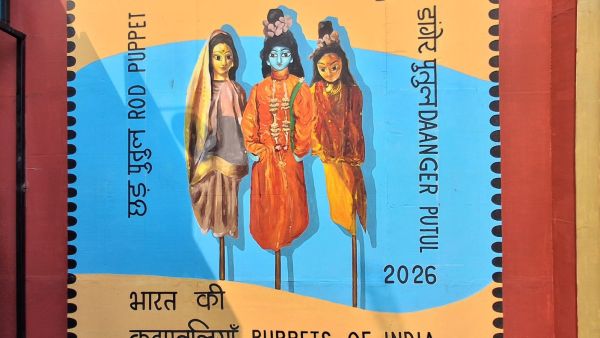 Durga Puja theme ‘Panchalika’ celebrates the ancient art of puppetry (Express photo by Partha Paul).
Starting every evening at 6 pm and running until dawn (around 4 am to 4:30 am), the pandal hosts live string puppet and rod puppet performances. The rod puppet performance features an artist dancing inside a bamboo frame with the puppet moving in rhythm.
Adhering to the West Bengal government’s 12-foot immersion guidelines, artist Sanatan Dinda crafted the idol to 12 feet, ensuring smooth transport to the Ganga ghats without obstruction near bridges. Tapas Dutta leads the pandal design, working on a budget of Rs 30 lakh.
Addressing rumours regarding ticket sales at various pujas, Dey clarified, “We are not involved in any ticket selling. We have some invited passes, but it is everyone’s puja, and anyone can come and see it.”
How to reach: The pandal is located a 5-minute walk away from Dum Dum Park Tarun Sangha.
Salt Lake EC Block: Mahabharat
Marking its 50th year, the EC Block Residents Association in Salt Lake has selected “Mahabharat” as its anniversary theme.
Maulinath Majhi, block secretary, said, “Mahabharat is connected with our real lives.” Built on a budget of Rs 50 lakh, the pandal features giant statues of Krishna and other figures crafted on-site using plaster of Paris, clay, plywood, and wood carvings.
Local team members created the artwork under the guidance of artist Barun Chand from the Art College. The committee noted that the design used no artificial intelligence or digital posters. A key feature of the setup is the alignment of the Durga idol, which appears to look directly at visitors, no matter where they stand in the pandal.
How to reach: Take the East-West Metro from Howrah directly to City Centre station (Salt Lake) within 20 minutes. The pandal is located directly opposite City Centre 1.
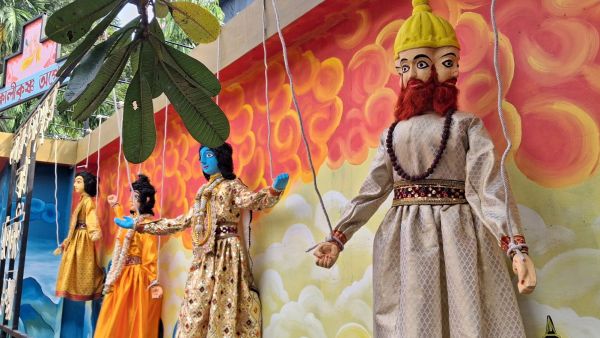 This year, the puja aims to bring this vanishing tradition of puppetry back into the spotlight (Express photo by Patrha Paul).
Suruchi Sangha: Source or origin
Located in New Alipore, Suruchi Sangha has chosen the theme “Utsa” (meaning source or origin) for its 2026 celebrations, commemorating the 125th birth anniversary of Bharatiya Jana Sangh founder Dr Syama Prasad Mookerjee.
Conceptualised by artist Anirban Das, the installation transitions from broad nationalist themes to a biographical study of Dr Mookerjee’s life, times, and intellectual legacy. The pandal displays archival photographs and rare visual documents capturing his upbringing, personal milestones, and writings.
Reflecting shifts in West Bengal’s political scene, the committee’s organisational leadership, historically associated with Trinamool Congress figures such as Sports Minister Aroop Biswas and Swaroop Biswas, now includes BJP Dum Dum MLA Sourav Sikdar serving as its puja secretary.
Sadanga Durgotsav Samity: The owl’s sketchbook
In its 49th year, Sadanga Durgotsav Samity presents “Hutom Pyanchar Naksha” (The owl’s sketchbook), a theme inspired by Kaliprasanna Singha’s classic literary work.
Located at 51/1B Raja Rajballav Street in North Kolkata (opposite Jagat Mukherjee Park), the committee prioritises sharp social critique over visual grandeur. Using the owl as a symbol of silent observation, the installation confronts societal apathy toward crimes against women and critiques passive spectatorship during modern tragedies, including the ‘Tilottama’ (RG Kar) incident.
How to reach: Take the Metro to Shyambazar Metro station, followed by a short walk down Raja Rajballav Street to the venue opposite Jagat Mukherjee Park.