


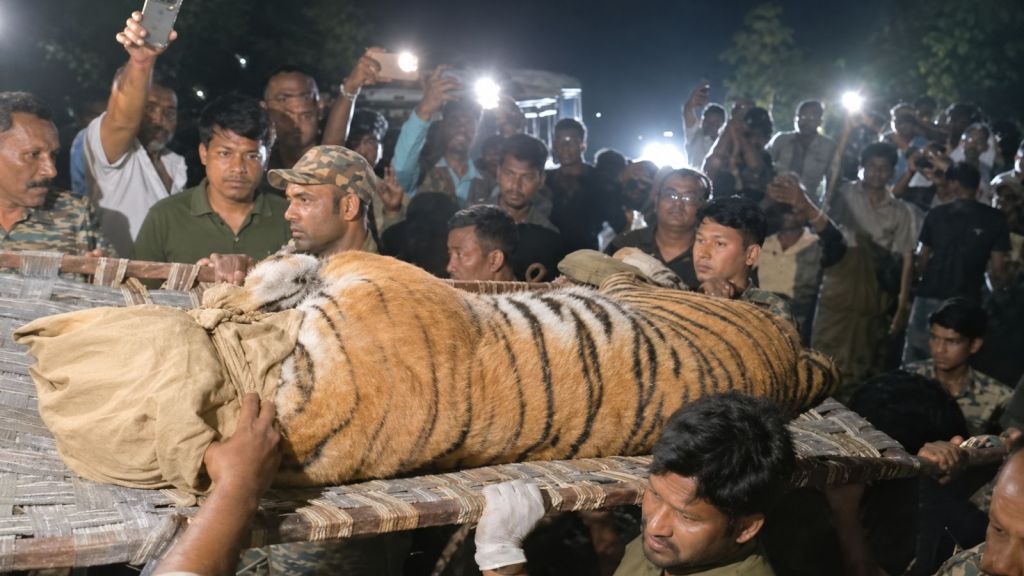
 Tigress Doars Rani, brought from Bihar to Bengal as part of a tiger relocation programme before it entered Assam, was tranquillised and caged in the northeastern state (Special Arrangement)


Nearly 10 days after it ventured into Assam, Doars Rani, West Bengal’s first relocated tigress was on Tuesday evening tranquilised and caged in the northeastern state.
Armed with nets, three elephants, earth movers, and teams with tranquiliser guns, the forest department officials of West Bengal and Assam began a joint operation to cage the tigress. It was finally captured in Gilaguri in the Dotma area of Assam’s Kokrajhar district at around 5.30pm on Tuesday.
“Finally we have been able to tranquillise and cage Doars Rani. We are bringing her back to Buxa Tiger Reserve. We brought in three elephants from Bengal, apart from earthmovers. The area was cordoned off with nets and finally we were able to tranquilise it after various attempts,” Manoj Kumar Oraon, West Bengal Forest Minister, told The Indian Express over phone from Assam.
“Yesterday, we had cordoned off the area with nets. But since evening fell, we could not catch it, and it escaped our teams,” he said.
“But today, we brought in three elephants from Bengal, and earthmovers… By afternoon, we tried getting close to the tigress but could not spot her. After hours of cat-and-mouse games, we spotted her and tranquilised her. We are bringing the tigress home. I was there when the entire operation took place,” Oraon added.
T-138 or Doars Rani was brought from Bihar’s Valmiki Tiger Reserve and released in Buxa Tiger Reserve — a protected forest and national park spanning over 760 sq km in north Bengal’s Alipurduar district — as part of the state’s first tiger relocation programme.
However, on October 24, the three-year-old tigress strayed into the Raimona National Park in the neighbouring Assam, travelling over 100 km from Buxa.
It was first spotted near Assam’s Hatigarh village, where it killed three domesticated pigs and four piglets. It then strayed to Narayanpur village in Gossaingaon sub-division in Kokrajhar district, following the Barsijhora village near Dotma town in Kokrajhar, which was cordoned off on Monday. On Tuesday, it was finally captured from Gilaguri, also in Kokrajhar’s Dotma area.
In December 2024, another tigress Zeenat, hailing from Simlipal in Odisha, had travelled over 300 km and crossed Jharkhand to enter Bengal. It was later tranquilised and caged in Bankura.
Historically an important tiger landscape in north Bengal, habitat degradation, changes in land use and a decline in prey availability significantly affected the conditions needed to sustain a resident tiger population in Buxa, the Ministry of Environment had said in a statement. The tigress’ release was meant to mark the beginning of a phased recovery in Buxa.
After being tranquilised and caged in Valmiki Tiger Reserve in Bihar, T-138 was flown in on a military aircraft to Hasimara Air Force Station in Alipurduar in the early hours of September 30. It was then taken to the Rajabhatkhawa forest area under Buxa Tiger Reserve.
On October 2, Chief Minister Suvendu Adhikari released the tigress into the wild from its 2.2-hectare soft enclosure. The plan, Minister Oraon had said then, was to first establish one tiger unit — a tiger and two tigresses.
To ensure an undisturbed habitat and expand the area’s prey base, the forest department had earlier relocated 242 households from core villages such as Bhutia Basti and Gangutia Basti.