Bangladesh may not send Hilsa to India this Durga Puja, stops imports too

Incidentally, a delegation from the Fish Importers Association visited Dhaka in August, met Ataur Rehman Khan, Bangladesh’s Commerce secretary, and requested that the ban on Hilsa exports to India be lifted.

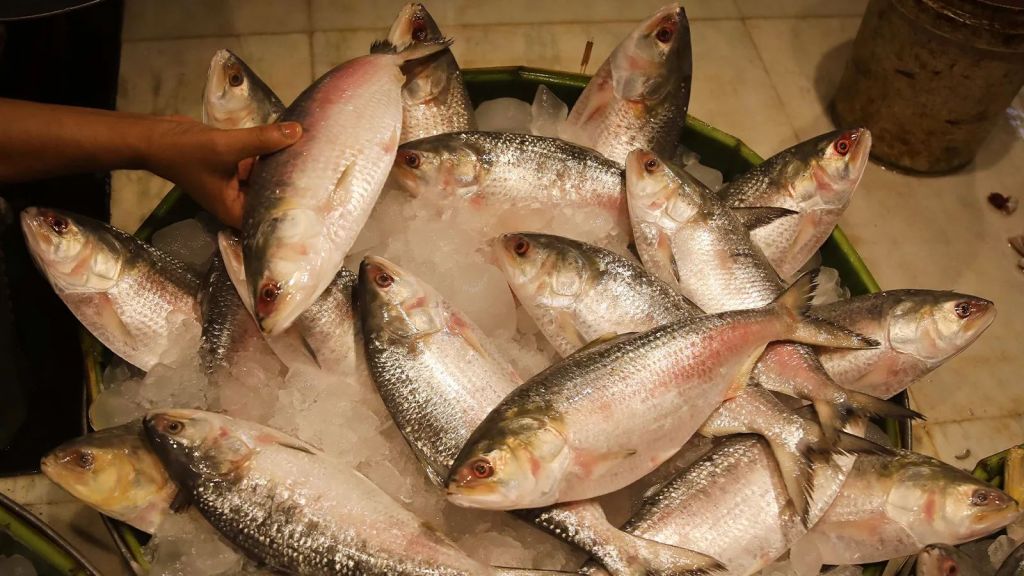
Bangladesh imposed restrictions on exporting Hilsa to India in 2012.Bangladesh imposed restrictions on exporting Hilsa to India in 2012. (File Photo)

In news that will disappoint fish lovers, Bangladesh is unlikely to export Hilsa to India this Durga Puja season and has also stopped importing the famed fish from India. This comes weeks after India exported 500 metric tonnes of Hilsa to Bangladesh in a role reversal of sorts.

According to fish traders in Kolkata, this is a deviation from the annual practice of the Bangladesh government earmarking the amount and window for Hilsa exports to India just before Durga Puja.

“They have abruptly stopped imports from India. All permits in their country were cancelled through a circular on September 23. Also, Bangladesh is not allowing the import of Hilsa this year. Time has run out,” said Syed Anwar Maqsood, secretary of the Fish Importers Association in Bengal and the Howrah wholesale fish market.

“Every year, between September 15 and 20, just before Durga Puja, the Bangladesh government makes an announcement, allowing us to import Hilsa. They also fix the amount which can be imported. But this year, the time has passed. From October 7, fishermen in Bangladesh will stop catching Hilsa. So we have no time to import,” he added.

“It is very unfortunate. Hilsa from Bangladesh is in high demand here, especially the ones from the Padma River. But this time, we won’t get it. Interestingly, even during the political upheaval in Bangladesh and under the caretaker government, we were allowed to import Hilsa,” added Maqsood.

“The movement of Hilsa from India to Bangladesh through Petrapole has stopped. They are unlikely to allow imports to India. We do not know what prompted the decision, but it is unprecedented,” said Kartik Chakraborty, secretary of Petrapole Clearing Agents Staff Welfare Association.

 
INTERACTIVE · TAP TO COMPARE
🐟 Hilsa: A Trade Reversed
🇧🇩
Bangladesh
→
🐟
🇮🇳
India
The Restricted Window
2012
Year Hilsa imports from Bangladesh were first restricted
1 month
Import window permitted since 2019 — only during Durga Puja
Permitted vs. Actual
Sept 2024
2,420 tonnes permitted → only 577 tonnes actually imported
Sept 2025
1,200 tonnes permitted → only 150 tonnes actually imported
"The Bangladesh government gives permission for a certain quantity. But since the window is small, the imported quantity is very low... This does not work out."
— Syed Anwar Maqsood, Secretary, Fish Importers Association, Bengal
🇮🇳
India
→
🐟
🇧🇩
Bangladesh
The First-Ever Reversal
~500 t
Hilsa exported to Bangladesh in the past two months, via Petrapole
150–200 t
Additional volume traders expect in the coming weeks
Where It's Coming From, Where It Goes
Source
Largely Gujarat's Bharuch region, routed via Howrah fish market
Demand
High-roe Hilsa sought after in Chattogram, Sylhet and other districts
Processing
Roe extracted and re-exported; remaining fish salted and dried locally
"This is the first time Hilsa from our country is being exported to Bangladesh. It is a welcome development. Most of the catch is from Gujarat."
— Syed Anwar Maqsood, Secretary, Fish Importers Association, Bengal
The Bigger Picture
Experts see this as more than a one-off trade flow. Pradip Dey, director of the Central Inland Fisheries Research Institute, called it "a strong market signal" — an opportunity for West Bengal to build a science-based, value-added Hilsa economy through better stock management, processing, and market linkages.
The shift follows sustained diplomatic effort: a Fish Importers Association delegation visited Dhaka in August, meeting Bangladesh's Commerce Secretary Ataur Rehman Khan, and the Association has separately written to Bangladesh's Prime Minister urging the import ban be lifted.
Note: Trade volumes and permitted-vs-actual figures are as reported by fish trade sources cited in the source article.
 

Incidentally, a delegation from the Fish Importers Association visited Dhaka in August, met Ataur Rehman Khan, Bangladesh’s Commerce secretary, and requested that the ban on Hilsa exports to India be lifted.

Story continues below this ad

Bangladesh imposed restrictions on exporting Hilsa to India in 2012. But since 2019, the neighbouring country has lifted the curbs for a short window during the Durga Puja season. “But now we see the small window for imports before Durga Puja is also gone,” said Maqsood.

In September 2019, India imported 500 metric tonnes of Bangladesh Hilsa. This rose to 1,850 metric tonnes in September 2020. In September 2021, 1200 metric tonnes were imported. The next year, this number was 1300 metric tonnes. In September 2023, 587 metric tonnes of Hilsa were imported. In September 2024, 577 metric tonnes of Bangladesh Hilsa came to India. Last year, it was 150 metric tonnes.

This year, in a role reversal, over 500 metric tonnes of Hilsa were sent to Bangladesh through the Petrapole land port in the past two months.

A substantial proportion of the consignments India sent originated from Gujarat, particularly the Bharuch region, while some supplies have moved through the Howrah wholesale fish market in Bengal. Hilsa from India with high roe content has high demand in Chattogram, Sylhet and other districts of Bangladesh. Some fish from India are also used to prepare dried and salted products in Bangladesh.

Ravik Bhattacharya is a highly experienced and award-winning journalist currently serving as the Chief of Bureau of The Indian Express, Kolkata. With over 20 years of experience in the media industry, Ravik possesses deep expertise across a wide range of critical subjects and geographical areas. Experience & Authority Current Role: Chief of Bureau, The Indian Express, Kolkata. Expertise: Extensive reporting across West Bengal, Odisha, Assam, and the Andaman Nicobar Islands. Ravik specializes in politics, crime, major incidents and issues, and investigative stories, demonstrating a robust command of complex and sensitive subjects. Experience: His long and distinguished career includes key reporting roles at several prestigious publications, including The Asian Age, The Statesman, The Telegraph, and The Hindustan Times. Ravik's current role marks his second stint with The Indian Express, having previously served as a Principal Correspondent in the Kolkata bureau from 2005 to 2010. Major Award: Ravik's authority and quality of work are substantiated by his winning of the prestigious Ramnath Goenka Excellence in Journalism Award in 2007 for Political Reporting. Education: His strong academic foundation includes a Bachelor's degree with English Honours from Scottish Church College under Calcutta University, and a PG Diploma in Mass Communication from Jadavpur University. Ravik Bhattacharya's extensive tenure, specialized beat coverage, and notable award confirm his status as a trusted and authoritative voice in Indian journalism, particularly for stories emanating from Eastern India. ... Read More

Stay updated with the latest - Click here to follow us on Instagram
Advertisement
Loading Recommendations...
Advertisement
Advertisement
Latest Comment
Post Comment
Read Comments