Why President Murmu returned Bengal’s ‘Anti-Goonda’ Bill

President returns Bill for reconsideration after Centre raises conflict with NDPS Act, 1985

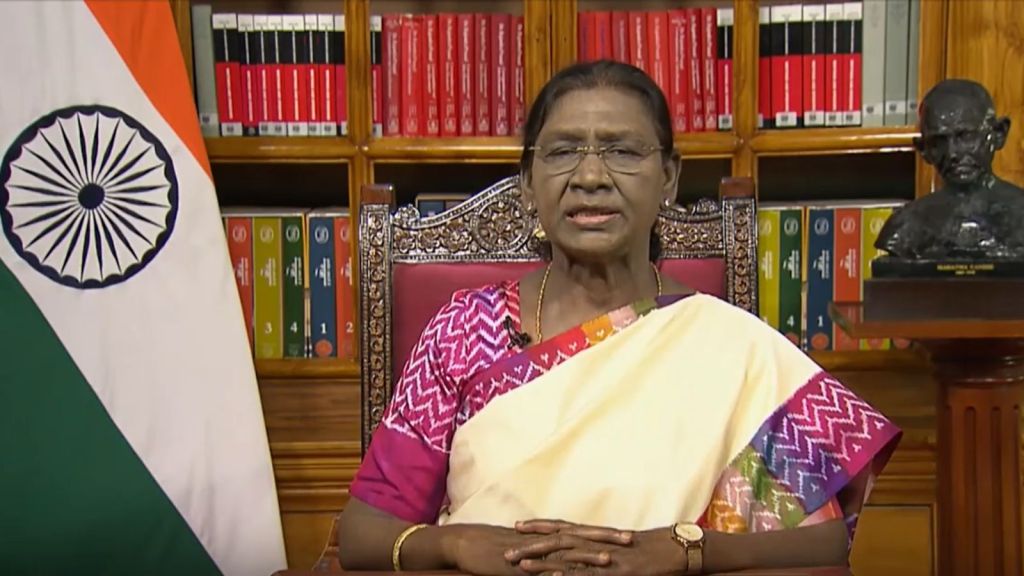
President Droupadi MurmuPresident Droupadi Murmu (File)

In a setback to the BJP dispensation in West Bengal, the President of India has registered a sustainable objection to Suvendu Adhikari government’s ‘anti-Goonda’ Bill and returned it for reconsideration after the Centre raised the issue of a conflict between the proposed legislation and the Narcotic Drugs and Psychotropic Substances (NDPS) Act, 1985.

In its note before returning the Bill, the Central government said, “Section (B) of the proposed Bill, insofar as it includes within the definition of ‘goonda’ a person who commits, attempts to commit, abets, promotes, finances or facilitates any offence punishable under the NDPS Act, 1985, may overlap with the preventive-detention framework provided under the PITNDPS Act, 1988, which is a specific Central legislation dealing with preventive detention of persons engaged in illicit traffic in narcotic drugs and psychotropic substances.”

“The proposed provision may, therefore, create an overlapping or parallel preventive-detention mechanism in respect of drug-related activities and may give rise to an issue of repugnancy under Article 254 of the Constitution of India. Accordingly, the reference to offences under NDPS Act, 1985 in Section 2(d)(iii)(B) may be deleted to avoid duplication and overlap with the existing Central statutory framework,” it added.

A senior official of the state administration said, “It is indeed a setback for the government as it wants to implement this Act as soon as possible. However, there is a provision to table this Bill again in the Assembly after making the necessary changes in the proposed Act where it is conflicting or overlapping with Central law. After that, it will be sent again for the assent of the President of India.”

To curb anti-social activities, the BJP government introduced the West Bengal Public Safety and Control of Anti-Social Activities Bill, 2026 in June. However, after facing criticism from the Opposition, Adhikari assured the Opposition that the legislation would not be used for political vendetta.

“Those who are expressing concern about the provisions of preventive arrest have no reason to be afraid. The administration will act in accordance with the law, and there will be no misuse of the law in any way,” the chief minister had said.

The Bill, apart from defining what constitutes an anti-social activity and who is a “goonda”, also has provisions to bar such people from entering a specified “area, district, or districts” for a period not exceeding one year.

Story continues below this ad

The Bill states that if a district magistrate, a Commissioner of Police, or a police officer not below the rank of DIG authorised by the state government is apprehensive that a “goonda” is engaging in or will engage in anti-social activities, they may, to prevent it, “direct such person to remove himself outside such area, district or districts, or part thereof, as may be specified in the order, within such time as may be specified therein, and prohibit him from entering or returning to such area for a period not exceeding one year; and require such person to report his movements, or to report himself, in such manner, at such times, and to such authority as may be specified in the order”.

On August 6, a division bench of the Calcutta High Court comprising Justice Tapabrata Chakraborty and Justice Partha Sarathi Chatterjee dismissed three Public Interest Litigations challenging the Bill on the grounds that the petitions were premature because the Bill had not yet received the President’s assent to become a law.

However, the high court’s observations and the state’s own submissions effectively contradict repeated public assertions made by Adhikari.

On multiple occasions, Adhikari claimed that the ‘Goonda Daman Bill’ had already received the Governor’s assent and became law. He also told the Assembly that the ‘Goonda Daman Act’ had been invoked against all those accused of orchestrating violence during the July 24 protest march at Esplanade.

Story continues below this ad

However, the state has now informed the high court that the Bill is still awaiting the President’s assent and has, therefore, not yet become law, rendering the chief minister’s claims incorrect.

Recording the state’s submission, the high court observed on Thursday, “As the Act is yet to receive Presidential assent, the writ petition is premature”.

Thereafter, the bench further clarified that once the Bill received the required assent and was promulgated, the petitioners would be at liberty to challenge its validity.

“However, we made an observation: once it receives the assent, you would be at liberty to come”, the Bench observed.


Atri Mitra is a highly accomplished Special Correspondent for The Indian Express, bringing over 20 years of experience to his reporting. His work is characterized by deep regional knowledge and a focus on critical administrative and political developments, establishing strong Expertise and Authority in his domain. Experience  Current Role: Special Correspondent, The Indian Express. Decades of Experience: Over two decades of extensive reporting experience, primarily covering administration and political news. Geographical Focus: Holds significant reporting experience from West Bengal, Bihar, and the North-East, providing a comprehensive understanding of the socio-political landscape in these regions. Key Coverage: Has dedicated more than ten years to covering administration and political news, with a keen focus on political developments in West Bengal. Electoral Reporting: Demonstrated a commitment to crucial political moments, having covered the 2009 Lok Sabha election and 2010 assembly elections during his time at Anandabazar Patrika, and the 2019 Bihar Lok Sabha election while working with News18-Bangla. Career Foundation: Began his career at the leading vernacular daily Anandabazar Patrika, where he worked for more than fifteen years, including a three-year stint as the Bihar correspondent. Education Advanced Degree: Holds a Master's degree in Economics from Rabindrabharati University, providing an analytical framework for his political and administrative reporting. Undergraduate Education: Holds a Bachelor's degree from Calcutta University. Prestigious Alumni: His educational background includes attending esteemed institutions: he is an alumnus of St. Xavier's, Kolkata and Ramakrishna Mission Asrama, Narendrapur. Atri Mitra's decades of dedicated reporting, substantial focus on political and administrative beats, and solid academic credentials make him a trusted and authoritative source for news and analysis from Eastern and North-Eastern India. ... Read More

Stay updated with the latest - Click here to follow us on Instagram

Advertisement
Loading Recommendations...
Advertisement
Advertisement
Latest Comment
Post Comment
Read Comments