Journalism of Courage



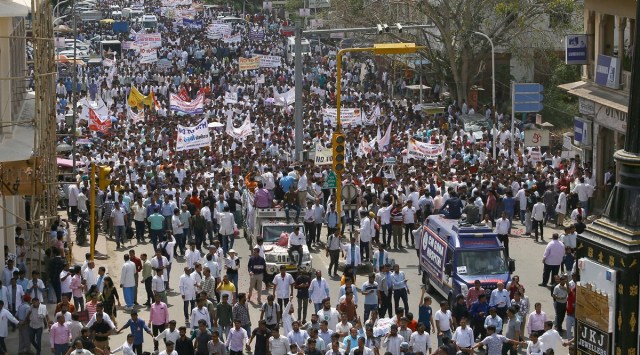 Doctors protest in Jaipur on Monday. (Express photo by Rohit Jain Paras)
 Naresh Yadav, 30, came to Jaipur from Alwar with his mother Lalita, 48, and other family members on March 24. Four days on, the family is still waiting for a coronary bypass surgery at the Sawai Man Singh (SMS) hospital in Jaipur, the largest govt-run hospital in Rajasthan.
“We are told that resident doctors are on strike, hence the operations are delayed by several days,” says Chintan Naval, kin of another patient awaiting an operation.
Healthcare in the state continued to be affected Monday with doctors protesting to seek the withdrawal of the Right to Health Bill which they say will hamper their functioning, among other things. The Bill was passed by the state Assembly last week.
Earlier in the day, government doctors and other private healthcare professionals took out a massive rally in Jaipur to press their demands and threatened that their hospitals will not be part of any state healthcare scheme in future.
Most private hospitals and nursing homes across the state have been shut for several days now while services have been affected in government hospitals as well.
At SMS hospital, along with his brother Pramod Naval, Chintan has been waiting for their father Ramchandra Naval’s bypass surgery for the last six days. Similarly, Khule Khan, 55, came with his brother Pappu Khan, 50, and others from Churu district after Pappu complained of severe chest pain.
“We had some tests done in Churu itself to save time but doctors here told us that the tests will be done again. However, due to the doctors’ strike the tests have been delayed,” Khule says.
In the Neurology ward, Rahul Saini, 22, of Jaipur’s Mansarovar, is suffering from Guillain-Barre syndrome in his leg. “The doctors are still attending to us,” he says.
However, the usually bustling ward barely has “6-7 patients who are serious and were already admitted, down from the 40-45 that we usually have,” says a doctor who did not wish to be named.
In the same ward, a family, who also did not wish to be named, said, “We came here from Tonk on March 23 and spent the entire day looking for a doctor. While the queues in government hospitals were long then, we went to private hospitals but they were shut, we even went to doctors’ homes but they didn’t entertain us there.”
After much struggle, the family was admitted at the SMS on March 24 “considering the seriousness of our case.”
At the hospital’s Dhanwantri Out Patient Department (OPD) too, the figures have nosedived. SMS superintendent Dr Achal Sharma says it is due to several reasons: “Patients themselves know about the strike, so those who have minor illnesses are not coming. Second, we get a lot of patients from neighbouring states. They too are not coming since the doctors’ strike began.”
What has increased is the number of patients in the Emergency Ward, which the hospital is “somehow” managing. This, Sharma says, is because most private hospitals in Jaipur are refusing to take emergency cases.
“Right now we are more concerned about severe plus acute cases, rather than elective cases (where surgery is scheduled in advance, usually for a non-life threatening condition).”
The acuteness of the situation can be gauged by the missing number of resident doctors at SMS: about 800 of them. At the heart of Rajasthan’s public healthcare, the hospital is making do with faculty, numbering 236, and about 100 each of medical officers and senior residents; of these, the faculty too lent support to protests through a two hour pen-down strike on Monday.
In SMS and its attached hospitals, resident doctors number around 1800, while elsewhere in Rajasthan there are about 2,500 more, as per the state government.
Most of the resident doctors who boycotted work in Jaipur joined the massive rally on Monday. After gathering at Resident Doctors’ Hostel at SMS around 11 am, the doctors walked the Maharani College Tiraha, Ashok Marg, Panch Batti intersection, Ajmeri Gate, and Albert Hall, before returning to the hostel around 2:30 pm.
In perhaps more trouble for the Ashok Gehlot government, the doctors held a meeting after the protest march and “unanimously decided that the private hospitals won’t implement any government schemes, such as Chiranjeevi and Rajasthan Government Health Scheme (RGHS), in future,” said Dr Vijay Kapoor, secretary of Private Hospital and Nursing Home Society (PHNHS).
He said, “If the Bill is not withdrawn, then it will be difficult to control the enraged medical fraternity”.
There is apprehension among resident doctors that the government may crack down on them. Leading a delegation of doctors, Dr Kapoor met SMS principal Dr Rajeev Bagarhatta on Monday, asking him that the protesting government doctors and residents should “not be pressured, and any action against them will only lead to more anger.”
Dr Chitresh Shekhawat, spokesperson of Jaipur Association of Resident Doctors (JARD), said that, “we are not scared of any action. We are only talking about our legitimate demands and point to point.”
Monday was also observed as a ‘Black Day’ by The Indian Medical Association (IMA), which had announced a nationwide protest against the Bill to show solidarity with the doctors in Rajasthan. The on-going week has also been declared as a ‘Black Week’ by the Federation of Resident Doctors Association (FORDA) to protest RTH.
However, some private hospitals in Jaipur, such as Mahatma Gandhi hospital, JNU hospital and NIMS hospital, have not joined the protests called by the private hospitals. Chhaya Pachauli of Jan Swasthya Abhiyan, which was instrumental in the drafting of the Bill, claimed that the number of protestors was swelled by including those who are not even doctors. Sharing an appeal issued by a caste organisation, Pachauli asked “what is the link between a caste and the RTH Bill? What benefit will the community get if the law is suspended? Why is a caste group calling its people to join a doctors’ rally?”
Meanwhile, the government is focusing on getting resident doctors to return. A government official said that while the channels are “always” open and they are ready to engage with private doctors and hospitals, “they should understand that there is a process to the law, it can’t be rolled back by the state government.”
“There are a lot of confusions which are created due to some communication gap, so we are trying to address them,” the official said.

 6 min read