While ruling BJP defended the legislation saying it was meant for common man, the opposition Congress first criticised the “unauthorised constructions” calling it as a “nexus between real-estate developers and state government officials”, but later supported the ruling party in passing the Bill titled “The Gujarat Regularisation of Unauthorised Development Bill, 2022.”
This is the third time, such a legislation had been introduced in the state to regularise illegal real-estate constructions built before October 1, 2022.
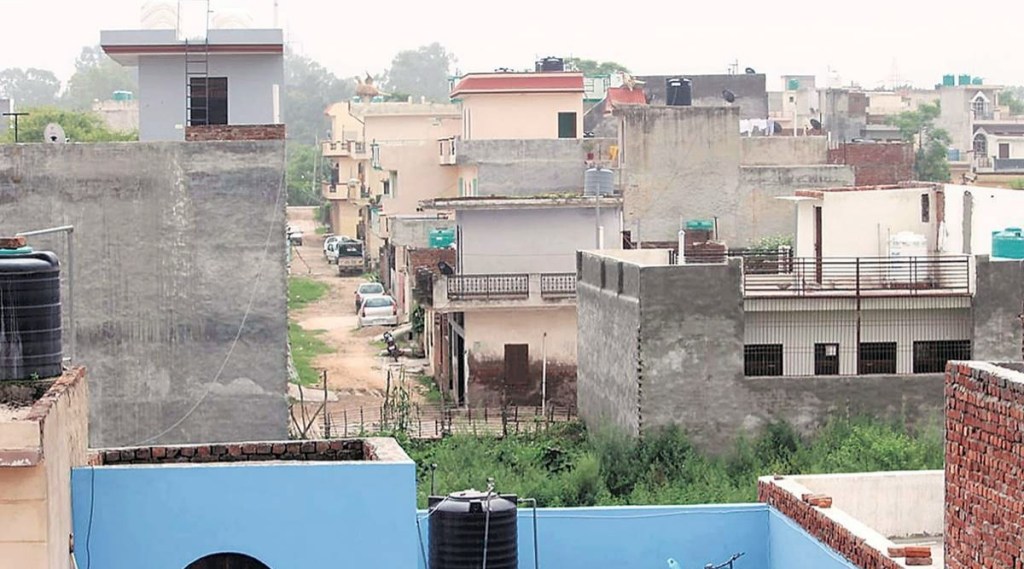
This legislation will cover unauthorised construction in residential, commercial and industrial segments.
After tabling the Bill, Rushikesh Patel, Cabinet Minister for Health, told the House, “A sample survey was recently undertaken to understand the extent and types of violations, especially in urban areas. This survey covered 8,300 buildings which included 5,600 buildings in eight municipal corporations, 596 buildings in areas under eight urban development bodies and 2,160 buildings in 24 municipalities.”
“As per the survey, 42 percent of the buildings in the state did not have building use or BU permission. 87 per cent of the buildings in the municipalities and 56 percent buildings under urban development bodies did not have BU,” the minister added.
The minister further said the government had served notices to the owners of these illegal construction under the Gujarat Provincial Municipal Corporation Act, 1949 and Gujarat Town Planning and Urban Development Act, 1976.
“But necessary steps by respective bodies could not be taken after issuance of notice and so to solve the situation arisen, the state government in 2001 and 2011, brought in a legislation to regularise unauthorised constructions. Despite this, several constructions could not be regularised,” said the minister defending his government’s decision to introduce the legislation for a third time.
Citing the fire accidents that happened in private hospitals in Ahmedabad and Rajkot on August 6, 2020 and November 27, 2020, the minister said an ordinance was introduced by the state government in October 2022 after the Gujarat High Court in 2021 had directed the government to clear its stand with regard to building use permission and fire safety.
Patel, who did not reveal the number of illegal real-estate constructions that have been regularised since 2001 — despite demands from Congress MLA, said an impact fee will be collected from the owners having unauthorised construction.
He said applications can be made online by owners or occupants within four months from October 2022.
Announcing the fees for unauthorised constructions in the residential space, the minister said Rs 3,000 will be charged up to 50 square meters. Rs 6,000 to be charged for area between 50-100 square meter, Rs 12,000 for area between 100-200 square meters, Rs 18,000 for area between 200-300 square meters and Rs 150 per square meter for area higher than 300 square meters.
“The fees for all others including shops and commercial will be double of residential rates,” Patel added.
While Congress MLAs like Shailesh Parmar welcomed the allowances made for smaller properties, he questioned the need for similar allowances of properties with larger area. “How did these unauthorised constructions happen,” asked Congress MLA Amit Chavda. “The real estate developers who made these properties got away with the profit. They sold them to unsuspecting people,” Chavda added.
Congress MLA Arjun Modhwadia citied examples from his constituency in Porbandar and said regularising illegal constructions benefits real-estate builders.
He said despite similar legislations in 2001 and 2011, unauthorised constructions have continued to crop up in Gujarat where the state government have been unable to prevent such constructions.
He also sought strict action to be taken against state government officials who permit illegal constructions.
Some of the Congress MLAs also objected to provisions in the Bill which prevent decisions of appellate officer unquestionable before any court of law. Despite the objections raised, the Congress MLAs sided with the ruling party — as they did in 2011.



 Share


