




Stay updated with the latest - Click here to follow us on Instagram
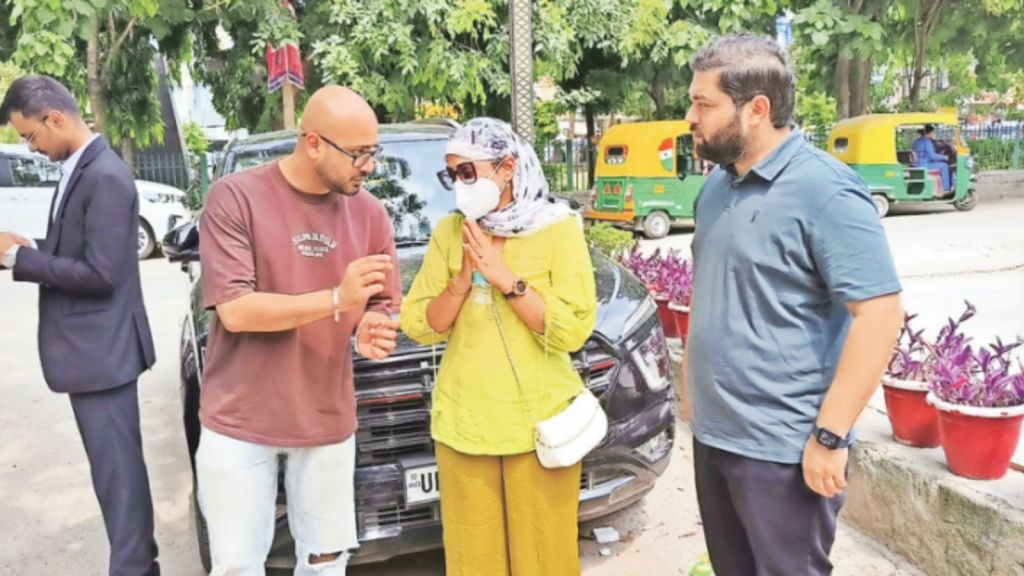 Yuvraj Singh Manchanda’s sister Karishma on Friday. (Express Photo)
A missing person report filed in Delhi. An unidentified body recovered in Gurugram. A photograph uploaded on an interstate police database. A Hue and Cry Notice circulated by the Gurugram Police as per procedure. Yet, Sarita Vihar resident Yuvraj Singh Manchanda (31), who was murdered on September 6 and thrown into a drain, remained unidentified and was cremated before his family could claim his body.
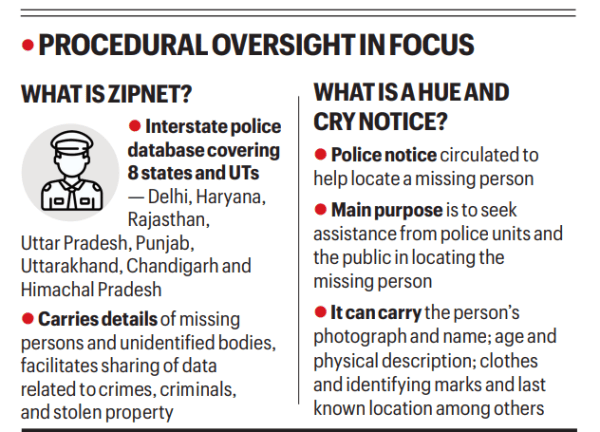
The sequence has raised questions over whether Gurugram Police checked Zonal Integrated Police Network (ZIPNET) — the police database meant to help match missing persons with unidentified bodies — after the body was recovered on September 10, and whether the Hue and Cry Notice, circulated to help locate a missing person, was shared with neighbouring police forces as well as per norms.
Further, according to Delhi Police, there is a discrepancy over the cause of death. While the postmortem examination records the cause as asphyxiation due to drowning, Delhi Police has said that Yuvraj was shot dead.
Yuvraj, an Adani Realty employee, had been missing since September 6. His family approached Lajpat Nagar police station on September 11. Delhi Police said his details, including a clear photograph, were uploaded on ZIPNET the next day.
Two days earlier, on September 10, Gurugram Police had recovered a decomposed body from a drain in Badshahpur. It was cremated on September 14 — two days after the alert was issued on ZIPNET.
DCP (South Gurugram) Hitesh Yadav told The Indian Express that police received information about the body on the night of September 10. “Soon after, a mobile forensic science unit and local police reached the spot… The body had decomposed and was beyond recognition,” he added.
Videography of the recovery of the body was carried out and a Hue and Cry Notice was circulated among police personnel as per procedure, the DCP said, adding that the body was kept at a mortuary for three days, as per norms.
“After no one claimed the body within 72 hours – the mandatory period – the postmortem was conducted. Details of the unidentified body were uploaded on CCTNS (Crime and Criminal Tracking Network and Systems) on September 14. The body was cremated the same day,” he added.
Gurugram Police said the CCTNS IIF-10 form for unidentified dead bodies was filled and the Facial Recognition System procedure followed. “There is no mandate to follow the ZIPNET procedure in such cases,” an officer from Gurugram Police said.
But a senior Delhi Police officer questioned why Yuvraj could not be identified when his photograph and missing person details were available on ZIPNET. “Had the Gurugram Police checked ZIPNET, Yuvraj could have been identified and Delhi Police alerted. This would have given the family an opportunity to claim the body and perform his last rites,” the officer said.
Yuvraj was eventually identified after his family was shown high-resolution photographs of the unidentified body. But by then, the body had already been cremated. The deceased’s DNA sample as well as other belongings recovered with the body have been preserved, police said. The ashes and belongings, including a kada, will be handed over to Yuvraj’s family, officers added.
“As of the evening of September 18, Delhi Police had not contacted us regarding the case,” a Gurugram Police officer said. The Indian Express has reached out to the Delhi Police for a response.
Stay updated with the latest - Click here to follow us on Instagram