‘We can’t let our guard down’: What getting around Delhi means for women students

From unreliable feeder buses and poorly lit stretches to harassment on public transport, women students said safety concerns shape even the simplest journeys to and from college. A string of rape cases have only added to their concerns

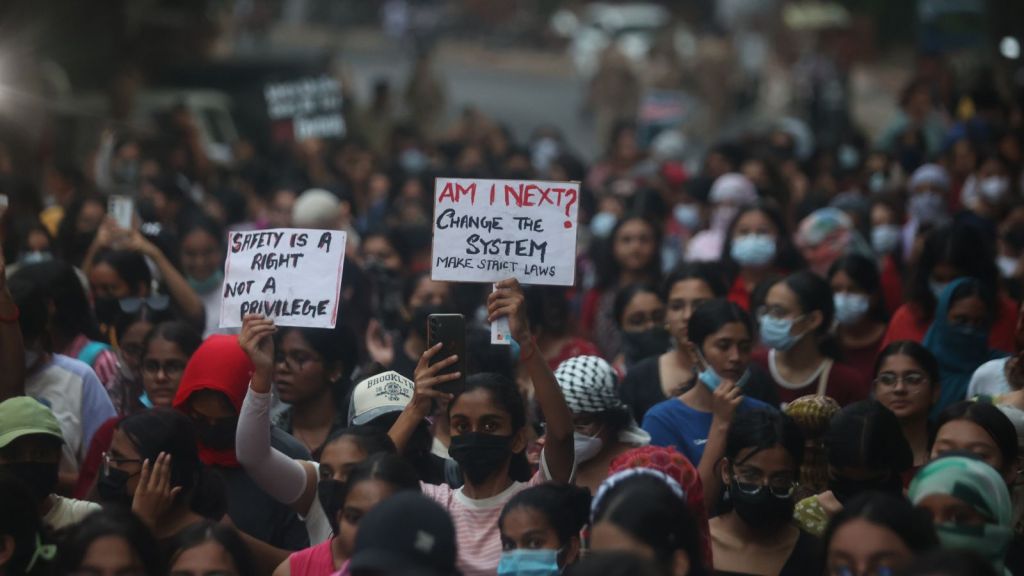
Hypervigilant commutes, moving in groups: Women students on navigating DelhiOn Wednesday, students protested against the gangrape of a teenager at a Delhi park. (Express Photo by Tashi Tobgyal)

September 18 was the first time Kirti Sharma, a first-year BA Programme student at Delhi University’s Maitreyi College, managed to take a bus home from college since classes began in August.

On most days, buses available from Satya Niketan in the evening head in the opposite direction from the one she needs to take home.

That day, a bus was stuck in a traffic jam near Satya Niketan during the Delhi University Students’ Union election. Kirti and her friend got on, but found themselves alone on the bus. “So we decided we would get off together at the same stop,” she said.

For thousands of women like Kirti navigating DU’s scattered off-campus colleges, the daily commute involves an exhausting calculation: which route to take, whose arm to hold, and how early to return behind locked hostel gates. The problem is compounded by gaps in the last-mile connectivity, poorly lit stretches, and street harassment.

And the alleged gangrape of a 17-year-old in a South Delhi DDA park and a string of sexual assault cases involving minors have brought these concerns into sharp focus.

Public transport issues

The gaps are most apparent at the end of the college day. Day-scholars who rely on feeder buses said the services that bring them to college in the morning do not always run when classes end.

Ananya Shukla, a second-year student at a women’s college, said students have checked with drivers and found that buses from their areas leave as early as 6 am, but there is no corresponding service around 4 pm, when colleges usually wind up.

Story continues below this ad

“At that hour, there are simply no buses available. They all head away in the opposite direction,” Ananya said.

She also pointed to the Delhi government’s DTC U-Special Bus Service, which was relaunched in August last year. “But there is no public data on how many women students are actually using these 26 buses, their occupancy or how frequently trips are cancelled,” said Ananya.

Left with few reliable options, students often walk through quiet stretches just to find an auto or an e-rickshaw.

The problems extend to the Delhi Metro. “I take the metro every day and you feel unsafe even inside the coaches,” said a first-year student from Lady Shri Ram College for Women. “This isn’t just about a particular college backlane or a park. Anywhere you go in this city, you are forced to be hypervigilant… we cannot let our guard down.”

Story continues below this ad

A 2021 alumna of the same college said students had heard the same solutions for years. “The solution every time is more policing, more surveillance, telling women not to step out after dark. Sometimes, after crimes, we see more police personnel deployed on the roads, but to what end? It becomes about managing women. This has become their sanitised fix,” she said.

Scattered colleges

Unlike DU’s North Campus, where colleges and departments are clustered together, institutions across South, East and West Delhi are more spread out, often alongside busy arterial roads and residential neighbourhoods. In South Delhi’s Chanakyapuri, students say these gaps are particularly visible.

“Even in an area like Chanakyapuri, there are so many isolated stretches where police personnel are entirely missing,” said a South Campus student. “And across South Campus, even where ‘pink booths’ have been installed, there is no one inside them most of the time. You pass by, and they are completely deserted.”

Yakshna Sharma, an advocate practising at the Delhi High Court and a 2025 graduate of DU’s Campus Law Centre, gave another example. “Outside Laxmibai College, a public men’s washroom has been built directly against the campus boundary wall. Female students have repeatedly complained about men openly urinating, catcalling and exposing themselves while looking into the college ground. Yet there are no working CCTVs, no police presence and no functional booths,” she said.

Story continues below this ad

Safety reduced to numbers

Amid these concerns, colleges have instructed women students to move out only in groups.

At the Rajkumari Amrit Kaur College of Nursing (RAKCON) in Lajpat Nagar IV, freshers who arrived on campus only days ago have already been instructed to follow rigid precautions.

“I just joined recently, but teachers have clearly warned us that whenever we need to step outside the campus, we must move only in groups. Even for small errands, like going to buy our textbooks, we made sure to go together,” said Ngawang Gatso, a first-year B.Sc Nursing student from Uttarakhand.

Tenzing Pamo, also a first-year student, said, “We stay inside the campus hostel, but stepping out is unavoidable for daily necessities. After the warning, we went in a group to get our books today. We definitely feel much more secure when we step outside together rather than going alone.”

Story continues below this ad

Their batchmate Yangzom, who is from Tibet, said, “It has barely been a day since we arrived, and the very first instruction we received was about stepping out cautiously. With everything happening in the area, our seniors and faculty emphasised that no one should walk around alone outside the gates.”

A third-year student living in the college’s residential accommodation said the 6.30 pm curfew means she and other residents largely avoid stepping out after dark.

Sophiya Mathew is a Correspondent at The Indian Express, based in New Delhi. She joined the Delhi bureau in 2024, and has specialization in Integrated Multimedia Journalism from the Asian College of Journalism (ACJ), Chennai. Professional Background Core Beats: Her reporting is primarily focused on the Environment and Education. Specialization: She has gained recognition for her ground-level reporting on the Yamuna floodplains and the socio-economic challenges faced by those living on its banks. She also focuses on the disparities in Delhi's education system, ranging from elite private schools to government institutions and refugee education. Recent Notable Articles (December 2025) Her recent work has been heavily centered on Delhi's severe winter pollution crisis and the government's regulatory responses: 1. The Air Pollution Crisis "A tale of two cities: Delhi govt schools choke in bad air, private classrooms set up air filters" (Dec 20, 2025): A high-impact feature contrasting the "Clean Air Bubbles" in elite schools with the reality of government school students who are exposed to an equivalent of 17 cigarettes a day due to outdoor exposure. "Delhi sees season's worst air day, second worst December AQI in nearly a decade" (Dec 15, 2025): An analytical report on the meteorological patterns trapping pollutants in the NCR. "Delhi bans non-BS VI vehicles from outside: Why curbing vehicular pollution is key" (Dec 17, 2025): Explaining the science behind targeting specific vehicle vintages to lower particulate matter. 2. Enforcement & Regulations "No fuel at pumps in Delhi without valid PUC certificate from December 18" (Dec 17, 2025): Breaking the news on the environment ministry's strict "No PUC, No Fuel" policy. 3. Education Policy "Law to regulate school fee in Delhi risks becoming procedural, say parents" (Dec 13, 2025): Investigating the loopholes in the new Delhi School Education (Transparency in Fixation and Regulation of Fees) Bill, 2025. "Monsoon Session: Private school fee regulation Bill cleared after four-hour debate" (Aug 9, 2025): Covering the legislative passage of the controversial fee hike regulation. Signature Style Sophiya is known for her observational depth. Her reporting often includes vivid details from school corridors, hospital waitlists, or the banks of the Yamuna to illustrate how policy failures affect the city's most vulnerable residents. She is a frequent expert guest on the 3 Things podcast, where she explains the complexities of Delhi’s environmental laws. X (Twitter): @SophiyaMathew1 ... Read More

Stay updated with the latest - Click here to follow us on Instagram

Advertisement
Loading Recommendations...
Advertisement
Advertisement
Latest Comment
Post Comment
Read Comments