
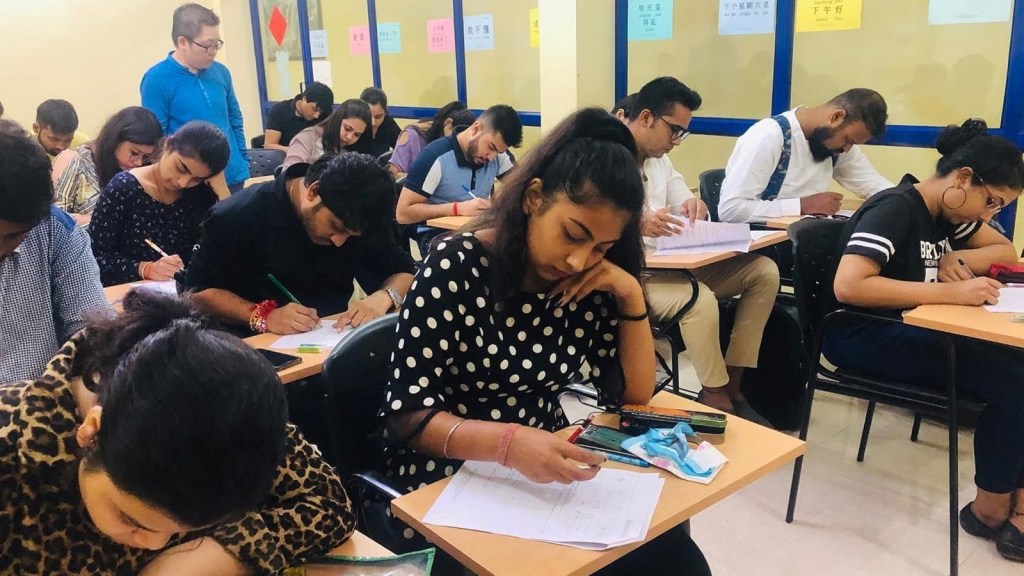
On a humid August day at MeiYu Chinese Centre in Delhi’s Karol Bagh, a native Mandarin teacher, Claire Laoshi, guides a group of beginner-level students through simple sentences. “Wo he kafei,” she says. “It means I drink coffee.”
The students repeat it as she explains how he means drink and that adding le turns the action into the past tense.

She then introduces a practical scenario. “If your colleague asks you in the morning, ‘Did you drink coffee?’ you can answer, ‘Wo he le (I drank)’…,” she says. “In Chinese, the adverbs always go with adjectives.”
The students nod, as they jot down the grammar lesson — some writing down the structure: Subject + Verb + Object.
“Next Saturday, when I ask you if you did the homework, you will say, ‘Wo xie le (I wrote it),’” says Laoshi.
The next sentence is tougher. “Ta men ti zuqiu (they play football).” Some stumble at first, until the teacher pronounces zuqui as dzoo chyoh.
By the end of the lesson, the students are familiar with simple Mandarin greetings.
“A says ‘Ni hao’, B replies ‘Ni hao ma?’…” Laoshi demonstrates.
One by one, the students respond: “Wo hen hao. Ni ne? (I’m fine. How are you)?” — marking their first attempt at a tiny dialogue in Mandarin.
They are part of the HSK 1 (Hanyu Shuiping Kaoshi or Chinese Proficiency Test) batch at the centre. It comprises 10 students, mostly in their 20s.
Mandarin has been steadily gaining popularity in the city among those seeking foreign scholarships and global career prospects.
According to data shared by Mandarin instructors in Delhi-NCR, learners come from a wide range of professional backgrounds: around 55% are corporate professionals, 25% are business owners from manufacturing and export sectors, and around 20% are university students or young professionals aiming to study or work abroad.
Some like Princi Narang, among the centre’s older students, were drawn to the language through social media and Chinese Dramas.
A digital marketing professional, the 21-year-old says she started learning Mandarin in May 2023. She initially travelled from her hometown in Muzaffarnagar to Delhi for classes, later shifting to Noida for convenience.
“I became interested in the language because of short reels on Instagram and binge-watching Chinese dramas. The characters and phrases fascinated me, and I thought — why not learn the language?” she says.
Narang has since progressed to the HSK 4 level.
She adds, “Initially, it was overwhelming — tones, characters, sentence structures. But when you want to learn something, you have to give it your all. My sister’s friends told me that Mandarin has great career opportunities, so it kept me motivated.”
Learning the language has helped her secure the Huayu Enrichment Scholarship to study at Ming Chuan University, which she will join later this year.
At Han You Chinese Language Institute in South Delhi’s Hauz Khas, batches are limited to 15-20 students. The co-founder, Arun Jaiswal, says that it is a deliberate choice as language learning requires individual attention and a focused approach. Noting that Mandarin has been gaining popularity, he adds that awareness is still limited.
“People are fascinated, but ultimately, they approach it from a career perspective,” says Jaiswal. “Chinese is a highly practical language and can be very rewarding, offering excellent salary packages.”
Earlier, job opportunities for those proficient in Mandarin were largely thought to be limited to tour guides or the tourism industry. But now, Jaiswal notes, the scope has significantly expanded to include roles such as interpreters, translators, positions in multinational companies, the travel industry, embassies and diplomatic missions, as well as government-linked posts.
The institute itself has come a long way from when it started with six students in 2018. “Initially, foreign languages were a niche… We wanted to focus on one language properly. Over the years, we evolved, added courses, and adjusted to student needs,” he adds.
Many college students are also choosing Mandarin over traditionally popular options like French and German.
At Delhi University, Prof. Payal Maggo, Director of the School of Open Learning (SOL), points to a university-led survey that highlighted the growing interest in Mandarin.
“Before introducing certificate courses in foreign languages at SOL, we conducted a survey and found a rising interest in Mandarin — apart from French and German,” she says.
“This year at SOL — even though it is not a large number — we found around 2,000 students were interested and 800 have already taken admission for this course. We are teaching French, German, Spanish, Mandarin, Japanese, Korean, and Italian. The turnout, however, was very low for Portuguese and Russian,” she adds.
Maggo says students are driven by both career and academic goals. “Many are exploring job prospects and study-abroad opportunities through foreign languages, while others take it up out of personal interest. Mandarin has gained popularity at DU, particularly because of the growing demand for translators in corporate firms. We’ve introduced it from the first year, as many students today already have exposure to foreign languages in school.”
As per the MeiYu centre, pre-Covid, students were mostly from academic and tourism fields. After the pandemic, there has been a sharp increase in corporate learners preparing for East Asian markets.
The institute’s faculty says, “Taiwan is currently offering generous, fully funded scholarships for Indian students, especially in fields like MBA, IT and engineering. With the India-Taiwan labour exchange growing and Taiwanese companies looking for skilled professionals, Mandarin proficiency is becoming a real advantage.”
Corporate demand has been another key driver.
The MeiYu centre reports that over the past few years, corporate firms have approached the institute for customised training programmes for their employees.
For instance, a manufacturing plant relocating from China to India requested Mandarin lessons for 75 Indian staff to facilitate onboarding and smooth communication this year. Similarly, 60 engineers were trained in Mandarin before they went to Taiwan for semiconductor studies. Major Chinese firms such as Oppo, Vivo, and Xiaomi have actively recruited Mandarin-speaking professionals, particularly in Noida’s manufacturing hubs.
“The corporate sector now sees Mandarin proficiency as a practical skill that directly impacts business communication, client relations, and international placements,” a faculty member at the institute tells The Indian Express.
Rakesh Kumar, Chairperson of the Centre for Chinese and South East Asian Studies at Jawaharlal Nehru University, underscores the importance of developing Indian teaching capacity.
“Native instructors may not know the culture, and students can face initial language barriers. But they are definitely better at developing curriculum. Here, their role is critical. But we need to have our own resource persons as well, which we seriously lack in India,” he says.


 Share


