In the 1970s, long before government records were accessible to the public with only a press on the smartphone, they were largely confined to the study tables of Members of Parliament and Legislative Assemblies. Data would be printed in government offices, bound in thick folders, posted to the representatives’ homes, and once exhausted of their use, thrown into dustbins. But their journey did not end there – often, they were fished out by domestic help and sold off to waste collectors, a habit Ramesh Chandra Jain, founder of Manohar Publishers and Distributors, decided to exploit. He would tell kabadiwalas around Delhi that he ran a bookstore in Daryaganj specialising in academic books and such government data would be a treasure trove of information for scientists and scholars.
“Whenever you get documents like these, give them to me,” he would say, and receive them, sort them, stock them, and sell them. Eventually, in India and across the world, word spread that if you were a social scientist specialising in the subcontinent, you will find pretty much anything you need – and do not – in one of the five floors of this bookstore on Ansari Road.
 The youngest of eight siblings, Jain started the bookstore in 1969 soon after the birth of his son, Ajay, out of a passion for rare and antique books. (Express photo)
Jain died Saturday at the age of 80. His legacy is legend in academic circles and includes patronage from historians Simon Digby, Ramachandra Guha, J S Grewal, and Indu Banga, among others.
The youngest of eight siblings, Jain started the bookstore in 1969 soon after the birth of his son, Ajay, out of a passion for rare and antique books, particularly those that were out-of-print, printed by NGOs, and unavailable elsewhere. This was the era of growing interest in South Asian studies, when American governments were funding scholars to study India in the aftermath of the wars with Pakistan and China, and PhD students would arrive at the bookstore’s doorstep on the reassuring recommendation of their advisors: “Ask for any title at Manohar and you’ll find 30 books on the subject, at least.” Without the benefit of email or fax, the bookstore’s reputation for sourcing obscure academia was booming via just the spoken word.
Walk into the store’s cramped and congested interiors and you will find huge steel shelves with thick volumes stacked from floor to ceiling. Fans whir away everywhere. Ajay says that though computers made their way into the store in the mid-1990s, there are some demands of classification that technology cannot meet. “Scholars come in looking for books on the social history of Indian spices, or the pandits who perform death rituals in Banaras, or the history of gunpowder in India. How are you supposed to feed such specific requirements into a computer?” Ajay says with a laugh, adding that his father knew a large part of the bookstore’s catalogue by heart. When Ajay joined the business in 1988, he would watch in fascination as customers stated their request, sat next to the front desk with a cup of tea, and the entire staff ran around the store looking for a suitable book. They often found multiple volumes on the subject.
Manohar has not had the financial might to achieve Jain’s target of one publication a day but has still released an enviable 1,800 titles to date. (Express photo)
Publishing was an inevitable offshoot of the business and started with a young scholar’s request to publish his doctoral thesis in the 1970s. Jain agreed. He was a huge admirer of the Asia Publishing House in Bombay because of their editorial standards, print quality and publication frequency – a formidable one book a day, in the laborious age of the letterpress and hand-setting – and wanted to emulate their model. He went looking for a famous printing press in Lucknow that was run by a Sanskrit speaker (reputed for correcting typos in the manuscripts he received) and spent days in the city during the printing process, proofreading pages while the press worked away. “He had a knack for picking young academics to publish who would go on to be published by big academic publishers like Cambridge and Oxford,” says Ajay. Manohar has not had the financial might to achieve Jain’s target of one publication a day but has still released an enviable 1,800 titles to date.
“He was a courageous and admirable man who often published texts with a critical slant towards the system, that others would be unwilling to publish,” says Indu Banga, a retired professor of medieval and modern history from Panjab University, whose first publication with Manohar was her doctoral study in 1978. “He was gentle and accommodating, even calling me to Delhi when he wanted me to sort out page-making problems if a text had too many footnotes,” adds Banga.
Word spread that if you were a social scientist specialising in the subcontinent, you will find pretty much anything you need – and do not – in one of the five floors of this bookstore on Ansari Road. (Express photo)
Amarjit Narang, a retired political science professor from IGNOU, who has also published with Manohar, says that Jain’s priorities were relationships instead of commerce: “He would not ask us to buy the books. He would just give his authors a complimentary copy of any book he published.”
Personally, Jain was a fan of biographies and memoirs, with a particular taste for Henry Ford, the founder of the Ford Motor Company. One of his longest quests was finding a scholar who could complete Gandhi’s incomplete My Experiments with Truth, which stops abruptly with a retelling of the 1915 Nagpur session of the Congress. That hope could someday find fruition at the bookstore’s very doorstep, because, as Ajay says, Manohar has a rare bookselling privilege of “our customers becoming our authors.”

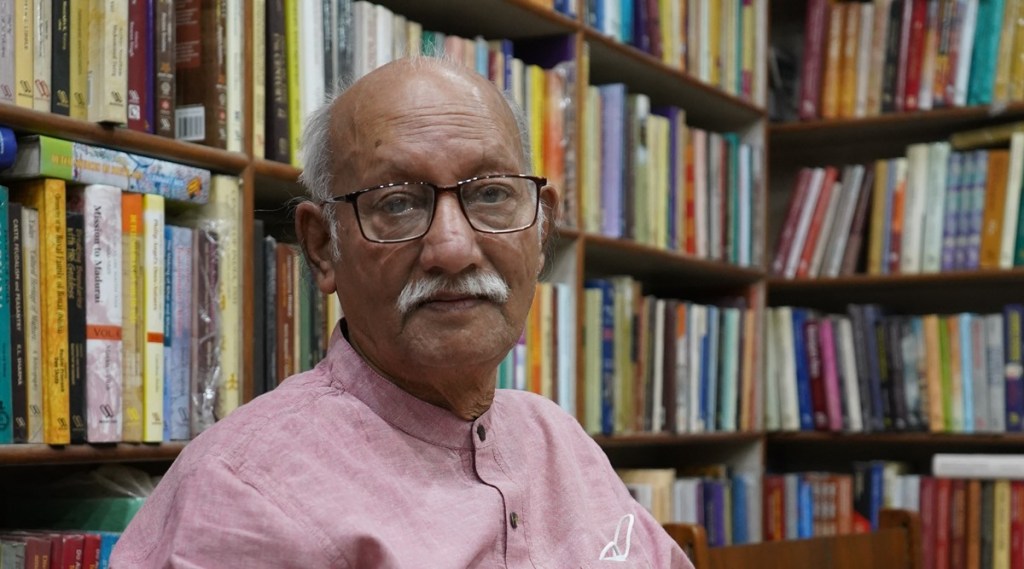 Jain died Saturday at the age of 80. His legacy is legend in academic circles and includes patronage from historians Simon Digby, Ramachandra Guha, J S Grewal, and Indu Banga, among others. (Express photo)

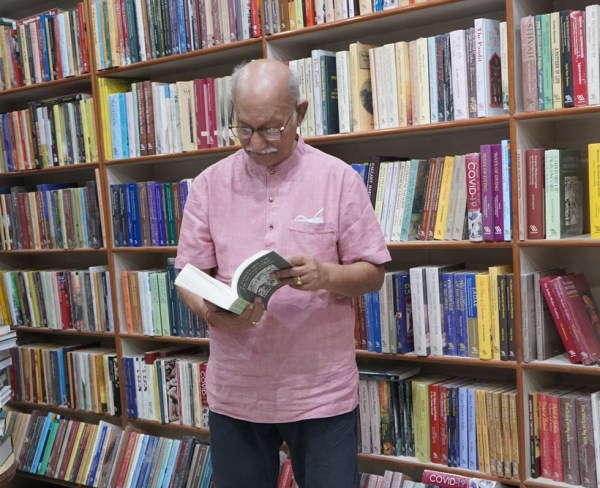 The youngest of eight siblings, Jain started the bookstore in 1969 soon after the birth of his son, Ajay, out of a passion for rare and antique books. (Express photo)
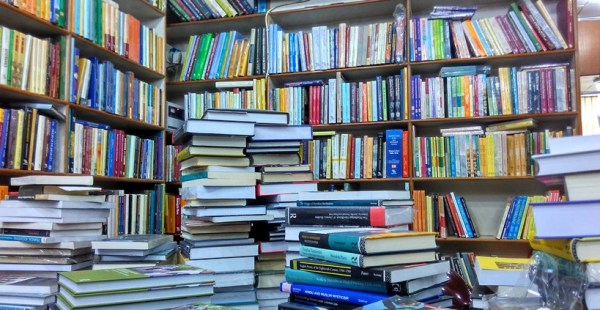 Manohar has not had the financial might to achieve Jain’s target of one publication a day but has still released an enviable 1,800 titles to date. (Express photo)
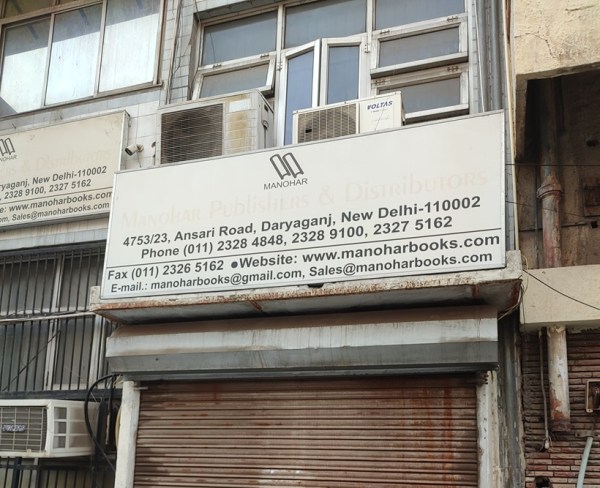 Word spread that if you were a social scientist specialising in the subcontinent, you will find pretty much anything you need – and do not – in one of the five floors of this bookstore on Ansari Road. (Express photo)

 Share


