Journalism of Courage



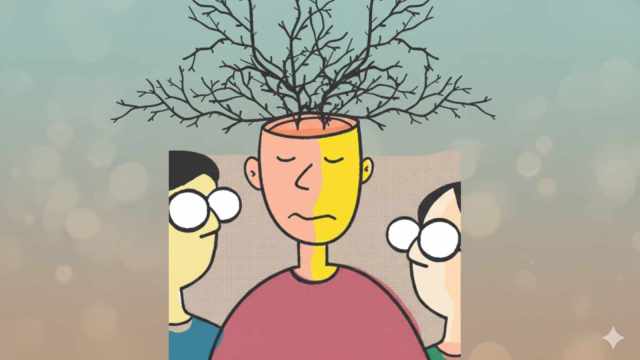 The counsellor who had prepared to gently help children identify and name their feelings was instead faced with a young teen who was able to articulate emotional nuance with a sophistication not many adults have. (Illustration: Mithun Chakraborty)
One morning a couple of months ago, a 15-year-old walked into the counselling room of a well-known school in South Delhi. The counsellor noticed that the child was wearing long sleeves; her eyes were trained to register oddities immediately. It was too warm for a full-sleeve shirt buttoned at the wrists.
“Ma’am,” the student hesitated, “may I share something with you?”
What the counsellor heard next was not surprising or unexpected – it was a story that is increasingly familiar to counsellors in schools across Delhi.
“Children are resorting to self-harm to curb unstoppable thoughts, or when they feel worthless,” the counsellor told The Indian Express. “It had taken this child months to gather the courage to open up to an adult.”
Cases such as the 15-year-old’s were fewer until a few years ago, the counsellor said – things are different now, and more children are talking. “There is growing awareness… It is encouraging students to reach out, they know confidentiality will be respected,” she said.
A board outside the counsellor’s room says, “What you say here stays here unless someone is hurting you… You want to hurt someone… You want to hurt yourself.”
Counsellors describe a generation that walks into their rooms unfiltered and unmasked, using mental-health vocabulary that teens from some years ago discovered only in adulthood.
They will barge in saying, “Ma’am, I’m having a panic attack; my exam is next period,” or collapse into chairs unable to accept that a close friend had chosen to sit with someone else during break.
Many of them carry smartphones loaded with adult content, have vocabularies from OTT shows, and anxieties sharpened by their parents’ inability to set proper boundaries for them, say counsellors.
In the days after a Class 10 student of St Columba’s School died by suicide last month, The Indian Express reached out to counsellors in several of the capital’s top schools. From that series of conversations emerged the portrait of a city full of teenagers grappling with significant emotional stress – the result of lingering pandemic scars; of life on the Internet that is simultaneously intimate and remote, understanding and impersonal; and of trying to cope in the adult physical world whose pulls and pressures they cannot yet understand.
Names of students, counsellors, and schools have been withheld to protect identities.
Parents ‘scared’ of their own kids
A veteran counsellor at a major school in West Delhi said she has never seen parents being as careful with their children as now. This counsellor has spent 18 years at her current job, which she took up after working at two of South Delhi’s most prestigious schools.
She remembered a father who was a teacher himself, telling her: “Ma’am, if we say anything to him, he locks himself in his room. What if he harms himself? Please tell us what to do.”
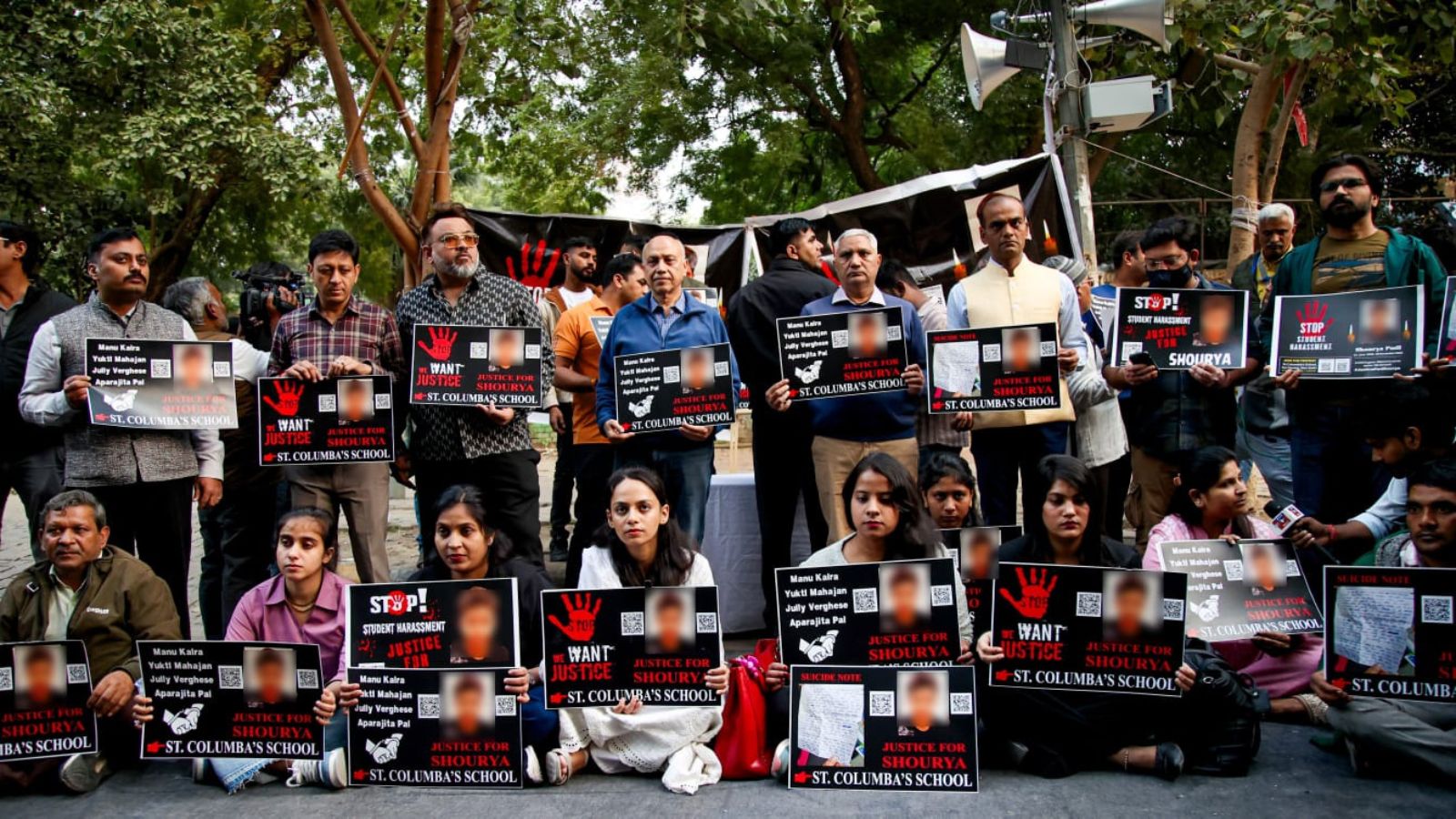 Parents protest outside St Columba’s after a Class X student died by suicide last month. Archive
This powerlessness that many parents feel is the outcome of “overly pampering” their children through their growing-up years, the counsellor said. “In the nuclear family set-up, parents fulfil all irrational demands to show their love, rather than teach the right life skills and values to make their children worthy citizens of the country,” she said.
In despair, these parents sometimes reach out to schools, the counsellor said. They will request teachers to confiscate their teens’ phones because they are unable to do it themselves, or call to maybe say their child is refusing to get out of bed for school.
The general irreverence of today’s children seems to be devoid of an awareness of gradation, she said – many do not seem to understand the difference between teasing and bullying, and they will casually call their teachers and parents names that previous generations would not even imagine.
Some of this behaviour can be traced to the pandemic, the counsellor said. “In the two years of isolation, the student-adult relationship flattened. Adults can no longer claim an automatic authority to impose decisions or enforce obedience.”
‘They already have the answers’
A young counsellor at a school in south-central Delhi recalled an occasion when a 14-year-old had googled every symptom that she thought she had. The counsellor who had prepared to gently help children identify and name their feelings was instead faced with a young teen who was able to articulate emotional nuance with a sophistication not many adults have.
“I was stunned,” the counsellor said. She realised that in some cases at least, the children’s problem was not ignorance, it was saturation.
“These children consume complex narratives on OTT platforms before they have had a chance to understand their own real worlds. The Internet has offered them a language, maybe even support of some kind. But it has also created children who come for counselling because they are struggling with too many answers,” said the counsellor.
Third and fourth graders can startle you with talk about “consent”, “dignity”, and “boundaries”, she said. She recalled one especially “boundaried” eight-year-old who knew exactly what she liked and disliked, what she would and would not accept; another who could describe internal emotional states with a clarity not seen even in middle-school children five years ago.
“Every generation is supposed to evolve,” said the counsellor.
‘Nine hours online, then school’
The counsellor from the South Delhi school who had spoken to the student in long sleeves at the top of this report recalled the time she had spent with a child who had thrown a sexually explicit phrase at a classmate, seemingly innocently. After stonewalling her for an hour, the student confessed he had picked up the expression from content that some older boys had shown him on their phones.
“Age-appropriate information and careful adult supervision are essential,” said the counsellor. She said she frequently discovers the secret late-night digital lives that many children have. “Long hours spent online, switching between [computer games such as] Roblox and Minecraft and social media, frequently contribute to increased impulsivity.”
Issues of body image, seen in teens or older children until recently, seem to be now appearing in primary school. A counsellor recalled a little girl with a perfectly proportionate body for her age wanting to lose 10 kilograms because she wanted “praise from everyone”.
Then there are issues of interpersonal behaviour. Many students refuse to take responsibility for their actions, react sharply to peers, and find it difficult to repair bruised friendships, counsellors said. In several schools, counsellors have sessions on resolving conflict and disputes, and on reflection and accountability.
Catastrophic Covid disruption
A counsellor at another South Delhi school identified clear pre- and post-Covid phases in her decade of working with children. The post-Covid generation, she said, returned to school sans entire layers of developmental scaffolding.
Many could not sit through a full school day; they would request “half-days” because a long time spent with peers overwhelmed them, she said. Conflicts over the smallest matters escalated because children had lost the muscle memory that guides face-to-face relationships.
Many children lost a parent to the virus, some lost both parents. The counsellor said she also started to notice a tendency towards self-harm, “a Blue Whale Challenge [online ‘suicide game’]-like behaviour” in which children snapped rubber bands on wrists, or punched walls until their knuckles bled. “They don’t know how to express what they feel,” she said. “So they copy what they see.”
Once, caught with a vape, a student told the counsellor, “What’s the big deal? I found this in my father’s drawer.” Another excitedly announced in school that her parents had promised to celebrate her 16th birthday with wine. “It took me a while to comprehend. I did not know how to respond,” the counsellor said.
‘Parents and schools, together’
And yet, in the majority of cases, the core of childhood remains unchanged, agreed all counsellors. Children still seek a place where they are not identified by their failures, where their anger is not punished, and where they can articulate heartbreak aloud. This is why counselling rooms often feel like the heart of a school – “despite all that has changed, children still crave security,” one of the counsellors quoted above said.
For parents, the counsellors have a prescription: reclaim your authority, but not through fear; encourage boundaries to the extent your children can lean on them; build environments for exploration, not perfection; privilege emotional grounding over emotional vocabularies; rebuild communication; teach children to navigate conflict instead of fleeing from it.
In the end, all counsellors agree on the critical need for collaboration – with parents and other stakeholders – to make things easier for a generation in school that is growing up too fast and yet not fast enough.

 9 min read