


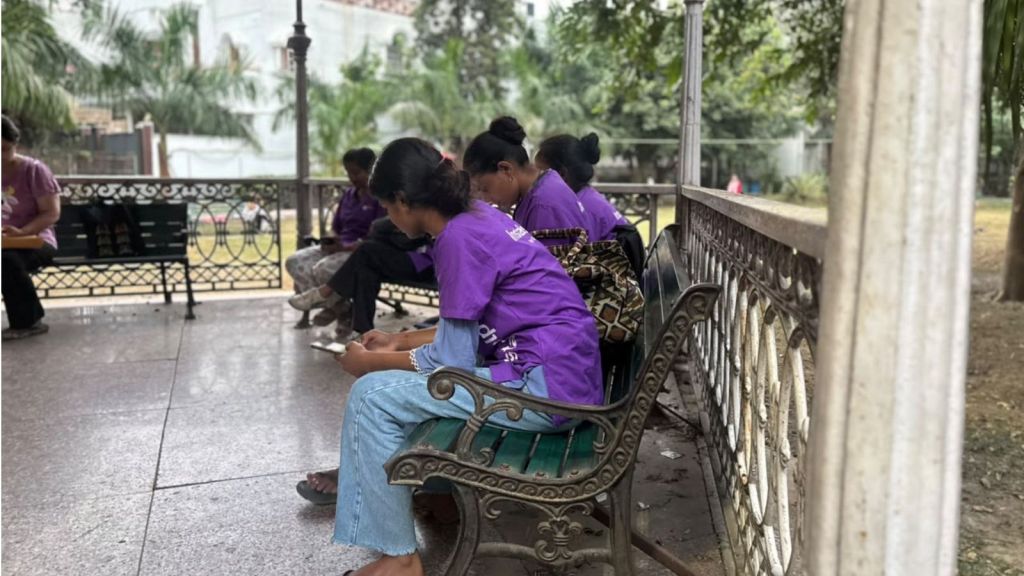


At 8.30 on an October morning, Pinky Devi (name changed) sits on a dusty footpath near Modi Mall in Noida’s Sector 25A. The 26-year-old has already washed clothes, cleaned utensils and dusted a house during a 45-minute early-morning booking.
After a 17-minute break, she has to reach another house across the road.
She waits for her friends, who are also gig workers, to receive their booking schedules for the day. The women often sit together in parks during breaks. “We eat together during the break in the park. If they (guards) see me eating there alone, they will not allow me,” she says, glancing at her broken phone screen to check the time.
On April 15, Pinky and about 40 gig workers with Urban Company took to the streets in Noida amid a massive labour unrest that shook the city with a 10-point charter — seeking better working hours and a place to rest among other demands.
Six months on, the April 15 protest has brought some changes for the women, they say.
In a meeting that took place with the company four days after the protest, workers claim some demands were fulfilled like limiting the areas in which they receive bookings and leaves. But access to washrooms and places to rest remains a problem.
A detailed questionnaire was sent to Urban Company via email seeking comment.
Story continues below this ad
Access to toilets
One of the demands raised during the protest specifically called for access to drinking water and washroom facilities. “We still do not get water to drink,” says Pinky. “We carry our own (bottle) so we don’t have to ask the customer every time. Some offer it, some are hesitant.”
Sushma (name changed), who recently switched to a platform that provides wellness and spa services, was not present at the April 15 protest. Her only pressing demand was for a place to relive herself.
Sushma, who had quit her old job in July, says: “I couldn’t urinate for four hours straight. I had been holding as I had back-to-back bookings. While working at the second house, I couldn’t control it and asked the owner where the washroom was.”
She says the owner initially hesitated to let her use her personal washroom, but eventually allowed her to use the one in the hall. “I was scared she would give me a low rating and feedback that I used her washroom. I knew I couldn’t work like this.”
Story continues below this ad
She says women sometimes had to relieve themselves near bushes when they had only a few minutes before their next booking.
The lack of a space to rest between bookings is another sticking point. Sushma says during winters, they would light wood fires to keep warm, but sitting outdoors becomes difficult in summer.
Riya (name changed), who is from Bihar, says the women had tried to explain to the company during the meeting how difficult it was to move between bookings. “We told them you stay in AC cabins, how will you understand us?” says the 38-year-old.
Some gains
Riya was among those who took part in the April 15 protest. She did not tell her husband she was attending it. “I feared he would be angry as many women were jailed,” she says.
Story continues below this ad
Her husband works in their village, while she works in Noida and lives in a rented apartment in Sector 34 with her two children.
There have been some gains, say the workers.
The company has limited the areas in which workers receive bookings, Riya claims. Earlier, she would get bookings across four or five areas. Now, she often gets multiple bookings in the same area, reducing the need to travel long distances between houses.
“Ek awaaz uthaaya hum log ka itna fayda hogaya ki ab ek se doosri jagah door nahi bhaagna hota. Warna humare liye kaun uthaata? (Just by raising our voice, we’ve benefited so much. Now we don’t have to keep rushing from one place to another. Otherwise, who would have stood up for us?),” she says.
She adds that some supervisors have spoken to apartment complexes, requesting their guards to allow workers to sit inside the societies even when they do not have a booking. “Earlier, the guard did not let us enter. They still do not always, but then we call our supervisor,” she says.