
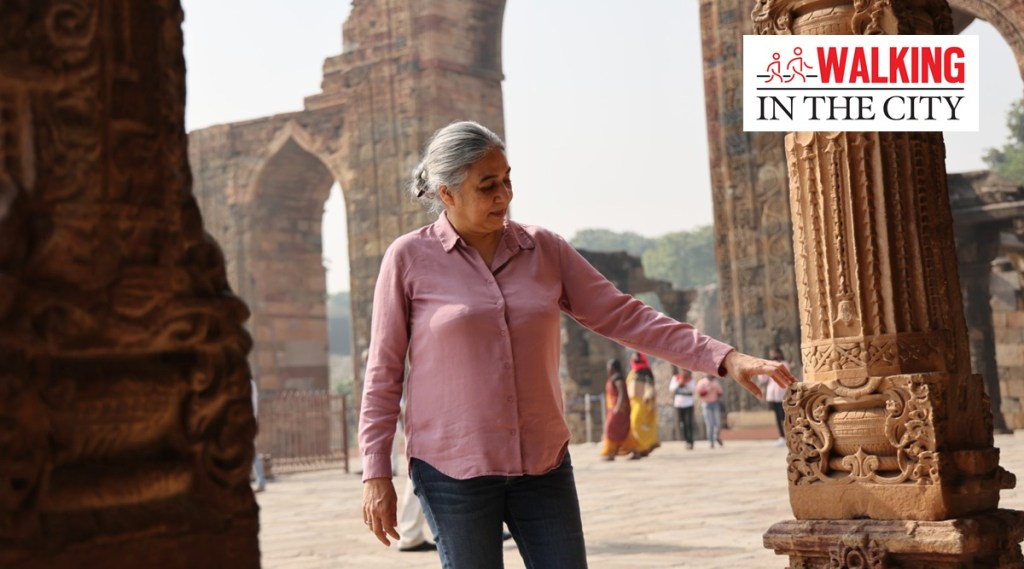
As author-historian Swapna Liddle takes one through Mehrauli, Delhi’s oldest inhabited area, multiple stories – spanning several decades and dynasties – begin to unfold.
Back in the 12th Century, some one-and-a-half centuries after the Tomar Rajputs ruled Delhi, the Turks arrived, bringing in the Sultanate rule. Qutb-ud-din Aibak, one of Muhammad Ghori’s most trusted generals, conquered Delhi, making it a garrison town. “One of the first things he did was to make a mosque for his soldiers. What they built is this, what’s called the Quwwatul-Islam Mosque. It was built out of the stones of temples that were destroyed during the war of conquest. This was a pretty standard practice at the time, to discredit the regime that was being overthrown, since these temples had been erected by the previous rulers. In contrast, temples with a purely popular following – such as the Dadabari Jain temple and the Joymaya temple, both nearby, were not harmed.

Apart from these re-used beams and pillars, the mosque also contained some new elements, you will notice that the arch here is not a true arch, it’s corbelled (formed by overlapping stones). And under the lintel that gives the arch its support, is a kirtimukha. This is because the masons are from India and for them this is a feature at the entrance of a temple to ward off the evil eye. Since this is a place of worship, they thought it’s important that it has to have one. Right here you see the dialogue that is working out, on what the aesthetics of new buildings are going to be,” says Liddle.
As we move within this UNESCO World Heritage Site, we hear different languages, and one can’t help but wonder how Delhi’s composite culture must have emerged.
 Tourist visit the Qutub Minar monument in New Delhi. File/Express Photo by Amit Mehra.
Liddle points to the motifs on the remains of the stone screen of the mosque, built from new stones a few years after the original mosque, where the rekhta in architecture unfurls, and the writing is literally on the wall. “The masons were given a brief to make some nice carving in stone, but the Muslims who were to pray here didn’t want gods or goddesses. So, the workers made these symbolic representations of Ganga and Yamuna as they would at a temple entrance, on the main doorway of the sanctum. These alternating spirals represent the tail of the Makara, the vehicle of Ganga. And you see the kalash at the base, which is another common element in a temple. This is the beginning of the composite culture that you see in later architecture too. But this is a narrative never told of the Qutub, neither by the ASI (Archaeological Survey of India) or the tour guides,” says Liddle.
The Qutub Complex is a favourite with Liddle, who has for many years been studying and writing on Delhi’s monuments, and interpreting them for participants in heritage walks that she leads. Her love for the city and its monuments began when she started exploring them as a college student. She is the author of several books and articles on Delhi’s history and monuments, and has been Convener of the Delhi chapter of the Indian National Trust for Art and Cultural Heritage (INTACH).
We cross decades in a few steps as we come to the extension of the mosque, built by Iltutmish, the successor of Aibak. By this time, the Sultanate has settled down, it has established itself, and Central Asia feels the effects of the Mongols. People begin to migrate to Delhi and the surrounding areas. These new immigrants are Muslims, necessitating the expansion of the mosque, says Liddle. “I was reading the text on the boards here, and one of the things it says is that this part of the mosque displays purely Islamic motifs, in contrast to the earlier part.”
It’s not that simplistic. As we take a closer look at the red sandstone screen of arches in this part of the mosque, Liddle points to the spirals and curves that have given way to more sophisticated geometric patterns and calligraphy. “Calligraphers from Central Asia have come in by now, and you can see their hand at work. Yet the kalash continues to be there, so do the lotus flowers. This is a generation later (1230s) and they know the ritual significance of a kalash, and they’re ok with it. Therefore, for us to say simply that the ornamentation is ‘Islamic’, is missing the complexity of the story completely. From here on we see the motifs of the lotus and kalash regularly in tombs and mosques, and it’s given pride of place,” she says.
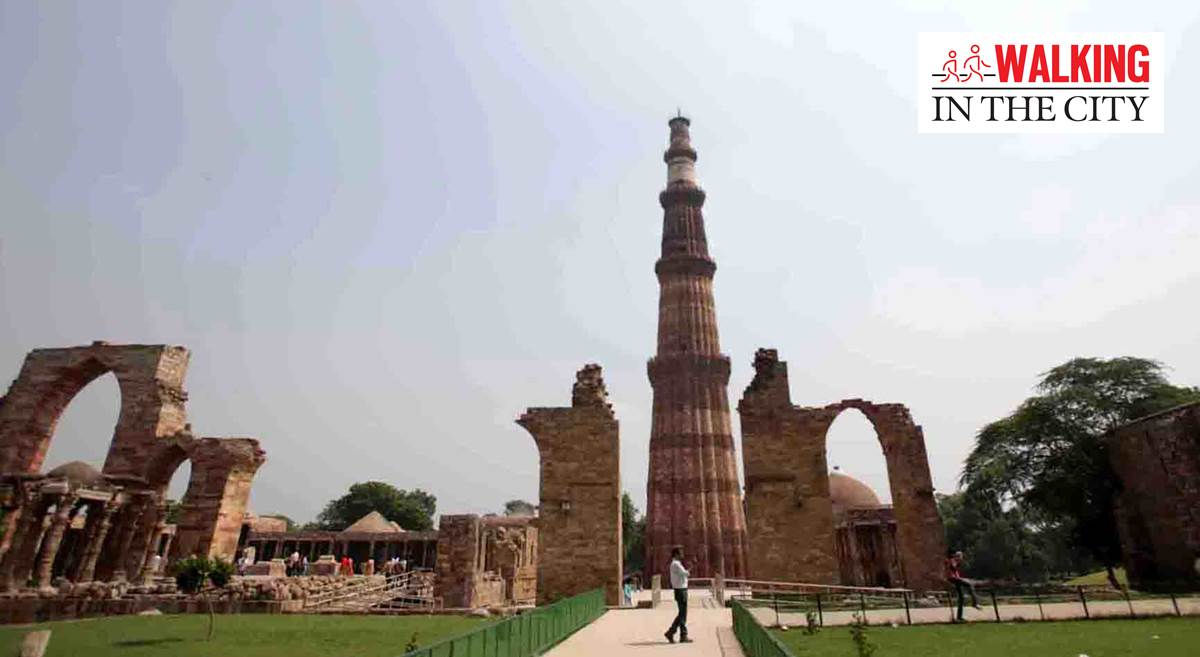 A landscape view of the Qutub Minar monument complex in Mehrauli, New Delhi. Express Photo
Liddle thinks the casual references to Sultanate and Mughal rule as ‘Islamic’ in the signage that dots the complex, is unfortunate. “What the ASI does, is that it mechanically reproduces what colonial historians wrote without any critical examination. So, if the Sultanate and the Mughals were Muslim rule, as they say, was British colonial rule Christian? And what about the current times we’re living in?” she says. “The identities of the new rulers of Delhi in the 13th century were complex, and their faith was just one element of it, and not necessarily one that determined their politics.”
Liddle thinks it unfortunate that visitors to the Qutub Complex are not informed of the other riches that lie in Mehrauli – the Mehrauli Archaeological Park and the Mehrauli Village. “They can easily open up the exit at the Qutub Minar into the park,” she says, “which is a beautiful place with many historic monuments, from parts of the original 11th century city wall to the 19th century additions by the British. All of this is set in a beautiful green park which has been a picnic spot for generations. Next to it is Mehrauli village, also steeped in history with several protected monuments.” Liddle feels that if these areas around the Qutub Complex were promoted, visitors could spend a whole day in Mehrauli. This would bring business to the local community, as these visitors would eat and shop as well. When it comes to tourism, governments think they have to do everything. But they don’t, they only have to make it easy for people to do things.
What stops our monuments, big and small, from being venues for events. Not big-ticket ones, with star performers, but for small groups? Many neighbourhood monuments used to be integral to the life of the community. Those living around them would use it as a meeting place, sit around, have their meetings or gossip sessions, either way, it was a good thing. Now there are guards who unnecessarily restrict even harmless activities. I think the major failure in tourism has been to not engage the community. They are in fact, the ones who have an immediate stake in this and if you can’t reinforce that and give them a voice, a sense of antipathy sets in. You can’t keep people out in the name of ‘maintenance’ and ‘beautification’, you have to work with people,” says Liddle.
Barely a kilometre-and-half away from the Qutub Minar is Gurdwara Shahidi Asthaan Baba Banda Singh Bahadur. We leave the Park and the calls of mynahs and babblers to walk through the narrow lanes of the village. As we make our way towards the gurdwara, the road marches forwards towards the dargah of Sufi mystic, Qutbuddin Bakhtiyar Kaki. One of the oldest dargahs in Delhi, it’s the venue for the annual Urs celebrations. But this isn’t why we come here.
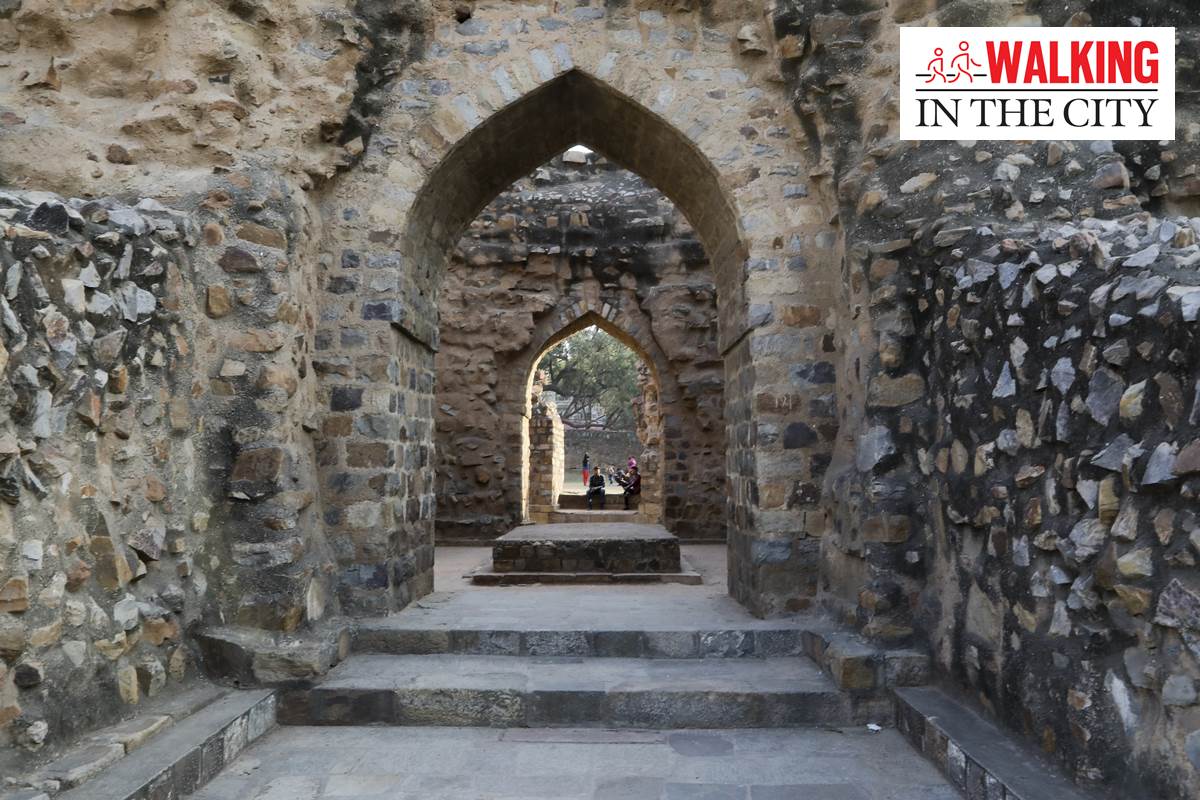 The tomb of Alauddin Khilji in the premise of Qutub Minar, New Delhi. File/Express photo by Abhinav Saha
Liddle can see recent changes. New prominence is being given to what is claimed to be the place of the martyrdom of Banda Singh Bahadur, a Sikh warrior of the early 18th century, who had put up an armed resistance against the Mughals, for which he was publicly executed in Mehrauli. Then in 1947, the village was the site of sectarian violence directed against the dargah. “In fact, Gandhi visited the dargah just days before his assassination, and made it one of the conditions of breaking his fast that the dargah would be handed back to its custodians. It was probably around this time that one part of a 16th century gateway was converted into a gurdwara. Over the last few years, I have seen that a narrative of 300 years of ‘martyrdom’ of Banda Bahadur has been developed, giving a sectarian form to what was essentially a political movement. That is the tenor of the new board that has been placed within the other part of the gateway. There is a conscious re-inscription of spaces, with an emphasis on conflict. Mehrauli’s history is one of conflict as well as reconciliation. We need to ask ourselves if the stories we tell through, whether through the signage at the Qutub Complex or the re-inscription of this gateway, we are not emphasising the conflict without giving space to the composite culture which is also very much a part of our layered past,” says Liddle.
 Share


