


Stay updated with the latest - Click here to follow us on Instagram

Journalism of Courage
 A 15-day drive, running from October 2 to October 17, aims to clean, beautify and eliminate another 300 to 400.
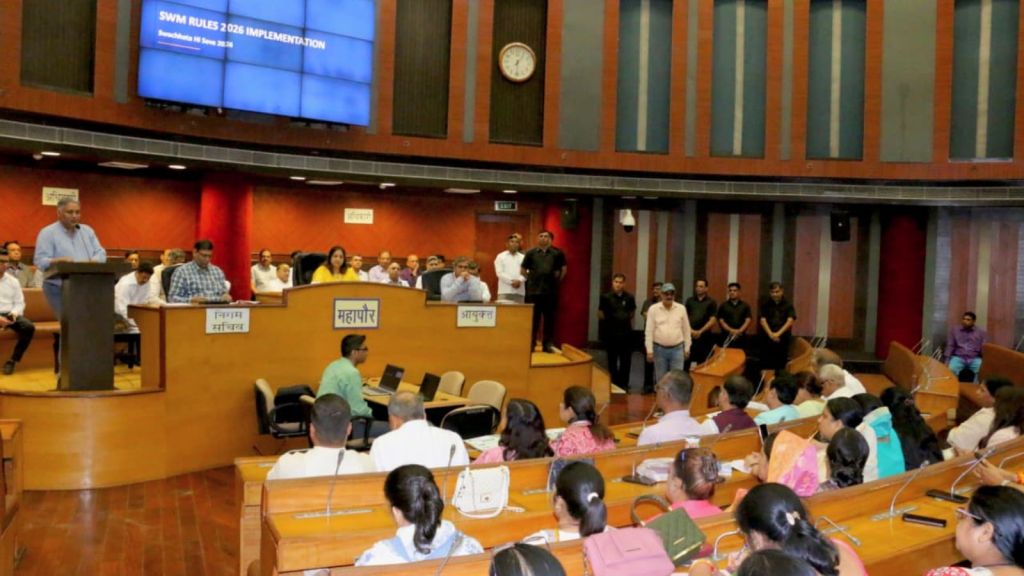
Ways to implement the Solid Waste Management (SWM) Rules, 2026, and calls for tighter monitoring dominated discussions at the Special Committee meeting held at the Municipal Corporation of Delhi (MCD) civic centre on Friday.
Chief Engineer Ajay Aggarwal presented the provisions of the SWM Rules, 2026, while several councillors flagged gaps in source-level waste segregation and disposal in their respective wards.
Waste management in focus
Delhi generates approximately 13,500 tonnes of waste daily, about 40% of which is wet waste. At present, however, MCD processes only 60% of it. To bridge the gap, the corporation is constructing five decentralised fresh waste processing plants with a total capacity of 6,000 tonnes. They are set to open by December or mid-January, which will prevent fresh waste from reaching landfills after January.
Aggarwal said MCD has identified 823 Garbage Vulnerable Points (GVPs) across the city and has already eliminated 230 of them. A 15-day drive, running from October 2 to October 17, aims to clean, beautify and eliminate another 300 to 400. In addition, tipper capacity will be increased from 1.75 to 2.25 cubic metres, raising the volume of waste collected by 30%. Fixed Compactor Transfer Stations (FCTS) are also being expanded, with the number in the South-Central zone rising from 17 to 50.
On legacy waste, Aggarwal claimed that around 200 to 220 lakh tonnes of the 280 lakh tonnes across Okhla, Bhalswa and Ghazipur have been cleared. He added that the Okhla and Bhalswa landfill sites are scheduled to be cleared completely within three months, while the Ghazipur landfill is set to be removed by December 2027.
Aggarwal further claimed that MCD is working to divert 1,500 tonnes of cattle waste generated along the Yamuna, in a bid to curb river pollution. MCD has also signed an agreement with the National Dairy Development Board (NDDB) for 600 tonnes of capacity across three plants, which will bring total dung-processing capacity to nearly 1,400 tonnes per day within the next year.
At the meeting, he also spoke about the MCD’s recent visit to Indore and said that the civic body is adopting elements from Indore’s 2016–17 sanitation model, focusing on 100% door-to-door collection, corporation-owned tippers, Material Recovery Facilities (MRF), and biomethanation plants
On four-way waste segregation at source, Aggarwal urged residents to segregate the waste in different bins before handing it over to the collectors.
Aggarwal further said that under Supreme Court orders and central guidelines, the civic body is establishing Reduce-Reuse-Recycle (RRR) centres in every ward, where citizens can donate clothes, shoes, utensils and books.
Councillors flag gaps
Councillors from different wards said that on-the-ground implementation of the SWM guidelines needs to be strengthened and that stricter penalties should be imposed.
Kalkaji Ward Councillor Yogita Singh questioned the feasibility of mandating four-way waste segregation, asking how many households in Delhi, and across India, realistically have enough space for four separate dustbins. She noted that while residents are willing to segregate wet waste, they strongly resist having waste-processing or composting points directly outside their homes because of the odour.
Subhash Mohalla Ward Councillor Manisha Ashish Punia pointed out that households may segregate waste, but segregation breaks down completely at the collection and transport stage, when all the waste is mixed together. She asserted that physical inspections of Bulk Waste Generators are necessary, and noted that, despite the massive volume of waste, her zone operates with only five to six tippers.
Rohini C Ward Councillor Dharamveer Sharma said that the penalty for open dumping should be raised from Rs 500 to Rs 10,000.
Meanwhile, AAP Leader of Opposition (LoP) in the MCD, Ankush Narang, alleged that the MCD House meeting was deliberately called on Friday to prevent AAP councillors from going to Jantar Mantar to protest against irregularities in the Election Commission’s Special Intensive Revision (SIR) process.
Stay updated with the latest - Click here to follow us on Instagram