The affidavit was placed before a bench comprising Chief Justice Ashwani Kumar Mishra and Justice Rohit Kapoor in a long-pending writ petition addressing the city’s unchecked subsoil extraction and environmental degradation.
The court had on September 22 cautioned that the Millennium City faces a progressively “grim” future unless aggressive remedial measures are taken to halt aquifer depletion and address the recurring paradox of monsoon waterlogging.
Urban water table under stress
According to the data submitted by Vidya Nand, Scientist and Head of Office at the CGWA’s North Western Region office, depth to water level (DTWL) observations across Gurugram Urban during the pre-monsoon seasons of 2025 and 2026 revealed widespread depletion and substantial spatial variation.
Depth to Water Level measures how far down from the ground surface one has to dig or drill before hitting underground water. A higher DTWL number means the water table has dropped deeper, signaling that local groundwater reserves are depleting and getting harder to reach.
Story continues below this ad
Across the urban limits of Gurugram, water levels ranged from 2.5 mbgl to 50.30 mbgl.
-Out of seven urban monitoring wells assessed by the agency, four recorded groundwater levels deeper than 20 mbgl. The deepest water level in the urban belt was recorded at Kherki Daula at 50.30 mbgl, the affidavit recorded.
-Six monitoring wells also recorded a fall in groundwater levels over the past year. The declines ranged from 0.08 metres to 2.34 metres, with the sharpest fall recorded at Baliawas. Only one monitoring station at the Cell Office recorded a rise of 1.34 metres.
The CGWA informed the court that the integrated findings demonstrate an overall decline in groundwater levels across urban Gurugram, punctuated by only localised pockets of recovery.
Wide variations across the district
Story continues below this ad
Across the wider Gurugram district, data collected by the Ground Water Cell, Haryana, and the Central Ground Water Board (CGWB) showed groundwater levels ranging from 1.0 mbgl to 50.3 mbgl during the pre-monsoon period in 2026.
In 2025, the range was 1.3 mbgl to 49.6 mbgl during the pre-monsoon period. The deepest level was observed at Tatarpur at 49.6 mbgl, while Kheri Daula recorded the district’s deepest point at 50.3 mbgl.
The data also showed sharp differences between individual locations.
The maximum annual water level rise was registered at Khawaspur, where levels improved by approximately 4.23 metres. Conversely, the steepest drop in the district occurred at Karola, where the water table plummeted by 5.41 metres.
The authority said the localised declines warranted continued regulatory monitoring and targeted artificial recharge measures. It also submitted that groundwater regulation within the state is statutory governed by the Haryana Water Resources Authority (HWRA).
High Court flags urban paradox
Story continues below this ad
The CGWA report was submitted in compliance with an order issued on August 19 by the High Court bench, which has been hearing a cluster of petitions originally filed in 2008 by Sunil Singh and joined by entities such as the Qutab Enclave Residents’ Welfare Association.
The litigation, active for nearly two decades, challenges rapid real estate expansion, including projects such as DLF Cyber City across Sectors 24, 25, and 25A, alleging construction proceeded without commensurate water supply networks, functional drainage, or requisite environmental checks, driving heavy reliance on unmetered private tubewells.
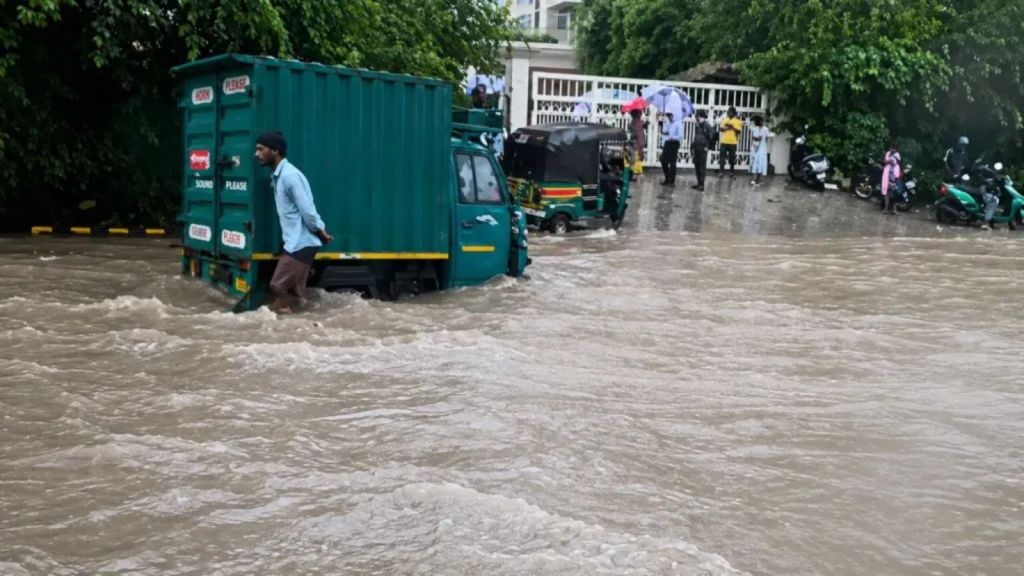
During the September 22 hearing, the bench had pointed out that Gurugram is caught in a stark urban contradiction: the city suffers from dwindling freshwater reserves and severe subsoil depletion, yet is paralysed every monsoon due to urban inundation because authorities fail to channel storm runoff into subsoil aquifers.
The judges had noted that natural water bodies have drastically diminished, sustaining channels remain blocked, and sewage treatment plants operate below capacity, failing to supply treated wastewater to ease freshwater demands.