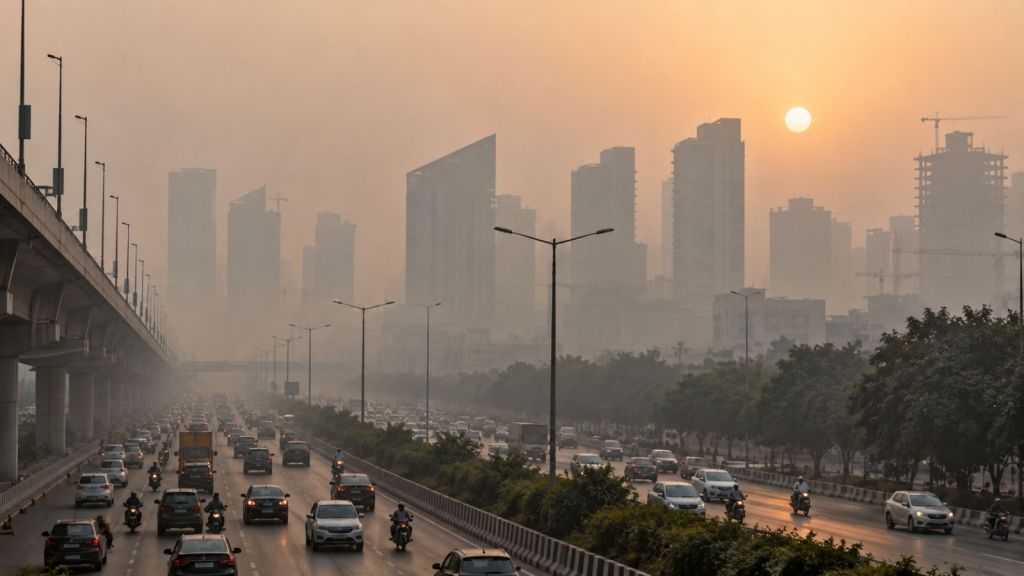
In a major push to check deteriorating air quality ahead of the winter onset, the administration in Gurugram on Tuesday announced a sweeping set of enforcement measures, including prohibiting the sale of fuel to end-of-life vehicles and those lacking valid emission certificates; live monitoring at over 1,000 sites; and constant sweeping across the roads in the Millennium City.
The decisions were taken during the 13th District Coordination Committee meeting and an inter-departmental review led by Municipal Corporation of Gurugram (MCG) Commissioner Pradeep Dahiya. The twin reviews set operational timelines for civic, transport, and environmental agencies ahead of the enforcement of the Commission for Air Quality Management’s (CAQM) Graded Response Action Plan (GRAP) to curb air pollution in the winter months across Delhi-NCR.

Fuel denial at retail pumps
In line with similar enforcement measures deployed in Delhi, the district administration has decided that vehicles without a valid Pollution Under Control (PUC) certificate, as well as those that have completed their statutory lifespan of 10 years for diesel vehicles and 15 years for petrol vehicles, will be denied fuel at pumps across Gurugram.
The Regional Transport Authority and the Food and Civil Supplies department have been tasked with issuing binding operational orders to fuel station operators. Fuel stations will also be brought under CCTV surveillance to track non-compliant vehicles.
Sensor grid for 1,054 emission sites
To curb fugitive dust and industrial emissions, the Haryana State Pollution Control Board (HSPCB) has placed 1,054 identified pollution-emitting sites measuring over 500 square metres, under direct electronic oversight.
Regional pollution officers confirmed that web cameras have been installed at 907 locations, while 534 sites have been equipped with low-cost air sensors tied directly to monitoring dashboards at the CAQM and HSPCB.
Failure to adhere to prescribed environmental benchmarks will lead to penalties, followed by complete work-stoppage orders for repeated infractions, said officials.
Story continues below this ad
Anticipating routine pollution watchdog bans on construction and demolition activities during peak smog episodes, Dhesi directed all engineering wings to finish ongoing road and civic infrastructure projects before seasonal curbs take effect.
Sweeping, monitoring network ramped up
The district-level restrictions will work in tandem with the MCG mitigation plan, which focuses heavily on dust suppression and corridor management.
The civic body has designated a 404.61-km road network for mechanised sweeping, currently deploying 24 sweeping machines that cover over 600 lane-kilometres each night between 9 pm and 7 am under GPS tracking. Dust abatement is supported by 40 water sprinklers alongside 10 truck-mounted and three tractor-mounted anti-smog guns.
Revamp of roads
Of the Municipal Corporation of Gurugram (MCG) total road network spanning 2,091 km, 611 km of road network has been identified as requiring redevelopment and improvement, while 1,480 km of road network is currently in good condition, according to officials.
Story continues below this ad
Against the civic body’s 2026 revamp target of 396 km, redevelopment work has been completed on 179.04 km, with 162 km of that stretch officially meeting the Commission for Air Quality Management’s (CAQM) environmental and quality benchmarks.
The civic body has accorded administrative approval to overhaul 376.72 km of roads to eliminate fugitive dust and align with CAQM quality benchmarks. Tenders have been floated for 371.2 km of the network, with work orders already awarded for 335.24 km to fast-track blacktopping, end-to-end paving, and dust-control measures before winter curbs take effect, officials said.
To address localised data blind spots, the civic body has also set a December deadline to expand Gurugram’s Continuous Ambient Air Quality Monitoring Stations (CAAQMS) from three to eight.
Concurrently, the rollout of Phase 2 of the Integrated Traffic Management System (ITMS) is underway, installing 2,722 cameras across 258 intersections, with nearly 1,400 featuring Automated Number Plate Recognition (ANPR), to penalise traffic violations and ease congestion across 31 mapped bottleneck hotspots.
Story continues below this ad
Alignment with Delhi’s winter strategy
The measures in Gurugram come as meteorologists project the usual seasonal drop in temperature, mixing height, and wind speed that traps emissions across the landlocked Indo-Gangetic Plain.
The measures announced by the administration in Gurgaon directly align with steps announced by the Delhi government over successive winters.
As reported by The Indian Express, the Capital’s multi-point Winter Action Plans have historically pivoted on tech-enabled enforcement: deploying drone surveillance across 13 chronic pollution hotspots such as Anand Vihar and Wazirpur, spraying bio-decomposer solutions over peripheral farmland to check stubble burning, and mobilizing round-the-clock patrol units against biomass burning.
Gurugram’s portal-based monitoring of plots over 500 square metres and vehicle age restrictions mirror Delhi’s mandatory dust-portal audit protocols and staged vehicular bans under GRAP stages III and IV.