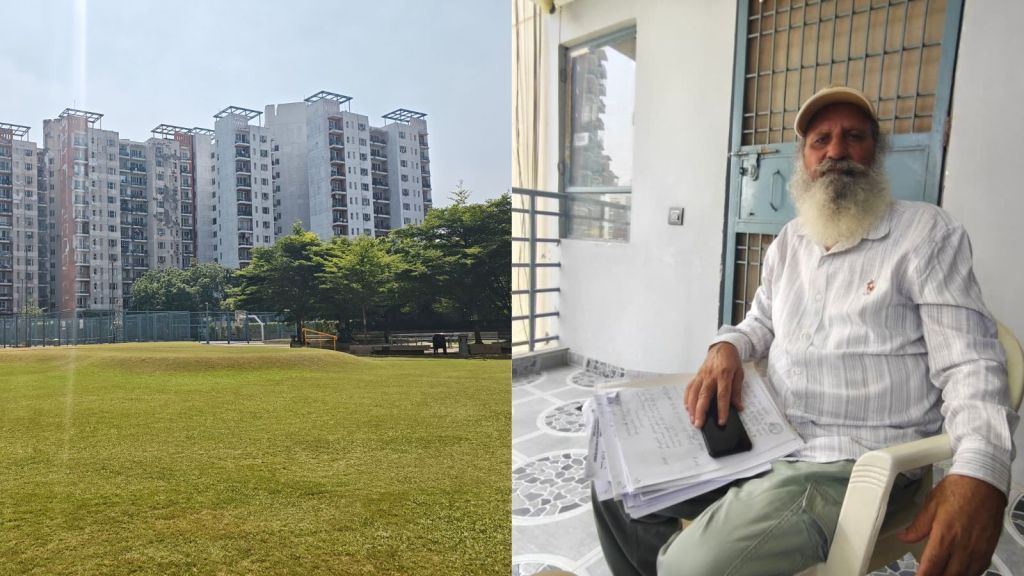
All Kashmir Singh wants is to be able to walk with his wife in the park of their Gurgaon housing society. But the 70-year-old, who lives in the EWS block of Mahindra Aura in Sector 110A, said restrictions imposed by the society have left them confined to their home.
“We have been locked inside our room for three days… Should we just die locked inside our room?” Singh wrote in a handwritten plea to the administration on August 31.
The friction had escalated last month after Singh was allegedly removed from a spot near a tower. Main tower residents reported the incident to authorities as “alleged trespassing”.
Singh’s complaint has since turned into a larger dispute between the rights of 141 EWS residents and 799 main-tower condominium residents on whether the society’s common spaces can be restricted on the basis of conveyance deeds and maintenance arrangements.
The main-tower residents said their conveyance deeds explicitly exclude EWS occupants from certain common areas and facilities. Singh and other EWS residents, on the other hand, said basic pedestrian movement and access to open spaces cannot be denied.
The District Registrar of Firms & Societies, Gurugram, has ruled in favour of the latter. Acting on the complaint filed by Singh and his wife, Meena Rani, 62, the Registrar on September 15 directed the Aura RWA to immediately lift all restrictions on EWS occupants.
 (left to right) RWA president SS Gill (centre) with other residents. The EWS flats are compact, 225-square-foot units originally allotted under state social housing mandates for about Rs 1.5 lakh. (Express Photo by Abhimanyu Hazarika)
A gated complex, two sets of rules
Story continues below this ad
The society has 799 condominiums, with units selling for upwards of Rs 2.5 crore. Owners pay approximately Rs 11,000 a month in Common Area Maintenance (CAM) charges.
Separate from the main towers is a block of 141 EWS flats — compact, 225-square-foot units originally allotted under state social housing mandates for about Rs 1.5 lakh.
The spatial separation between the two groups was formally codified about two years ago, when the RWA erected a seven-point signboard titled “Notice for EWS Residents / Proposed Owners / Tenants” on the ground floor of the EWS tower.
Citing Clauses 18 and 20 of the conveyance deeds, the notice explicitly declared that EWS occupants “have no rights to use or claim title to the common areas and facilities designated for the flat owners/residents of the AURA Group Housing Complex”.
Story continues below this ad
It further stipulated that EWS owners “do not hold membership rights in the RWA”, that “no power backup is provided by AURA RWA for EWS units”, and that car parking is “not an entitlement for EWS”.
The board concluded with a specific warning: “It has come to our attention that some EWS occupants are violating the above stipulations by accessing the Central Park and sports facilities, which are exclusively meant for flat owners of AURA Complex. The AURA RWA reserves the right to restrict access to these areas for any EWS resident/occupant found in violation.”
In its order, the District Registrar ruled that private conveyance agreements cannot extinguish basic human mobility: “While Clauses 18 and 20 restrict EWS owners from claiming proprietary ownership or commercial club/facility rights as outlined in the builder agreement, they do not and cannot legally empower an RWA to place a blanket prohibition on basic human mobility, ingress, egress, or safe pedestrian movement on internal paths/roads.”
Highlighting the situation of senior citizens, the Registrar observed: “Imposing restrictions that confine senior citizens with medical conditions (such as diabetes and vision ailments) to their apartments by barring them from walking on common pathways or sitting in open parks amounts to harassment and systemic discrimination.”
Story continues below this ad
The directive ordered the RWA to ensure unhindered movement on internal pathways and grant EWS residents access to open parks for “peaceful recreation, fresh air, and health maintenance”.
‘Not against the poor, but…’
Singh moved into the society in 2021 after decades of working on construction sites and as a driver in Delhi. Since 2012, he has served as a Radha Soami Satsang Beas preacher.
His wife is diabetic and suffers from retinal vision loss.
He insisted his complaint was driven by basic dignity rather than entitlement. “We are not against paying more maintenance. We don’t want to fight. They say they are God fearing but don’t consider us humans worthy of welfare?”
Story continues below this ad
Pointing to what he described as a double standard in daily access, Singh alleged: “Their maids can go (into the common areas) while we can’t.”
Residents in the towers, however, rejected claims of class bias.
S S Gill (65), RWA president and a former Border Security Force (BSF) officer who currently runs an aviation academy, and former RWA general secretary Advocate Rajesh Arora claimed they harbour no malice toward the underprivileged.
They said they come from humble backgrounds themselves and built their careers through hard work.
Story continues below this ad
“We are not against the poor, but the two (EWS and other residents) cannot be forced to mix through such orders,” Gill said, pointing out that gated enclaves function on strict financial contributions.
He highlighted operational costs including swimming pool maintenance of Rs 3,000 a day and the deployment of more than 80 private security personnel and cleaning staff. “They want all rights without paying,” he alleged.
Gill also contested the legal validity of the administrative directive: “The District Registrar is not a court of law or record.”
Regarding Singh’s willingness to pay maintenance fees, Gill added: “He may not be against maintenance, but what about others? As per policy, we can’t charge (them) beyond a cap.”
Story continues below this ad
Arora also argued that administrative officers cannot adjudicate on property deeds. “The EWS sale deeds make it clear they do not have access to our internal roads and parks. Rights in those were not sold to them,” Arora claimed.
He also highlighted “financial arrears”, claiming that against a nominal monthly charge of Rs 705, the EWS block has accumulated nearly Rs 7 lakh in unpaid maintenance dues.
Other elderly residents also questioned the order.
Col. Ved Prakash (75) noted that the community had functioned without dispute for years: “We’ve lived here peacefully for 8 years. These things were never demanded before…”
Rakesh Chadha (75), a retired senior audit officer, said: “The order was one-sided; they didn’t consider our views.”
Story continues below this ad
The recent dispute follows earlier regulatory intervention by the Department of Town and Country Planning (DTCP).
In June, the District Town Planner (Enforcement) issued a show-cause notice censuring the RWA for allegedly locking gates along the emergency fire tender path near the EWS tower and encroaching on bays legally designated as the mandatory 5% reserved parking for EWS units.
The RWA has sought that the District Registrar’s directions be kept in abeyance pending legal review. Administrative officials have warned of proceedings under the HRRS Act if access is obstructed.
“We had an RWA meeting on Sunday where we agreed to appeal the order and head to Chandigarh. We are in the process of collecting signatures of residents,” Gill said.
Singh, meanwhile, said he is not asking for much: he wants to walk with his wife in the park without needless strife.




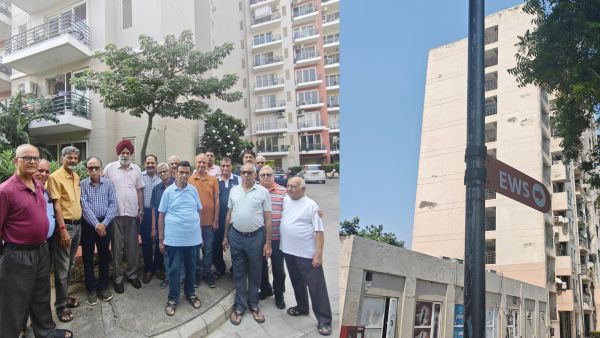 (left to right) RWA president SS Gill (centre) with other residents. The EWS flats are compact, 225-square-foot units originally allotted under state social housing mandates for about Rs 1.5 lakh. (Express Photo by Abhimanyu Hazarika)
