Journalism of Courage



 Union Minister for Petroleum and Natural Gas Hardeep Singh Puri (right) interacts with Indian Oil CEO Shrikant M Vaidya (left) during the flagging off of 1st Green Hydrogen Fuel Cell Bus, at India Gate, in New Delhi on Monday. (Express Photo By Amit Mehra)
 The country’s largest fuel retailer Indian Oil Corporation (IOC) Monday started the operational trial of green hydrogen-fuelled buses in Delhi and the nearby areas of the National Capital Region (NCR).
The trial, which was launched by Petroleum Minister Hardeep Singh Puri in the capital with two hydrogen fuel cell buses manufactured by Tata Motors, will include 15 buses by the end of the year.
As part of the trial, the buses will ply on a predetermined route of over 100 km in Delhi NCR and will clock a cumulative mileage of over 3 lakh kilometres for long-term performance and durability assessment. Initially, the two buses will ply without passengers, given that the standards for using the highly flammable hydrogen as an automotive fuel are still a work in progress.
 The buses are fitted with four cylinders with a cumulative capacity of 30 kilograms of hydrogen at 350 bar pressure. (Express photo by Amit Mehra)
In a few weeks, four more buses will be added to the trial as it enters its next phase, which should also see these buses ply with passengers on board.
The four buses are currently undergoing tests at the Automotive Research Association of India (ARAI) in Pune for that purpose, a senior IOC official said.
Hydrogen produced by splitting water in an electrolyser powered by renewable energy is called green hydrogen, and it is considered totally clean as it has no carbon emissions in its entire value chain. The green hydrogen being used for the trial is being produced at IOC’s green hydrogen demonstration plant at the company’s research and development facility in Faridabad.
The buses are fitted with four cylinders with a cumulative capacity of 30 kilograms of hydrogen at 350 bar pressure, providing a total estimated range of over 350 km for a full refill, which comes out to around 12 km per kg. This is considerably higher than the fuel economy of around 3 km per litre for diesel-powered buses. According to IOC officials, it takes 10-12 minutes to fully refill one bus with 30 kg of hydrogen.
In a hydrogen-powered fuel cell automobile, hydrogen reacts with oxygen in the fuel cells, releasing electrical energy to power the automobile, and water as the byproduct. Fuel cells are considered highly efficient as compared to conventional internal combustion (IC) engines. The electrical efficiency of fuel cells is 55-60 per cent as compared to thermal efficiency of around 25 per cent for IC engines.
Fuel cell vehicles more efficient than battery-powered EVs: IOC
Fuel cell vehicles are also considered superior to regular battery-powered electric vehicles.
“Fuel cells are highly efficient as compared to other mobility options. Fuel cell vehicles have inherent advantages of long range and lower refuelling time as compared to battery vehicles,” the IOC said.
Speaking at the launch of the trial, Puri termed green hydrogen-powered fuel cell automobiles as “game-changing technology” in mobility, adding that the trial marks the beginning of a journey that is likely to “ultimately culminate in green mobility”.
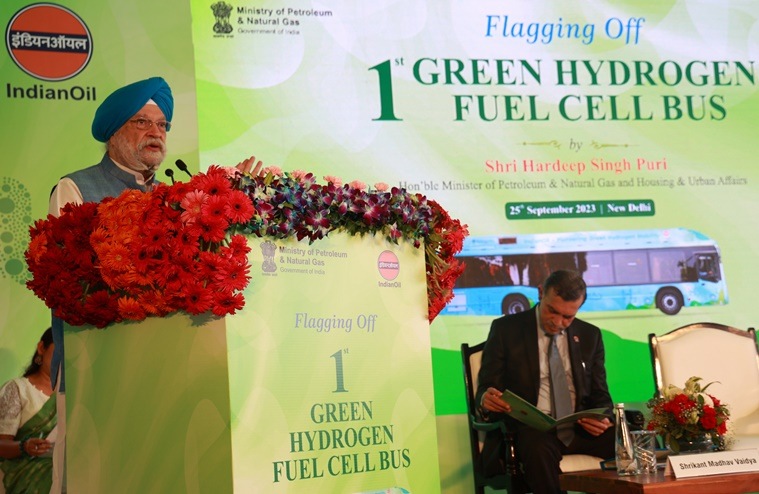 Puri said that the global demand for hydrogen is expected to increase by four to seven times to 500-800 million tonnes per annum (mtpa) by 2050. (Express Photo By Amit Mehra)
It may be noted that India sees itself as a potential green hydrogen production and export hub, and the government even launched the National Green Hydrogen Mission in January with an initial outlay of around Rs 20,000 crore to give a fillip to the sector. Various Indian energy companies, from the public sector as well as the private sector, have announced plans to foray into the green hydrogen ecosystem.
“The success of this project can catapult India from being net importer of fossil energy to becoming net exporter of clean hydrogen energy; provide global leadership to other countries in terms of technology transfer while becoming a large green hydrogen producer and supplier of manufacturing parts,” Puri said.
Future fuels like green hydrogen, if successful, will also help India reduce its dependence on oil and gas imports. India is the world’s third-largest consumer of crude oil and depends on imports to meet over 85 per cent of its requirements.
In the case of natural gas, the country depends on imports to meet about half its requirements. Apart from looking to be a leader in green hydrogen, the country is also pushing for higher use of biofuels and increased adoption of electric mobility to meet its climate goals while reducing fossil fuel import dependency.
The minister added that the global demand for hydrogen is expected to increase by four to seven times to 500-800 million tonnes per annum (mtpa) by 2050, while the domestic demand is expected to jump to 25-28 mtpa from the current 6 mtpa.
Green hydrogen, which is at a nascent stage globally, has a number of challenges as well; the foremost being the prohibitive cost of production, followed by challenges of storage and transportation at scale to make it viable for use as an automotive fuel.
According to industry estimates, the capital expenditure for setting up an electrolyser currently costs around $1,200 per kilowatt capacity. IOC’s demonstration plant at Faridabad produces green hydrogen at a cost of around Rs 1,000 per kg, according to company officials.
Even at a sizeable scale, the cost of green hydrogen production would be close to Rs 400 per kg, which is also quite high compared to conventional fuels like diesel and petrol. With more innovation in technology and processes and scaling up of green hydrogen production, the costs are likely to come down, but that is likely to take a few years provided there is considerable push from governments and the industry.

 6 min read