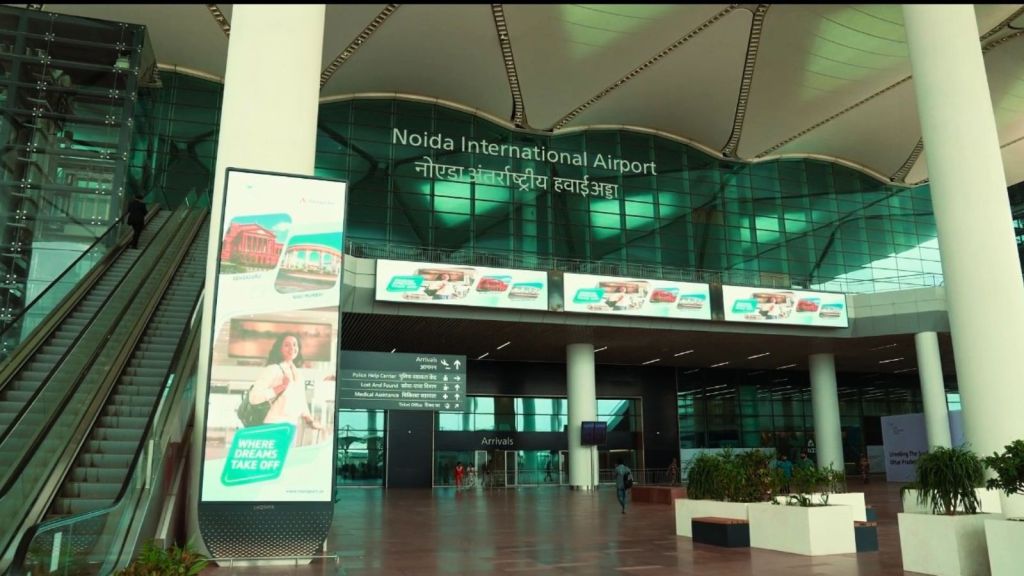
As Noida International Airport in Jewar begins handling passenger and cargo traffic, a separate road network is in the works for trucks carrying goods to the airport — a move aimed at keeping freight vehicles off roads used by passengers.
The Greater Noida Industrial Development Authority (GNIDA) is now considering changes to its Master Plan 2041 to prepare for that traffic — including a new link to the Ganga Expressway and a separate elevated route to move freight between a proposed logistics hub and the airport.
Sources said a presentation on the proposed changes was recently made before Industrial Development Minister Nand Gopal Gupta Nandi in Lucknow. A notification is likely soon after the proposals are reviewed and approved.
At the centre of the proposal is a 105-metre-wide road that will connect to the Hapur bypass. GNIDA also plans to extend this connectivity by about 15 km to link the area with the Ganga Expressway.
GNIDA officials said this would reduce the distance between Noida-Greater Noida and the Ganga Expressway to around 30 to 45 minutes.
Six-lane elevated road for freight movement
The authority has also proposed a six-lane elevated road connecting the Multi-Modal Logistics Hub (MMLH) to Jewar airport’s cargo terminal.
The proposed road is planned parallel to the Western Dedicated Freight Corridor. The aim is to allow goods to move between the logistics hub and airport without relying on roads carrying passenger and general traffic.
Story continues below this ad
Why are separate freight and passenger routes needed?
Officials said two major projects are planned in Greater Noida — the 849-acre Multi-Modal Logistics Hub (MMLH), which will function as a dry port, and the 360-acre Multi-Modal Transport Hub (MMTH) near Boraki Railway Station.
The logistics hub is focused on freight, with links to major roads and dedicated freight corridors. The transport hub is focused on passengers, bringing together interstate and local bus services and connections with rail, road and MRTS.
Both are expected to increase movement into and out of the city, particularly as Greater Noida develops further as an industrial and logistics centre.
The idea is that freight and passenger traffic would increasingly have dedicated infrastructure rather than competing for the same road space.
Story continues below this ad
The region already has links to major transport corridors including the Yamuna Expressway, Eastern Peripheral Expressway and Dedicated Freight Corridors. The proposed Ganga Expressway connection would add another regional link.
Sources said the aim is to distribute the expected increase in traffic — particularly commercial vehicles — more efficiently, so that growing freight movement does not add to congestion on roads used by passengers.
Maulshree Seth is an Assistant Editor with The Indian Express, based in Lucknow. With over 15 years of experience in mainstream journalism, she has built a formidable reputation for her on-ground reporting across Uttar Pradesh. Her expertise spans a wide array of critical beats, including state politics, governance, the judiciary, and rural development.
Authoritativeness Maulshree’s work is characterized by depth and historical context. Her coverage of high-stakes state elections and landmark judicial rulings has established her as an authoritative voice on the intersection of law and politics in Northern India. She is frequently recognized for her ability to gain access to primary sources and for her nuanced understanding of the socio-economic factors that drive the world's most populous sub-national entity.
Trustworthiness & Ethical Journalism Her reporting is rooted in rigorous fact-checking and a steadfast dedication to neutral, unbiased storytelling. By prioritizing field-based verification—often traveling to the most remote corners of the state—she ensures that her readers receive a truthful and comprehensive view of events. ... Read More