


Stay updated with the latest - Click here to follow us on Instagram
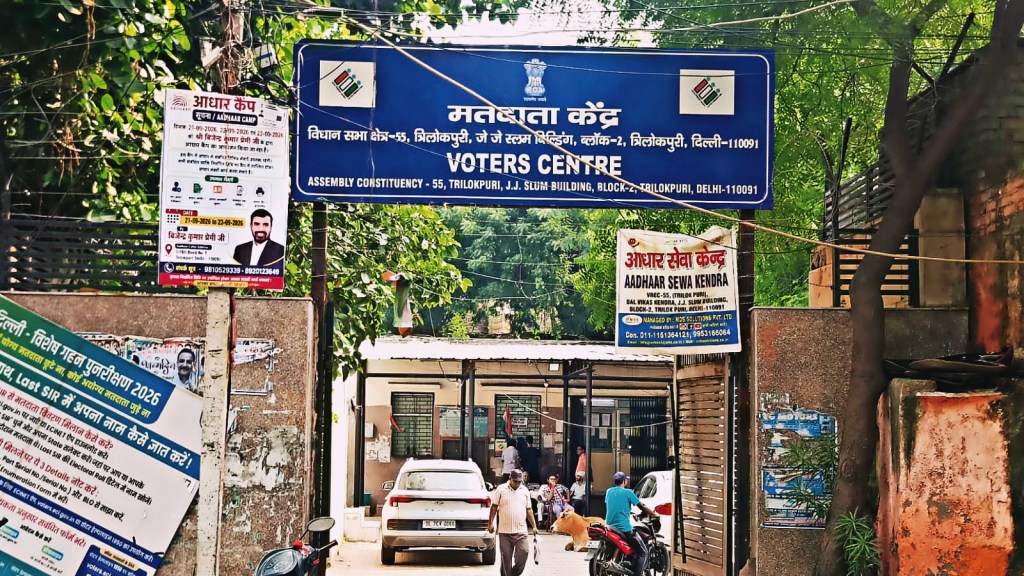 The SIR camp at Trilokpuri. (Credit: Devansh Mittal)
Meera Mittal (73) had prepared herself mentally for the three-km journey from her home in Mayur Vihar to the office of the Electoral Registration Officer (ERO) for the verification hearing under the Special Intensive Revision (SIR) of electoral rolls in Delhi.
Mittal suffers from diabetes and has undergone treatment for her tailbone, and finds e-rickshaw rides on the city’s bumpy roads excruciatingly painful.
But when she reached the Voter Registration Centre in East Delhi’s Trilokpuri, she was faced with a challenge she had not anticipated: stairs with no handrails.
“There is no ramp and it seems impossible for me to climb these stairs. I don’t know how I will go up when my turn comes,” Mittal told The Indian Express on Wednesday.
Mittal, a veteran social worker, is among lakhs of Delhiites who have been queueing up at government offices across the national capital after they got notices to prove their eligibility to remain on the electoral rolls.
Delhi had 1.45 crore electors before the SIR began – of them, 97.5 lakh made their way to the draft roll published on August 31.
Around 47.5 lakh electors were marked “uncollectible” – because Booth Level Officers (BLOs) found them to be absent, moved, dead, have duplicate entries, or due to other reasons – and struck off the rolls.
One-third, or around 33.1 lakh electors, on the draft roll have since received notices to prove their eligibility to stay on the electoral roll. While 13.79 lakh electors got notices because they could not link themselves to the electoral roll of the last intensive revision, 19.33 lakh were picked out for “logical discrepancies” in their enumeration forms.
The Voter Registration Centre in Trilokpuri is the hub where hearings are being held. The final electoral roll will be published on November 4. While BLOs have been told to facilitate hearings for senior citizens, Mittal said no one told her the process could have been completed at her home.
Same for 65-year-old Babu Lal, who is blind. “No one told us these documents could be submitted online, or that the BLO could have taken these at our home,” 36-year-old Manoj Bairwa, Babu Lal’s son, said.
At the centre, three officials sat in separate rooms, and civil defence volunteers called out the names of electors. Most people were able to attend their hearing in their designated two-and-a-half-hour slot.
Trilokpuri Assembly seat had 1.89 lakh electors before the SIR, out of which 1.26 lakh or nearly 67% found their way to the draft electoral roll. Around one-third of those on the draft rolls got notices.
Sixty-year old Shubha Mitra said she had to shut her flower shop to attend the hearing. “I had heard there might be some kind of action or investigation if our names were deleted from the list. So I could not risk not coming,” Mitra said. She said she had got a notice because the age difference between her and her mother had been flagged as being less than 15 years.
Mitra’s mother Amita Mitra said: “They are saying that the LIC policy that we got (as documentary proof) will not work, we will have to get my mother’s original documents at a camp which will be organised on Sunday.”
Several electors claimed they were not informed what documents to bring along. So 36-year-old Devi Barman had brought all the documents that she could find: Aadhaar, PAN, bank passbook, marksheet, birth certificate. “I can’t keep coming again and again. So I brought along everything,” Barman said.
Some said they had been flagged for reasons beyond their control. Among them were the daughters of 57-year-old Lily Ojha, who got notices because they are twins, and hence the age gap between them is less than nine months. This was supposed to be a “logical discrepancy”, and Ojha said she had “shouted at” the officials.
In minor anomalies such as this, a letter from the BLO can be uploaded to resolve the issue.
Anoop Kumar Sharma (44) said he was flagged because his parents have six children. “But only two out of the six have filled the SIR form. The others don’t care. So I have come to meet these people who are claiming to be my brothers and sisters and filing SIR forms,” Sharma said.
As the people waited for their turn, a cow wandered inside the compound and sat down lazily. After some time, a dog walked into the centre. Partly in amusement and partly in frustration, some people wondered whether the animals too had been issued notices.
Stay updated with the latest - Click here to follow us on Instagram