Long lines, tight security: Delhi University votes in shadow of tragedy that took 5 lives

Voting for the Delhi University Students' Union polls kicked off on Friday, 12 days after the Satya Niketan hostel collapse.

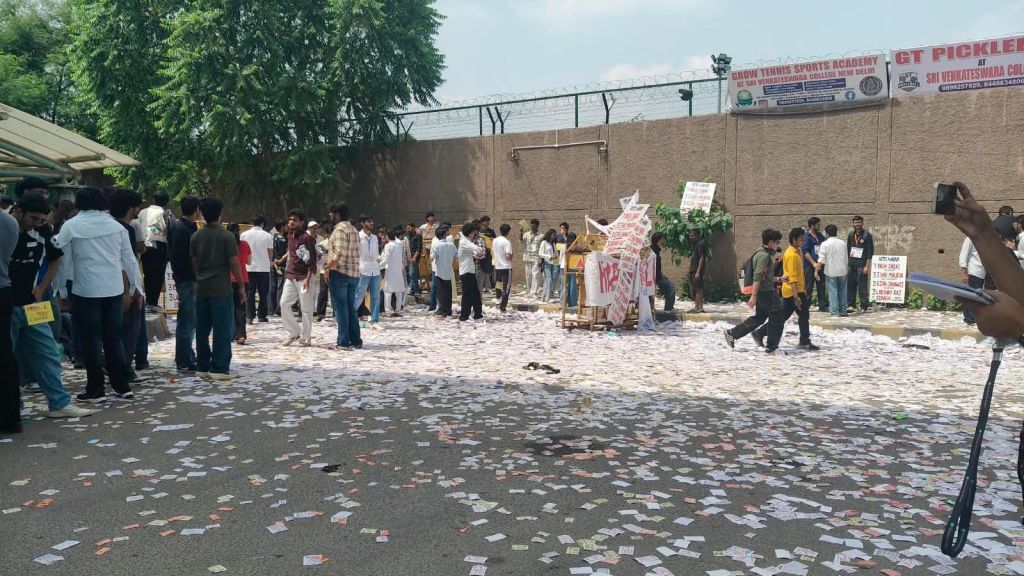
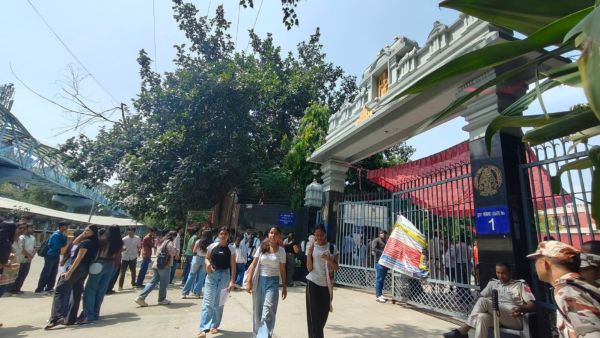
Outside Sri Venkateswara College in South Campus during the DUSU polls. (Express Photo by Sophiya Mathew)Outside Sri Venkateswara College in South Campus. (Express Photo by Sophiya Mathew)

For days after a private hostel in Satya Niketan collapsed on September 6, killing seven people, including five Delhi University students, student groups from across the spectrum had protested near the Durgabai Deshmukh South Campus Metro Station close by.

Twelve days later, on Friday, while voting was underway for Delhi University Students’ Union (DUSU) polls, the same area was carpeted with thousands of colourful voting slips.

The election is taking place in the shadow of the tragedy at Satya Niketa — a hub of private student accommodation for students of DU’s South Campus colleges — and student housing and safety were common themes across manifestos. However, the last few days leading to Friday’s voting saw old patterns of money and muscle power re-emerging.

Scenes from North Campus

By 8.30 am, when voting began, security had been increased in North Campus.

Heavy barricades were put up at several points along the route to the Arts Faculty to restrict the entry of outsiders.

While party supporters were barred from entering the campus, SUVs and groups of supporters of key candidates from the National Students’ Union of India (NSUI) and the Akhil Bharatiya Vidyarthi Parishad (ABVP) were visible in the morning hours.

By 10.30 am, even as a sizeable crowd of student voters was yet to show up, party supporters were seen moving around, urging students to vote for particular candidates.

Story continues below this ad

There were minor arguments as supporters gathered near the entry points, with police personnel asking them not to stand close to the barricades and to move away from the entry area.

Vrinda Singh, a second-year law student at Campus Law Centre in North Campus, was waiting outside for her friends before casting her vote.

“The key issues were college-specific. Student housing wasn’t discussed predominantly here… Candidates were mainly addressing infrastructure-related issues… maybe because the issues affecting us here are different from South campus,” she said.

She said she had actively participated in the student protests at Jantar Mantar in July, which culminated in the resignation of then Education Minister Dharmendra Pradhan. She believed that since then, student participation and interest in politics had subtly changed but not enough to have a significant impact on the outcome of the DUSU elections.

Story continues below this ad
Outside Sri Venkateswara College in South Campus. (Express Photo by Sophiya Mathew) Outside Sri Venkateswara College in South Campus. (Express Photo by Sophiya Mathew)

Anmol, an NSUI worker whose friend Neeraj Bawa was seriously injured in the Satya Niketan building collapse, said the presence of independent candidates had made the contest more closely fought.

“Had it been only NSUI and ABVP, without any independent candidates, the chances would have been better. This time, it seems to be a tight contest because the NSUI vote could be split, with some of it going to Deepanshu Shokeen (independent), who was denied a party ticket. He has a strong support base, including many people who would have rather supported the NSUI,” he said.

He added that despite the Satya Niketan tragedy, he did not think raising the issue of student housing would have been a key turning point in the election.

Preparations on the ground

Around 960 EVMs have been deployed, with 40 kept in reserve to tackle the situation of technical glitch if any occurs, Chief Electoral Officer Prof Raj Kishore Sharma said. The DU Chief Electoral Office has also provided EVM machines to colleges for college-level elections happening parallelly with the DUSU polls.

Story continues below this ad

This is the first time EVMs are in use in almost all colleges, with the exception of a few due to technical reasons. Previously, most DU colleges had been using ballot papers for college-level student union elections.

At South Campus, by noon, students at Sri Venkateswara College had queued up in long lines reaching up to the metro station, to cast their vote.

Speaking with The Indian Express, college Principal Prof Vajala Ravi said, “… this time, arrangements have been very well regulated compared to previous years. All 215 teaching staff, 150 non-teaching staff, and about 50-60 contractual staff, including the security, have been deployed on election duty.”

The college has three gates, and only one gate was opened to regulate student traffic and ensure smooth oversight.

Story continues below this ad

College vice-principal, Prof Nandita Narainasamy, said the college has the highest number of PwD students (Persons with Disabilities) at 79. She said special arrangements have been made, with booths set up at the ground floor, for them.

Meanwhile, Ravi said polling booths had been set up in the same building across four blocks, with students divided so that each booth had a roughly equal number of voters. “We have 20 courses, and each booth may have five or eight courses to ensure an equal division of students,” he said.

Speaking with The Indian Express, Ramjas College Principal Ajay Arora said, “Polling was very slow initially, but after 11.30 am, mainly in the last half an hour it (student turnout) picked up well. Out of 5,973 students, 2,578 students have cast votes for both college and DUSU elections together. This is aexpected participation.. roughly at 43 per cent.”

By late afternoon, celebrations had broken out in front of a few campuses as college-level election counting had taken place. At Bhaskaracharya College, the Students’ Federation of India (SFI) nominee won the presidential position.

Sophiya Mathew is a Correspondent at The Indian Express, based in New Delhi. She joined the Delhi bureau in 2024, and has specialization in Integrated Multimedia Journalism from the Asian College of Journalism (ACJ), Chennai. Professional Background Core Beats: Her reporting is primarily focused on the Environment and Education. Specialization: She has gained recognition for her ground-level reporting on the Yamuna floodplains and the socio-economic challenges faced by those living on its banks. She also focuses on the disparities in Delhi's education system, ranging from elite private schools to government institutions and refugee education. Recent Notable Articles (December 2025) Her recent work has been heavily centered on Delhi's severe winter pollution crisis and the government's regulatory responses: 1. The Air Pollution Crisis "A tale of two cities: Delhi govt schools choke in bad air, private classrooms set up air filters" (Dec 20, 2025): A high-impact feature contrasting the "Clean Air Bubbles" in elite schools with the reality of government school students who are exposed to an equivalent of 17 cigarettes a day due to outdoor exposure. "Delhi sees season's worst air day, second worst December AQI in nearly a decade" (Dec 15, 2025): An analytical report on the meteorological patterns trapping pollutants in the NCR. "Delhi bans non-BS VI vehicles from outside: Why curbing vehicular pollution is key" (Dec 17, 2025): Explaining the science behind targeting specific vehicle vintages to lower particulate matter. 2. Enforcement & Regulations "No fuel at pumps in Delhi without valid PUC certificate from December 18" (Dec 17, 2025): Breaking the news on the environment ministry's strict "No PUC, No Fuel" policy. 3. Education Policy "Law to regulate school fee in Delhi risks becoming procedural, say parents" (Dec 13, 2025): Investigating the loopholes in the new Delhi School Education (Transparency in Fixation and Regulation of Fees) Bill, 2025. "Monsoon Session: Private school fee regulation Bill cleared after four-hour debate" (Aug 9, 2025): Covering the legislative passage of the controversial fee hike regulation. Signature Style Sophiya is known for her observational depth. Her reporting often includes vivid details from school corridors, hospital waitlists, or the banks of the Yamuna to illustrate how policy failures affect the city's most vulnerable residents. She is a frequent expert guest on the 3 Things podcast, where she explains the complexities of Delhi’s environmental laws. X (Twitter): @SophiyaMathew1 ... Read More

Stay updated with the latest - Click here to follow us on Instagram

Advertisement
Loading Recommendations...
Advertisement
Advertisement
Latest Comment
Post Comment
Read Comments