


Journalism of Courage



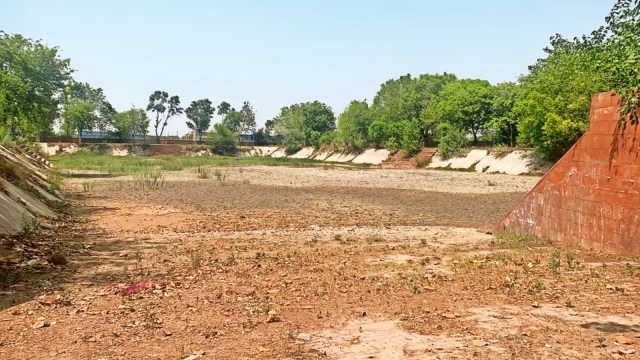 A dried up pond in Mungeshpur. (Himanshu Harsh)
It is 12 in the afternoon and not a single person is to be seen on the streets in Mungeshpur. The lanes are deserted, ponds have dried up, fields are empty. A lone peacock can be spotted inside an abandoned building. It could well be a scene from a ghost town, or a film depicting a post-apocalyptic era.
Hitherto a largely unknown Northwest Delhi village, a reading of 52.9 degrees Celsius catapulted Mungeshpur into spotlight on Wednesday. The IMD attributed the reading to either an error or local factors. On Thursday, officials said the final report was awaited.
The unprecedented heat has only added to the woes of the residents already reeling under water shortage; an electricity cut Wednesday night further added to their misery.
“There has not been a single drop of water supply for a week now,” says Jay Bhagwan, sitting inside his home in a dingy lane.
For those living along the main street, the situation is no better.
Sunita Singh, 53, tells The Indian Express: “Ever since they started drilling work for the PNG pipeline a week ago, the water supply has been affected badly.” Adds her neighbour Rishi Kumar, 55, “The water comes for around 2 hours but there is no pressure.”
Residents say whatever little supply they get, is “sucked up” by water motors installed in a few homes.
Ravinder Kumar, a Delhi Police official, says: “For a month now, the water supply has been cut down to only 20-30 minutes from 2-2.5 hours.”
For people living further down the road, the situation is much worse. “We got water supply for the first time today after two weeks,” says Ujjwal Jhanjar, 20.
Jeet Kaur, another resident, says the village went out of power the previous night after the electricity transformer blew up at 11pm due to the heat. “Patta bhi nahi hil raha tha, paseene mein bhige bhige raat guzri (Not even a leaf shook, we spent the night drenched in sweat),” she shares.
The power was restored at 11am the next day.
Explaining the disparity in water supply, the 55-year-old says there are two pipelines in the area of which only the latter, the new one, is getting the water in limited quantity. “The streets which have the old pipeline have been receiving no water for 10-15 days,” she adds.
The water scarcity has hit the cattle as well. “Cows and buffaloes need much more water than the average person, but since there’s not enough supply, they have been falling ill frequently,” says Kaur.
The water shortage has forced Anita Devi, an MCD employee, to skip work. “Five-six hours of commute in this weather without any proper water supply at home is too much to handle,” says Devi, whose office is in Dwarka.
Most of the villagers in Mungeshpur rely on agriculture and animal husbandry. Vikas Rana, a social worker, tells The Indian Express: “Generally, jowar (sorghum) and dhaan (rice) should have been sown by now, but since there’s no water for irrigation, all the fields have been lying empty.”
Only last week, Rana’s six-month-old son Harsh was admitted to a private hospital situated 12 kms away after being diagnosed with low water level (dehydration).
Rana is upset that despite being in the news, Mungeshpur has not been visited by “a single bureaucrat or political leader” yet. “Most of the lakes and ponds have either dried up or are on the verge of it… this has never happened before…” he adds.
Neksi Lal Ram Vilas, 52, owner of two sweets shops, says: “I have to buy 15-20 water cans everyday to prepare sweets.”



 4 min read


