An hour before midnight on October 1, 60 women walked through the quiet streets of Delhi’s Vasant Kunj, talking, laughing and occasionally breaking into song. Dressed in jeans, kurtas and sneakers, they moved through the neighbourhood, their footsteps and conversations carrying through the pools of streetlight.
The walk was organised by Women Walk at Midnight, a decade-old initiative that was inspired by the movement that followed the 2012 gangrape case. For those behind the Delhi chapter, the exercise is meant to make women being out late visible, familiar and, eventually, unremarkable.
It also came on the heels of several protests following the alleged gangrape of a 17-year-old at Aastha Kunj Park. In marches at Delhi University, students had spoken about the fear of walking home alone and the need to find someone to travel with them.
“We’ve seen Nirbhaya, Unnao, RG Kar, and now this current wave of protests hitting the city. Every time, it feels like we take one step forward and a thousand steps backward,” said Mallika Taneja, a long-time organiser. “Why are we still having to ask if a woman can just walk alone?”
Last week’s walk was at Aastha Kunj Park. Mansi, a clinical psychologist, said, “So many people had turned up in solidarity, maybe because of the protests across the city… There was heavy police deployment, it felt oddly funny.”
 It was organised by Women Walk at Midnight, an initiative launched in 2016. (Express Photo by Sophiya Mathew)
Walking for change
On Thursday, the walk started at 9.30 pm, at Vasant Arcade. The group moved through Pocket 2 and Sector C, passing the Vasant Kunj North police station before taking the main road towards C-9 Market.
At the market, the women stopped outside shuttered shops, spread long sheets of paper across the pavement and began drawing under the light of camping lamps and phone screens. A participant held up a handwritten placard that read “If Day can be ours, Night is too”.
Story continues below this ad
Others drew phrases such as “Reclaim the Night”, “Equal Rights!”, and “Raat ke Dai Bhaje…”. Some coloured and doodled trees, eyes, women, flowers, and kites.
Drishti, a performer, theatre artist and dancer who started the Faridabad chapter of the walk in 2023, said being outside at night was once something that required convincing at home. “I had to pack for the next day, lie a little at home,” she recalled.
There were questions about why she could not walk during the day: “Din mein nahi chal sakte? Raat ko kyun chalna hai? (why can’t you walk during the day, why walk at night).”
At one point, she said, she was allowed to go but only for half an hour.
Story continues below this ad
Her own relationship with the night has since changed. “It started… as a desire, a thrill to be out at night as I wasn’t allowed to by my parents,” she said. “But over time… there’s so much ease that I find in it. I am a night person.”
She remembered one walk, when her mother called as she boarded the Metro around 9 pm. Instead of asking when she would return, her mother simply said: “Okay beta, have fun.”
“I realised that it takes doing it again and again and again and again to get to that point,” Drishti said. “The city also gets used to seeing women go out.”
Mallika went on her first night walk under the banner in December 2016. “I thought to myself… ‘Akele chalna hai (I want to walk alone)’,’” she recalled.
Story continues below this ad
Ten years on, she said, women walking at 11 pm, midnight or 1 am are drawing less surprise. “During the walks, people come and join us, there is curiosity. This is the change,” she said.
For Vasundhara, a Delhi University student, the walk was about women having the freedom to take up space, both in public places and in society. “Women are everywhere, but when it comes to positions of power, our presence is often just a token,” she said. “We are rarely given the space to truly represent ourselves.”
At C-9 Market, the women spread long sheets of paper across the pavement and began drawing. (Express Photo by Sophiya Mathew)
The Delhi Police accompanied the group after organisers sought their cooperation, with uniformed personnel and police vehicles ahead of and alongside the walkers.
The organisers had also set out simple rules for participants: walk at a comfortable pace, pause when needed, travel together in carpools, and respect the people and spaces encountered along the way. Participants who did not want to be photographed could use masks or dupattas, and live locations were not to be shared with people outside the registered group.
Story continues below this ad
Along the way, Drishti, carrying a small speaker, played classic Hindi film songs. Within seconds, women around her joined in: “… yeh kaisa abhinay, na jaanu main, na jaane woh…”
Their voices rose above the low hum of traffic and the distant barking of street dogs. A few paces ahead, they began singing to another song.
The act of walking, for Mallika, is also about reclaiming enjoyment from the language of fear and restriction. “Isn’t this just joyous and wonderful? Isn’t this a completely different way of occupying space, the city?” she said. “A different way of resisting and protesting?”
“We have to think about what we want, and we have to demand more,” she said. “Sometimes by sloganeering, and sometimes by sitting out at midnight, drawing, walking, and singing.”
As the walk ended, the question of safety surfaced.
Story continues below this ad
Manjusha, a first-time participant, asked, “Is anyone going towards Delhi Cantonment? How do you get home from here?”
Around her, women began figuring out who was headed that way, so they could travel together.


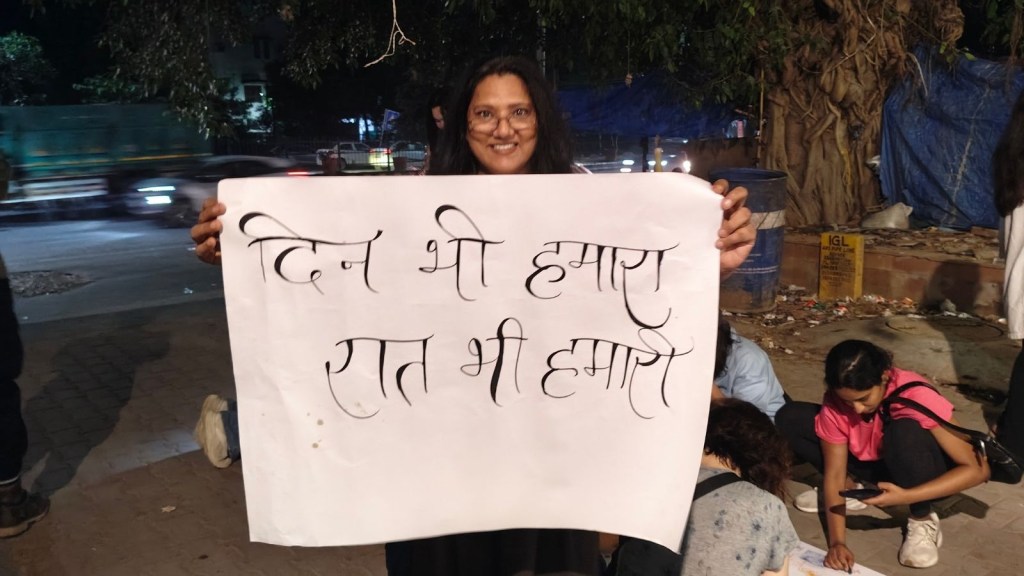


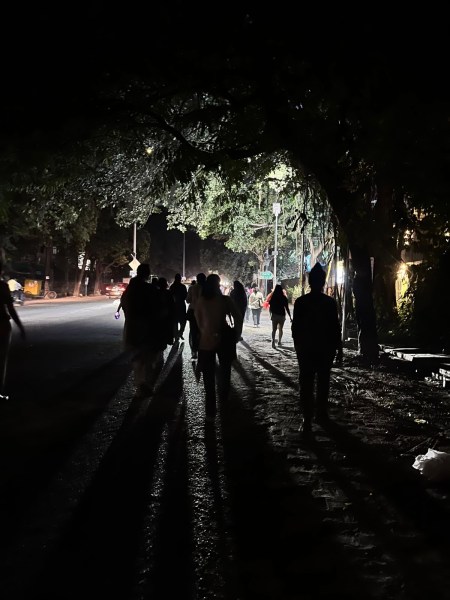 It was organised by Women Walk at Midnight, an initiative launched in 2016. (Express Photo by Sophiya Mathew)
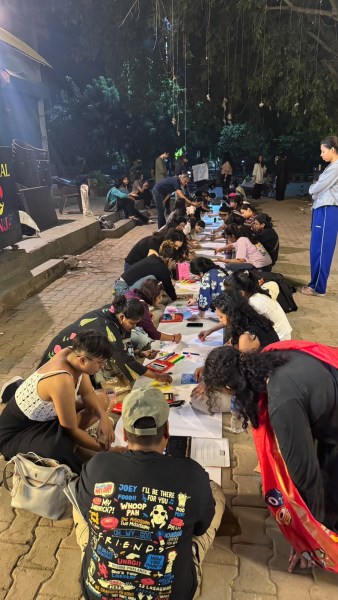 At C-9 Market, the women spread long sheets of paper across the pavement and began drawing. (Express Photo by Sophiya Mathew)
