


Stay updated with the latest - Click here to follow us on Instagram

Journalism of Courage
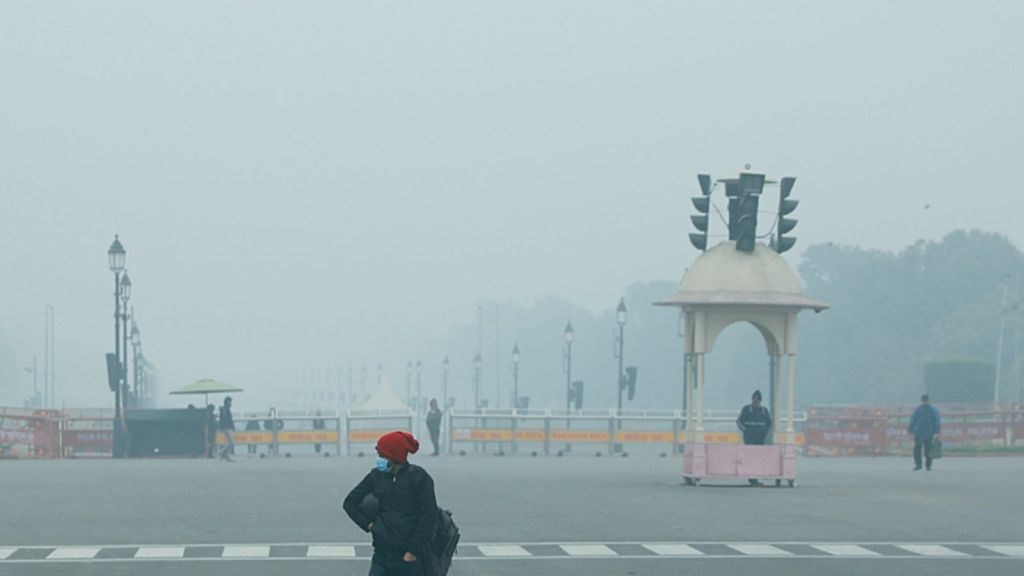 Among the key measures is a ban from November 1 to January 31 on motor vehicles registered outside Delhi that do not meet BS-VI emission standards. (File Photo)
A complete ban will be imposed on all construction-demolition activities from December 10 to January 20 to combat Delhi’s winter pollution, Environment Minister Manjinder Singh Sirsa said on Monday.
The government also said that petrol, diesel, and CNG pumps will sell fuel only to vehicles with a valid Pollution Under Control Certificate (PUCC) throughout the year. It has separately announced an enforcement drive against vehicles with invalid PUCCs from October 1 across 500 petrol pumps using Automatic Number Plate Recognition (ANPR) systems, alongside strict action against end-of-life vehicles.
With winter approaching, the Delhi government discussed measures such as restrictions on vehicles, construction activity, office attendance and parking at a high-level meeting on air pollution chaired by Union Environment Minister Bhupender Yadav at Paryavaran Bhawan.
Chief Minister Rekha Gupta attended the meeting along with Sirsa, Public Works Department Minister Parvesh Sahib Singh, and senior officials from various departments. The meeting reviewed major sources of pollution in the capital, ongoing mitigation measures, and ways to strengthen monitoring and coordination between departments. Emphasising a regional airshed approach, Sirsa noted that while Delhi generates around 30% of its pollution, roughly 60% to 65% comes from or is influenced by surrounding NCR areas, necessitating coordinated regional action.
The discussions came as the Delhi government prepares to implement a set of restrictions that will come into force annually from November 1 to February 28. As reported by The Indian Express on July 2, the restrictions, which were notified on June 23, will operate parallelly with the Graded Response Action Plan (GRAP), under which graded curbs are imposed by the Commission for Air Quality Management (CAQM) based on the prevailing air quality.
Under the new framework, for the first time, several measures will be made mandatory in advance, rather than GRAP curbs kicking in after air pollution has already reached a certain level.
In the existing framework, GRAP stage 1 is triggered when the air quality index (AQI) is in the 201-300 range, stage 2 at 301-400, stage 3 at 401-450, and stage 4 above 450. The measures become progressively stricter as air quality deteriorates.
Among the measures announced by the government on Monday:
CURBS ON ENTRY OF VEHICLES: Between November 1 and January 31, no non-BS6 vehicle that is registered outside Delhi can enter the capital. This restriction on older vehicles will not apply to CNG and electric vehicles, emergency services vehicles, and vehicles in other exempt categories.
STAGGERED OFFICE TIMINGS: Between November 1 and January 31, offices of the Municipal Corporation of Delhi (MCD) will operate from 8.30 am to 5 pm, and Delhi government offices from 10 am to 6.30 pm.
Private entities have been advised to adopt staggered working hours and measures such as car-pooling, ride-sharing and common buses to reduce vehicles on the road.
50% WFH: From November 1 to January 31, government and private offices are required to ensure no more than 50% physical attendance, with the remaining employees working from home or following a two-day-per-week work-from-home model.
Essential services, including hospitals, public transport, power, water supply, sanitation, disaster management and pollution-control agencies are exempt.
HIGHER PARKING FEES: To discourage the use of private vehicles, parking charges at authorised parking sites will be doubled between November 1 and February 28. Parking facilities owned and managed by the Delhi Metro Rail Corporation are exempt. To support the shift toward mass transit, the government aims to raise daily ridership to 72 lakh on the Metro and 42 lakh on DTC buses, supported by a fleet of 5,088 electric buses, officials said.
CONSTRUCTION CURBS: From November 1 to January 31, dust-generating demolition and open civil construction activities will be prohibited, except for essential public infrastructure projects. Mandatory 100% CCTV web-camera coverage will be enforced across construction sites, and registration on the ‘Malba App’ will be required for building plan approvals, said officials.
Construction and demolition are banned completely from December 10 to January 20, barring urgent government and emergency works, officials said. Vehicles carrying construction material such as sand, stones, bricks, and cement cannot enter the city during this period, barring exemptions for projects of national importance, essential public infrastructure, and emergency works.
OTHER STEPS: Anti-smog guns or mist systems must be deployed at large commercial buildings and construction sites.
* RWAs, housing societies, institutions, contractors will be responsible for preventing the burning of waste, biomass, leaves, garbage and plastic in their areas. Sirsa has urged RWAs and market associations to take a ‘Zero Burning Pledge’ and set up dedicated electric heating booths for security guards to prevent open fires.
* Surveillance and enforcement will be stepped up round the clock with an AI-enabled Command and Control Centre operating from October 1, supported by 334 dedicated enforcement teams, officials said Monday. The Continuous Ambient Air Quality Monitoring Stations (CAAQMS) network will also be expanded from 47 to 60 stations.
* In an ongoing crackdown on industrial sources, the government has surveyed 11,271 units, sealing or shutting down 2,283 non-compliant polluting units, officials added.
ALL-YEAR EXERCISE: At Monday’s meeting, the Delhi government reiterated that pollution control would be treated as a year-round exercise rather than limiting it to the winter months.
The Chief Minister said the guidance and suggestions of Union Minister Yadav would strengthen the government’s action plan. Sirsa said the government was working to control pollution through the year using technical and scientific measures.
Stay updated with the latest - Click here to follow us on Instagram