3 min readNew DelhiOct 29, 2024 09:36 AM IST
First published on: Oct 29, 2024 at 03:53 AM IST
The National Green Tribunal (NGT) has issued notices to the Delhi Police Commissioner and Traffic Commissioner to file a response detailing the actions taken to control vehicular pollution. It also observed that a transparent process should be followed to invoke different stages of the Graded Response Action Plan (GRAP).
The green body, which was hearing a suo motu plea based on a report last year by The Indian Express, also pulled up the Commission for Air Quality Management (CAQM) for “lapses” in preventing the dip in the air quality. It observed that despite the bench’s emphasis earlier on taking effective steps, there was no improvement in air quality.

Further, the bench directed CAQM to “disclose the steps taken by it this year until September to ensure that the air quality does not dip in the coming months of winter”.
The directives were issued on October 24 during a hearing by the Principal Bench headed by NGT Chairperson Justice Prakash Shrivastava and comprising judicial member Justice Arun Kumar Tyagi and expert member Dr A Senthil Vel.
In response to a CAQM submission on the GRAP schedule, the Tribunal stated: “It is not disclosed as to what duration is treated to be sufficiently long duration. We feel that objective criteria need to be applied, and a transparent process needs to be adopted for invoking the different stages of GRAP.”
On Monday, Delhi recorded a better 24-hour average Air Quality Index (AQI) at 304 compared to Sunday’s 356. However, the air quality continued to be in the ‘very poor’ category. The Capital continued to be the worst polluted city in the country for the second consecutive day, according to data from the Central Pollution Control Board (CPCB).
The air quality may further slip to the ‘severe’ category on October 31 “in case of additional emissions from firecrackers and stubble fire”, stated the Indian Institute of Tropical Meteorology (IITM) in its forecast Monday. In its six-day outlook, IITM expects the air quality to fluctuate between ‘very poor’ and ‘severe’.
As of 8 pm Monday, Mundka was the most polluted among the pollution hotspots with an AQI of 352, according to CPCB.
On Monday, the average wind speed was 6-9 kmph, while the predominant surface wind was from East/Southeast, according to the India Meteorological Department (IMD). “The predominant surface wind is Easterly and is likely to continue for the next three days. The wind direction changed from Westerly or Northwesterly on Saturday (October 26). The Northwesterly winds keep the weather clear and visibility remains high. In easterlies, the opposite happens,” said an IMD scientist.
The wind direction will return to the Northwesterly on Wednesday (October 30), a day before Diwali, it is predicted. It also said the average wind speed, which was earlier favourable for the dispersal of pollutants at 10 kmph, will reduce to 8 kmph Wednesday.
Data from the Indian Agricultural Research Institute (IARI) revealed that 142 farm fire events were detected in Punjab on Monday. While 13 such events were detected in Haryana and 28 in Uttar Pradesh, none were reported in Delhi. So far, 3,795 cases have been reported from Punjab, Haryana, Uttar Pradesh and Delhi.

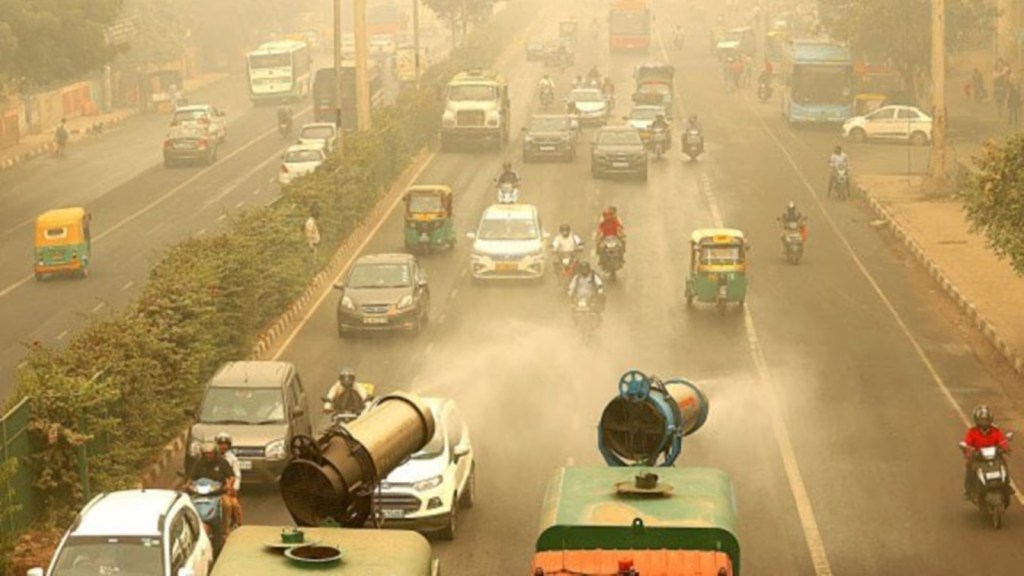 On Monday, Delhi recorded a better 24-hour average Air Quality Index (AQI) at 304 compared to Sunday’s 356. (File Photo)


 Share


