




Stay updated with the latest - Click here to follow us on Instagram
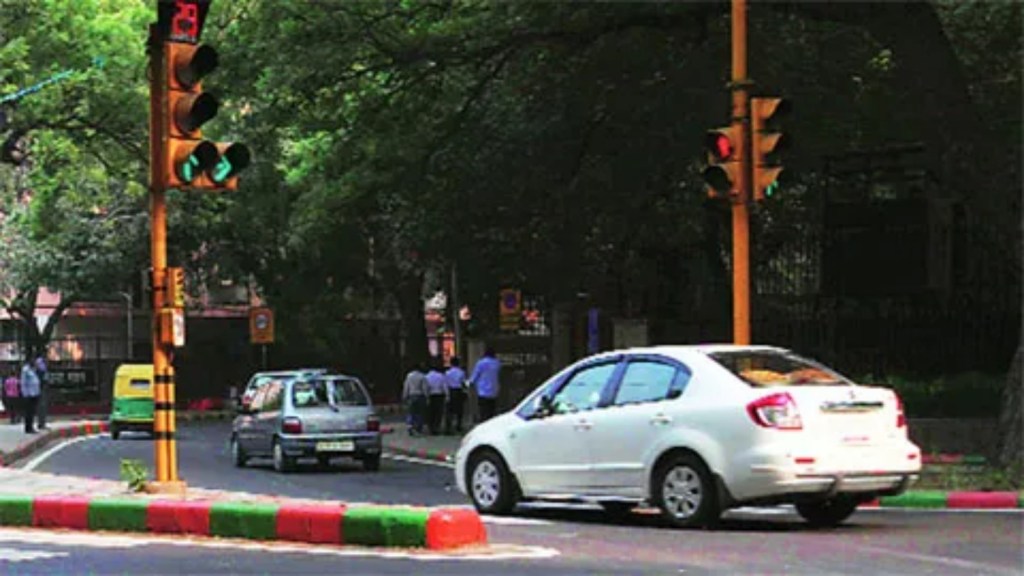 One of the biggest changes ITMS will bring is adaptive traffic control, under which traffic signals will no longer be dependent only on fixed cycles. (Source: File)
Delhi’s traffic lights could soon stay red or green for longer or shorter periods depending on how heavy the traffic flow is.
The change is part of the city’s Integrated Traffic Management System (ITMS), which is finally moving towards implementation after more than a decade. The system will use cameras and technology to adjust signal timings, detect traffic violations and give commuters real-time information about traffic and road conditions.
The project will, however, not become operational overnight. The Delhi Traffic Police will roll out the project in three phases.
The first phase will first cover five major corridors – Ring Road, Outer Ring Road, Rao Tula Ram Marg, Teen Murti and C-Hexagon. Seven more corridors will be taken up in the second phase, followed by the remaining corridors in the third.
Apart from the initial five corridors, the Traffic Police has divided the city into 42 corridors for the broader implementation of the ITMS.
The traffic police had initially proposed a project costing around Rs 2,100 crore, of which about Rs 1,700 crore has been sanctioned. Tendering is expected to take around eight months, followed by another 24 months for implementation, said officials.
One of the biggest changes ITMS will bring is adaptive traffic control, under which traffic signals will no longer be dependent only on fixed cycles.
At present, many traffic signals work on pre-set timings. This can leave motorists waiting at a red light even when there is little traffic, while another stretch nearby is crowded.
Under ITMS, cameras and technology will assess the volume of traffic on different stretches and adjust signal timings accordingly.
“For instance, if traffic from ITO towards DDU Marg is light but the signal remains red for 30 seconds, the system could detect this and adjust the cycle. The objective is to make signals respond to actual traffic movement rather than simply follow fixed timings,” an official said.
The system will also help officials spot congestion and manage diversions. Variable Message Signboards (VMS) will provide motorists with real-time information about congestion, diversions and other road conditions, helping them choose alternative routes.
Further, ITMS will incorporate information about VIP movements and green corridors. Once a green corridor is entered into the system, the information can be passed to traffic signals along the route.
Parking information will also be integrated into the system. “A driver in an unfamiliar area may not know where the nearest parking facility is and may end up circling the area looking for a space or parking on the roadside,” a senior official said.
Under ITMS, parking information will be integrated into the system, allowing motorists to identify nearby parking facilities.
Delhi already uses cameras to detect violations such as red-light jumping, crossing the zebra crossing and overspeeding. The new system will expand the use of cameras beyond these existing violations to include driving without a seatbelt, triple riding and wrong-side driving.
“A vehicle with a large number of unpaid challans, one linked to a hit-and-run case, or a vehicle otherwise being sought by the police could trigger an alert when detected by the camera network. The alert would be sent to the Traffic Inspector as well,” the official said.
At present, such information may reach the control room, following which personnel have to identify and intercept the vehicle.
Moreover, the system could help trace the route a vehicle has taken. If it is detected at different camera locations, those sightings can be used to establish a probable route. Officials said this could help trace vehicles sought in connection with a crime.
The ITMS will share information with commuters about disruptions and changing traffic conditions.
Delhi frequently sees sudden changes in traffic because of protests, public gatherings, religious events, festivals and other activities. Under ITMS, information about such disruptions can be fed into the system and shared through available information systems and VMS boards.
For instance, if a religious event is expected to affect a road, motorists could be alerted in advance.
The larger objective is to create a system where traffic authorities have a real-time picture of what is happening on Delhi’s roads, while commuters have access to the same information that can help them plan their journeys and avoid unnecessary delays, said officials.
Stay updated with the latest - Click here to follow us on Instagram