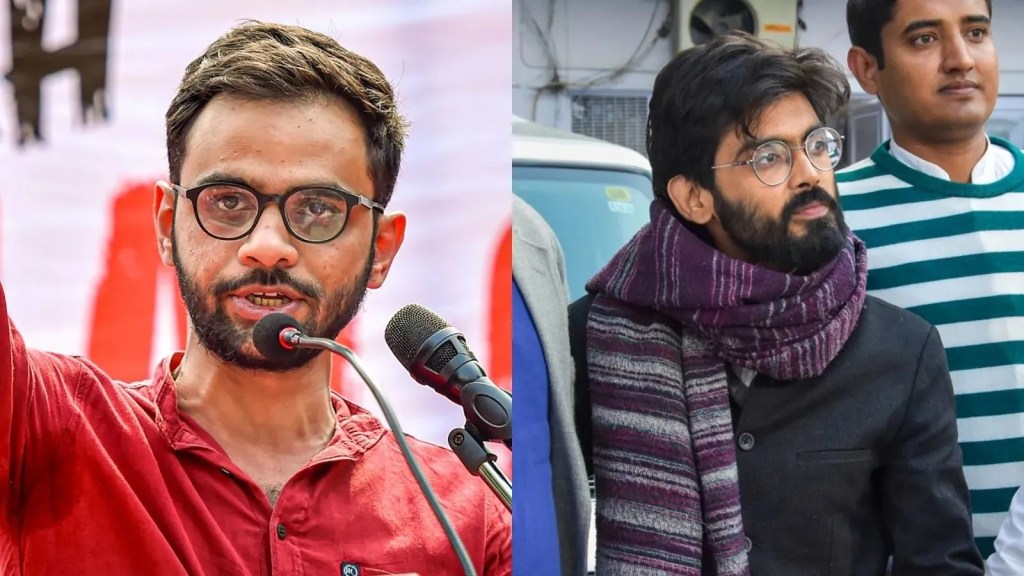
The Delhi High Court rejected the bail pleas of student activists Umar Khalid and Sharjeel Imam in the ‘larger conspiracy’ case linked to the February 2020 Northeast Delhi riots on Wednesday.
Refusing the bail, the Delhi High Court held that the two cannot claim parity with others who were granted bail by the Supreme Court.
A division bench of Justices Prathiba Singh and Dinesh Bhatt held that it is “bound by judicial discipline” of the Supreme Court verdicts.
It also held that Umar and Sharjeel cannot claim parity with two other accused, Tasleem Ahmad and Abdul Khalid Saifi, who were granted bail by the apex court on grounds of divergent views on bail jurisprudence under the Unlawful Activities (Prevention) Act, 1967.
The two were relying on this, even as a reference to a larger bench for deciding the divergent view is pending before the top court.
They are facing charges under the stringent terror law and have been in jail for over six years now. The High Court had earlier rejected Umar’s bail pleas twice — once in October 2022 and a second time in September 2025. Both times, the Supreme Court had upheld the Delhi High Court’s order.
The Supreme Court, in its order on January 5, had refused bail to Umar and Sharjeel while granting bail to five other co-accused in the case. It also established a “hierarchy of participation”. In this hierarchy, Umar and Sharjeel were classified to be on a “higher footing” compared to the five others.
Story continues below this ad
The court had kept it open for them to apply for bail either a year after the judgement or after examination of protected witnesses, whichever is earlier.
However, a judgment in May had expressed “serious reservations on various aspects of the judgment” of January.
Dealing with a UAPA bail plea in a separate case, another SC bench had observed that it has “serious reservations on various aspects of the (January) judgement… including foreclosing the right of the two applicants (in the January verdict) to seek bail for a period of one year.”
Relying on this May verdict, Saifi and Tasleem were also granted bail.
Story continues below this ad
On Wednesday, however, the Delhi High Court held that this judgement shall not apply in Umar and Sharjeel’s case as there are specific verdicts pertaining to bail jurisprudence in the Northeast Delhi riots case by the apex court.
The two have been booked for offences under the Indian Penal Code, Prevention of Damage to Public Property (PDPP) Act, Arms Act and the Unlawful Activities (Prevention) Act (UAPA).
They are facing allegations of a ‘larger conspiracy’ to allegedly cause the riots in Northeast Delhi between February 23 and 25, 2020, which left 53 people dead and over 700 injured.
Till date, charges have not been framed in the case. Examination of witnesses, including protected witnesses, only takes place after the trial begins after framing of charges.
Sohini Ghosh is a Senior Correspondent at The Indian Express. Previously based in Ahmedabad covering Gujarat, she recently moved to the New Delhi bureau, where she primarily covers legal developments at the Delhi High Court
Professional Profile
Background: An alumna of the Asian College of Journalism (ACJ), she previously worked with ET NOW before joining The Indian Express.
Core Beats: Her reporting is currently centered on the Delhi High Court, with a focus on high-profile constitutional disputes, disputes over intellectual property, criminal and civil cases, issues of human rights and regulatory law (especially in the areas of technology and healthcare).
Earlier Specialty: In Gujarat, she was known for her rigorous coverage in the beats of crime, law and policy, and social justice issues, including the 2002 riot cases, 2008 serial bomb blast case, 2016 flogging of Dalits in Una, among others.
She has extensively covered health in the state, including being part of the team that revealed the segregation of wards at the state’s largest government hospital on lines of faith in April 2020.
With Ahmedabad being a UNESCO heritage city, she has widely covered urban development and heritage issues, including the redevelopment of the Sabarmati Ashram
Recent Notable Articles (Late 2025)
Her recent reporting from the Delhi High Court covers major political, constitutional, corporate, and public-interest legal battles:
High-Profile Case Coverage
She has extensively covered the various legal battles - including for compensation under the aegis of North East Delhi Riots Claims Commission - pertaining to the 2020 northeast Delhi riots, as well as 1984 anti-Sikh riots.
She has also led coverage at the intersection of technology and governance, and its impact on the citizenry, from, and beyond courtrooms — such as the government’s stakeholder consultations for framing AI-Deepfake policy.
Signature Style
Sohini is recognized for her sustained reporting from courtrooms and beyond. She specialises in breaking down dense legal arguments to make legalese accessible for readers. Her transition from Gujarat to Delhi has seen her expand her coverage on regulatory, corporate and intellectual property law, while maintaining a strong commitment to human rights and lacuna in the criminal justice system.
X (Twitter): @thanda_ghosh ... Read More