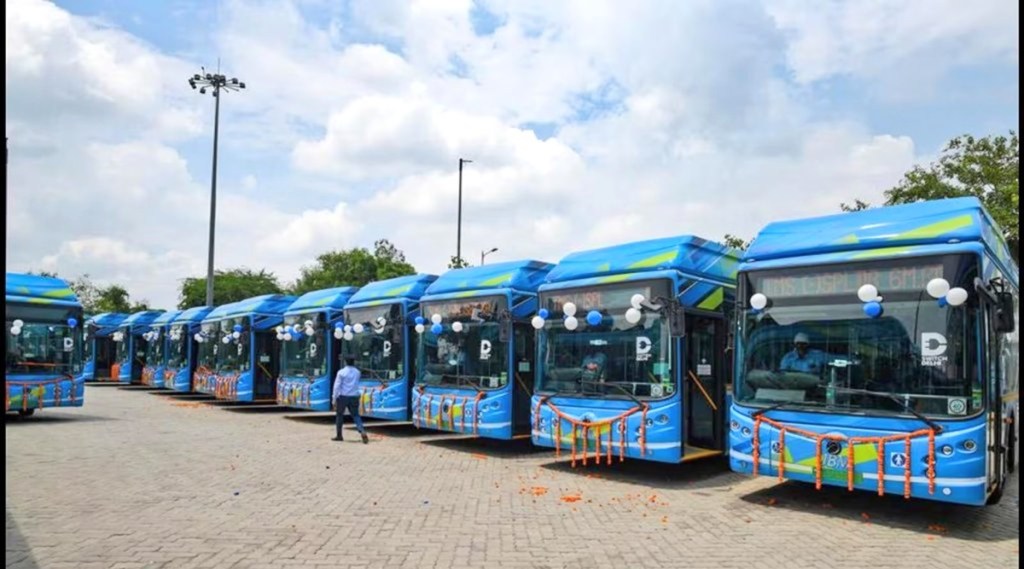
Amid the ongoing “credit war” between AAP and BJP over work done in the national capital for the G20 Summit, Chief Minister Arvind Kejriwal and Lieutenant Governor Vinai Kumar Saxena came together to flag off 400 new electric buses from the IP Depot Tuesday. With this, the count of e-buses in Delhi has gone up to 800 and the strength of the fleet to 7,135.
Speaking after the inauguration, Kejriwal said Delhi has now become the city with the most number of electric buses on its streets. He said by the end of 2023, the city will have 1,900 electric buses: “Delhi would then be counted among the few cities in the world to have the most number of e-buses. We will be able to reduce CO2 emissions by 1.07 lakh tonnes every year.”

He also said the AAP government has a target to meet by December 2025, which is to have 10,480 buses — 80% (8,280) of these would be electric.
In a post on X (formerly Twitter), Saxena said these 400 buses are the first tranche of 1,500 electric buses being provided by the Centre under the FAME-II scheme. “Of the 1,500 buses under this scheme, 921 buses are being provided with FAME-II subsidy of Rs 416.82 crore borne by the Central Govt. For the remaining 579 buses, GNCTD will bear the subsidy of Rs 262.04 crore,” he said in a series of posts.
Kejriwal also urged the Centre to provide subsidy for the remaining buses that will be procured by the government.
“Each bus has a life cycle of 12 years. The total spending on these 921 buses would be Rs 4,091 crore, of which Rs 417 (10% of the total) would be provided by the Centre,” he explained.
Kejriwal said the remaining 90% financial burden would be incurred by the Delhi government. “In our target of 8,200 buses, we will get a subsidy on 900 new buses. Earlier, we got a subsidy on 300 buses from the central government. So, 1,200 buses would be on subsidy from the central government. We urge the central government to provide a subsidy on the remaining buses as well. We thank the Centre for the subsidy on the 1,200 buses,” he said.
Earlier, the inauguration of about 100 e-buses which had arrived in May was delayed over the question of who would launch them — the Delhi government or Centre. They were later pressed into service without any formal event.
When asked about the BJP claiming credit for the buses, the CM said, “I always say, take the credit, we don’t have any problem. We are just here to work for the people.”
The buses are air-conditioned, can run up to 225 km, are disabled-friendly, have CCTV cameras and panic buttons, a facility for two-way communication with the control room, and a GPS unit for live tracking. They are also equipped with disc brakes, and fire detection and suppression systems.
These will run from Mayapuri, Nehru Place, Rohini 1, Rohini 2, and Banda Bahadur Marg depots.
Further, the CM said the government is strengthening the infrastructure of depots for e-buses. It has so far spent Rs 182 crore on installation of 1,500 depots.
Meanwhile, the BJP deputed around 100 members of its youth wing, the Bharatiya Janata Yuva Morcha, to stand with placards thanking Prime Minister Narendra Modi for the procurement of the lot of 400 electric buses leading up to the depot.
Leader of Opposition in the Delhi Assembly Ramvir Singh Bidhuri alleged, “Foreign guests are coming to the G20 conference in the capital and buses were required to transport them. Due to the wrong policies of the Delhi government, buses were not available for the guests in the capital.”
BJP MP Manoj Tiwari also claimed Delhi’s public transportation infrastructure would have been efficient and problem-free had a BJP government been in power.



 Share


