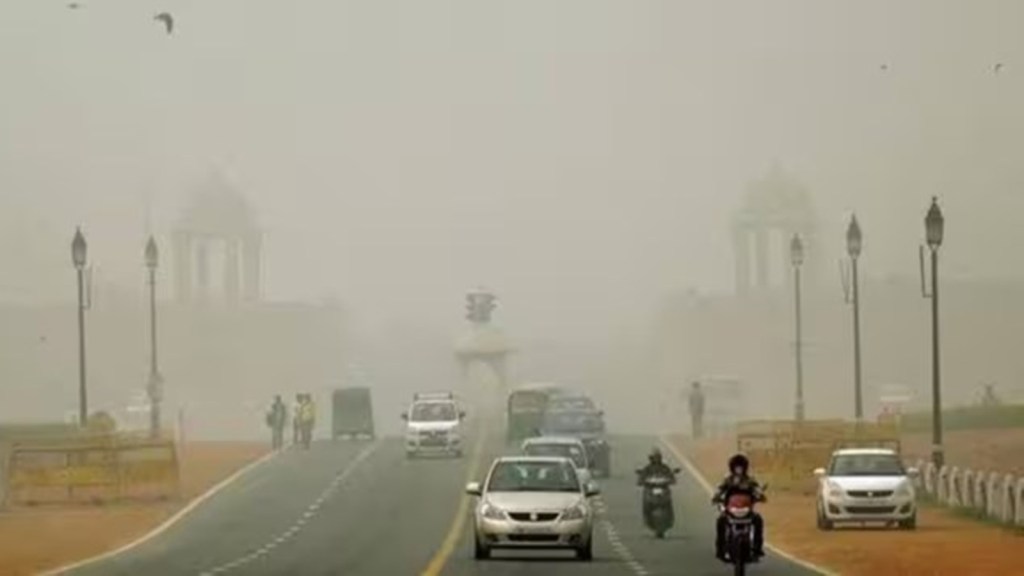
Delhi’s air quality improved slightly on Thursday, thanks to increased wind speed that helped disperse pollutants. The Air Quality Index (AQI), however, remained “very poor”.
The 24-hour average AQI recorded at 4 pm was 306, against 364 a day earlier. Pollution levels in Delhi remained the highest in the country, data from the Central Pollution Control Board (CPCB) showed. Out of 241 cities, only Delhi was in the “very poor” category on Thursday — the fourth consecutive day.
Delhi Environment Minister Gopal Rai said the timings of government offices in the Capital may be changed to curb pollution.
Among the 13 pollution hotspots, Anand Vihar reported the worst AQI at 431. While the air was in the “severe” category in the early hours, it remained “very poor” throughout the day.
Calm winds prevailed on Wednesday and Thursday night, but northerly winds picked up speed in the daytime. Reaching up to 8 kmph, the wind speed was favourable for improving air quality. According to the Indian Institute of Tropical Meteorology (IITM), Pune, an average speed of at least 10 kmph is favourable for the dispersion of pollutants.
The India Meteorological Department (IMD) attributed the improvement in air quality to stronger winds. “Not only did the air quality improve, but mist also cleared. This is due to strong winds of 5 to 10 knots speed,” said IMD scientist Krishna Mishra.
Particulate Matter (PM) 10 was the prominent pollutant on Thursday — four times the prescribed standard.
Even with the influx of northerlies, the pollution level did not increase because the contribution of stubble burning remained insignificant and the change in wind speed enabled the pollutants to disperse, said Anumita Roychowdury, Executive Director of Research and Advocacy at the Centre for Science and Environment.
Going by the Indian Agricultural Research Institute (IARI) data on Wednesday, 57 cases of stubble burning were reported in Punjab, 15 in Haryana, 68 in Uttar Pradesh and none in Delhi. Between September 15 and October 23, as many as 3,137 cases were detected.
“Farm fires are likely to pick up now… because of meteorological factors. Moreover, the stubble-burning peak and the festival season at the start of November are to coincide. If we don’t take measures to cut down on emissions, we might be looking at severe air quality in the coming two weeks,” said Sunil Dahiya, founder and lead analyst at Envirocatalysts.
Delhi’s transport sector was the biggest contributor, with emissions from transportation accounting for approximately 16.3% of the city’s air pollution on Thursday — up from 13.5% on Wednesday, according to the Centre’s Decision Support System for Air Quality Management.
According to an IITM forecast issued Thursday, Delhi’s air quality is likely to be in the ‘poor’ category on Friday and worsen to ‘very poor’ during the weekend. In a related development, the MCD has decided to allocate Rs 20 lakh per zone to enhance air quality management in the city. The funds will be utilised to strengthen machinery and manpower to mitigate dust pollution.



 Share


