80-year-old told to plant 21 trees for one fallen neem, Delhi HC slams govt

Calling the Delhi Preservation of Trees Act “badly drafted”, the court has sought a response from the government.

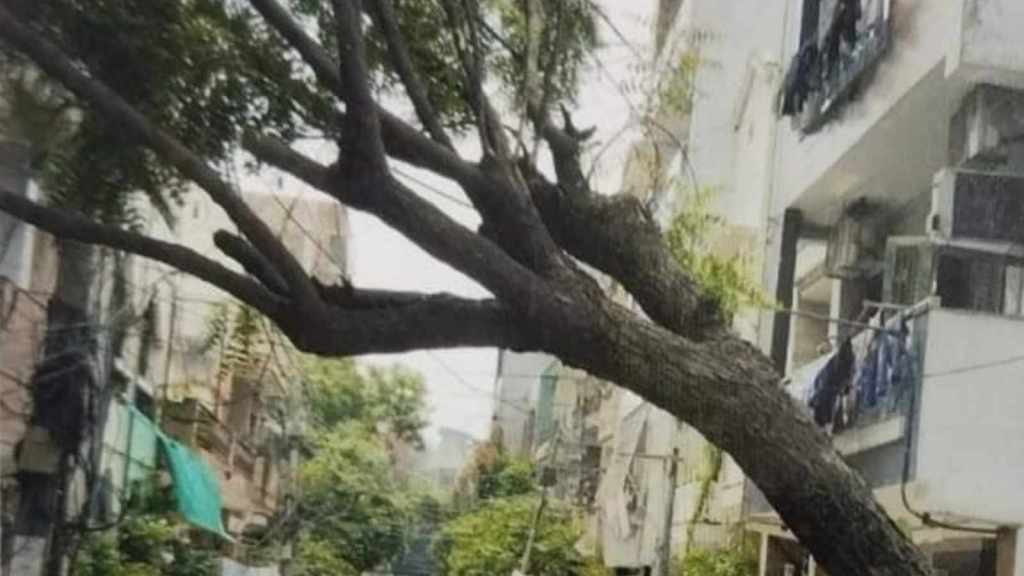
neem 1600The neem tree planted outside Gurmail Bhatia's home in Rohini before it was uprooted in 2024.

In 1991, Gurmail Singh Bhatia planted a neem sapling outside his home in Delhi’s Rohini. A retired Class I Union government officer, Bhatia, now 80, said he “nurtured” it for 35 years.

But a storm uprooted it in May 2024 — and the tree became the centre of a dispute.

The Delhi government’s forest department found Bhatia responsible for illegally felling and pruning the tree and, in August this year, directed him to plant 20 tall saplings at a nearby location and one additional tree at the original site.

Bhatia moved court through his advocate RK Ruhil.

On Tuesday, the Delhi High Court lambasted the state government for passing such an order and stayed the deputy conservator of forest’s direction.

Justice Amit Mahajan orally inquired from the state, “How can you pass such an order? You’re not a court.”

The court also said the Delhi Preservation of Trees (DPT) Act, under which the government order was issued, was “badly drafted”.

From a fallen tree to a complaint

On May 11, 2024, a severe dust storm and thunderstorm struck Delhi, with wind speeds reaching up to 77 km/h. The neem tree outside Bhatia’s home was uprooted.

Story continues below this ad

Part of the tree was left hanging dangerously over live electric wires. Bhatia, in his plea filed in court, said he complained to the MCD’s horticulture division seeking action.

According to Bhatia, it took the MCD about two months to attend to the site. The civic body cut the fallen tree into pieces and carried away the material along with about two-thirds of the stem. About one-third of the stem was left at the site, where, Bhatia said, it continues to rot.

Bhatia, in his plea, contended that his estranged younger son, with whom he is already embroiled in a partition suit dispute, subsequently complained against him, alleging that he had illegally felled the tree.

Following this, the forest department’s tree officer initiated proceedings against Bhatia, issuing notice to appear before the officer in December 2024.

Story continues below this ad

21 trees, and seven years of maintenance

On August 17 this year, the tree officer, holding Bhatia to be preliminarily in violation of the Delhi Preservation of Trees (DPT) Act, issued a series of directions.

Bhatia was ordered to plant “20 tall saplings at a nearby location, along with the planting of one additional tree at the same site”.

The order specified that the saplings had to be native tree species, with a minimum height of six feet and a collar girth of at least 10 cm.

He was also directed to ensure the “maintenance, watering, and complete survival” of all the saplings for seven years, including replacing any that died.

Story continues below this ad

Before the order was passed, Bhatia had told the forest department that, given his medical condition, it would “not be possible” for him to look after the proposed trees.

What the forest dept said

The deputy forest conservator defended the move in court, citing Section 31 of the Delhi Preservation of Trees Act.

This section empowers tree officers with quasi-judicial and legal powers, including summoning witnesses, issuing a search warrant under CrPC (Code of Criminal Procedure) etc, and also empowering them to issue directions to persons to make alternate plantation.

Section 24 of the Act further provides for imposition of penalty for violating any provisions of the Act, including violating order of the tree officer.

Story continues below this ad

The argument did not convince Justice Mahajan. He orally remarked, “You have no power… How can you ask someone to plant trees if they don’t want to?… This is a badly drafted Act, I don’t know who has drafted this Act.”

The High Court has sought a response from the Delhi government’s forest department.

Sohini Ghosh is a Senior Correspondent at The Indian Express. Previously based in Ahmedabad covering Gujarat, she recently moved to the New Delhi bureau, where she primarily covers legal developments at the Delhi High Court Professional Profile Background: An alumna of the Asian College of Journalism (ACJ), she previously worked with ET NOW before joining The Indian Express. Core Beats: Her reporting is currently centered on the Delhi High Court, with a focus on high-profile constitutional disputes, disputes over intellectual property, criminal and civil cases, issues of human rights and regulatory law (especially in the areas of technology and healthcare). Earlier Specialty: In Gujarat, she was known for her rigorous coverage in the beats of crime, law and policy, and social justice issues, including the 2002 riot cases, 2008 serial bomb blast case, 2016 flogging of Dalits in Una, among others. She has extensively covered health in the state, including being part of the team that revealed the segregation of wards at the state’s largest government hospital on lines of faith in April 2020. With Ahmedabad being a UNESCO heritage city, she has widely covered urban development and heritage issues, including the redevelopment of the Sabarmati Ashram Recent Notable Articles (Late 2025) Her recent reporting from the Delhi High Court covers major political, constitutional, corporate, and public-interest legal battles: High-Profile Case Coverage She has extensively covered the various legal battles - including for compensation under the aegis of North East Delhi Riots Claims Commission - pertaining to the 2020 northeast Delhi riots, as well as 1984 anti-Sikh riots. She has also led coverage at the intersection of technology and governance, and its impact on the citizenry, from, and beyond courtrooms — such as the government’s stakeholder consultations for framing AI-Deepfake policy. Signature Style Sohini is recognized for her sustained reporting from courtrooms and beyond. She specialises in breaking down dense legal arguments to make legalese accessible for readers. Her transition from Gujarat to Delhi has seen her expand her coverage on regulatory, corporate and intellectual property law, while maintaining a strong commitment to human rights and lacuna in the criminal justice system. X (Twitter): @thanda_ghosh ... Read More

Stay updated with the latest - Click here to follow us on Instagram

Advertisement
Loading Recommendations...
Advertisement
Advertisement
Latest Comment
Post Comment
Read Comments