
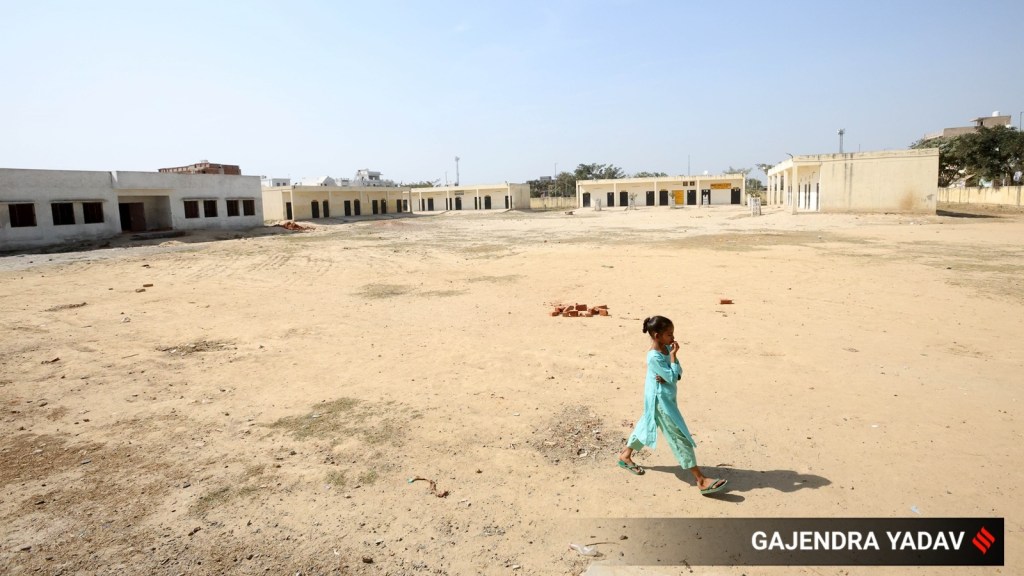
At first glance, this 16-room pale yellow structure resembles a derelict building. There are several broken benches, the toilets are filthy, reeking of stool and urine, there is garbage scattered in the compound, which also contains pieces of glass and liquor bottles, and the water hand pump — the only source of water for the children — is clogged with dirt and plastic wrappers.
This, however, is the only government-run primary school for the children of those displaced during the first phase of land acquisition for the upcoming Noida International Airport at Jewar in western Uttar Pradesh.

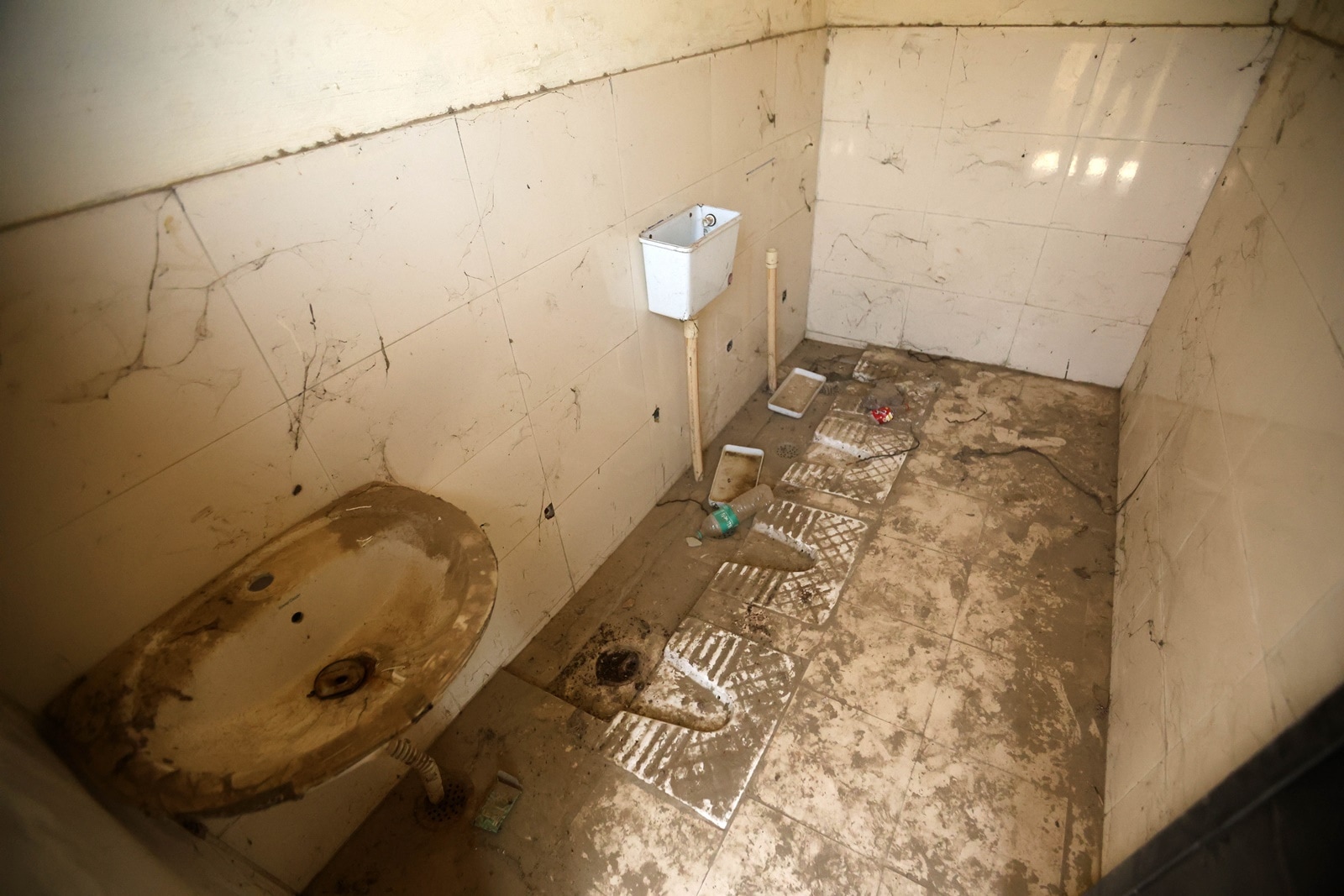 The toilet is in a derelict state at the school in Rehabilitation and Resettlement (RR) colony in Jewar (Express Photo by Gajendra Yadav)
Located in the Rehabilitation and Resettlement (RR) colony in Jewar, the school — ‘Composite School R&R Site’ — was built by the Yamuna Expressway Industrial Development Authority (YEIDA); officials said it was handed over to the district administration in 2021.
During the first phase of land acquisition in 2018, the land in six villages — Rohi, Nagla Chitr, Nagla Ganeshi, Nagla Sareefkha, Nagla Phoolkha and Dayanatpur Kheda — was acquired. This also included the land of the three primary schools in Rohi, Nagla Sareefkha and Nagla Ganeshi.
Post the acquisition, schools of all six villages were merged into one to hold classes till Grade 8. Even as the airport is set to begin domestic and international flight operations soon, those displaced are still awaiting a “proper” school promised to them seven years ago.
When The Indian Express visited the school on February 17, located 8.3 km away from the airport, only 8 of the 16 rooms in the building, which included an office, a library and a staff room, were functional. Of the 626 children who officials claimed were enrolled in the school, only 150 were present — most without uniforms. With most of the benches broken, children in a few classes were seen sitting on a plastic mat.
According to the villagers, the composite school is not close to anything that was promised to them by YEIDA. “This school is for six villages. They had told us that the school we would get would be better than those in Delhi and Noida, but look at its condition,” said Shiv Kumar (40), a farmer from Dayanatpur Kheda.
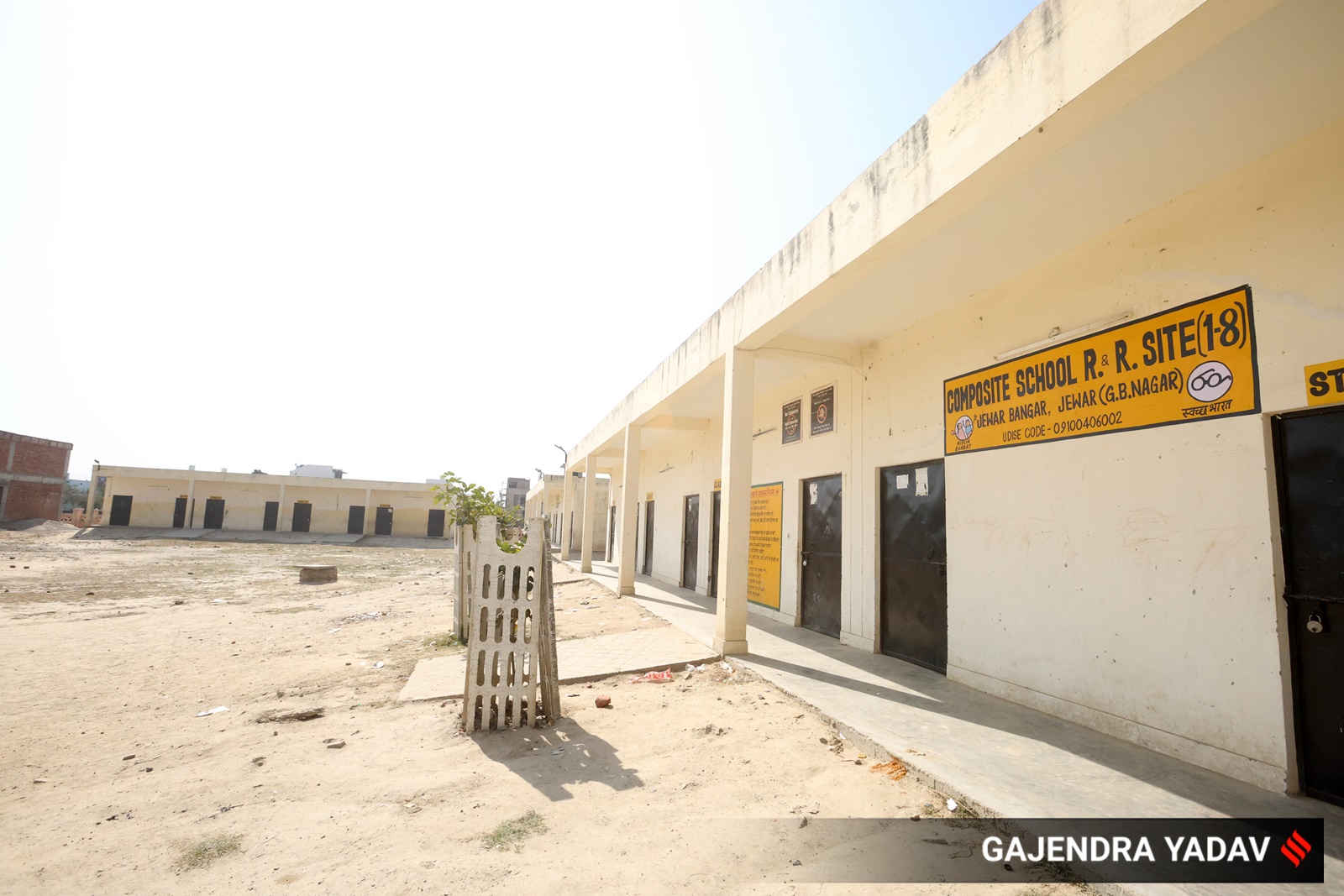 Composite School Rehabilitation and Resettlement (R&R) Site-18 in Jewar Bangar. (Express Photo by Gajendra Yadav)
His three daughters go to the nearby Jewar Public School. “Hum log zyada padhe likhe nahi hai, par itna pata hai ki padhne se zindagi badal jata hai. Nahi toh fir yahi pe gaai bhains aur gobar karna padega isliye private school bhejte hai (We are not highly educated but we know that education can change lives or else the children would have to work with the animals here),” he said.
Babita Devi (35), a resident of Rohi, said: “I am not educated but I thought my children would be. But now it feels that their lives would also be like mine, sweeping the road.”
Babita is a mother of three. Her elder daughter, aged 14, completed Class 8 from the composite school last year. “She doesn’t speak much, I am scared that if I send her to another school to study further, she will be teased or assaulted. Her safety is more important,” said Babita.
Would she send her daughter to the composite school if it taught students beyond Class 8? “Of course,” she answered.
When contacted, Shailendra Bhatia, YEIDA Officer on Special Duty, told The Indian Express: “We had a master plan for the school. To ensure that the school gets ample space, we have reduced the size of the adjacent areas.”
Maintaining that the school was well-planned, he added, “It is our priority so that the children do not suffer.”
At Nagla Chitr, Nagla Ganeshi and Nagla Sareefkha, most girls don’t join another school after Class VIII. Instead, they help with household chores. A few bright students join the boys to travel a kilometer-and-a-half to Jain Inter College in Jewar to study further.
In Rohi and Dayanatpur Kheda, relatively well-off residents send their children to private schools about 5 km from the RR colony. “This school has no facilities. Had there been proper facilities, I would never have sent my daughter that far,” said Mona (24), a resident of Rohi.
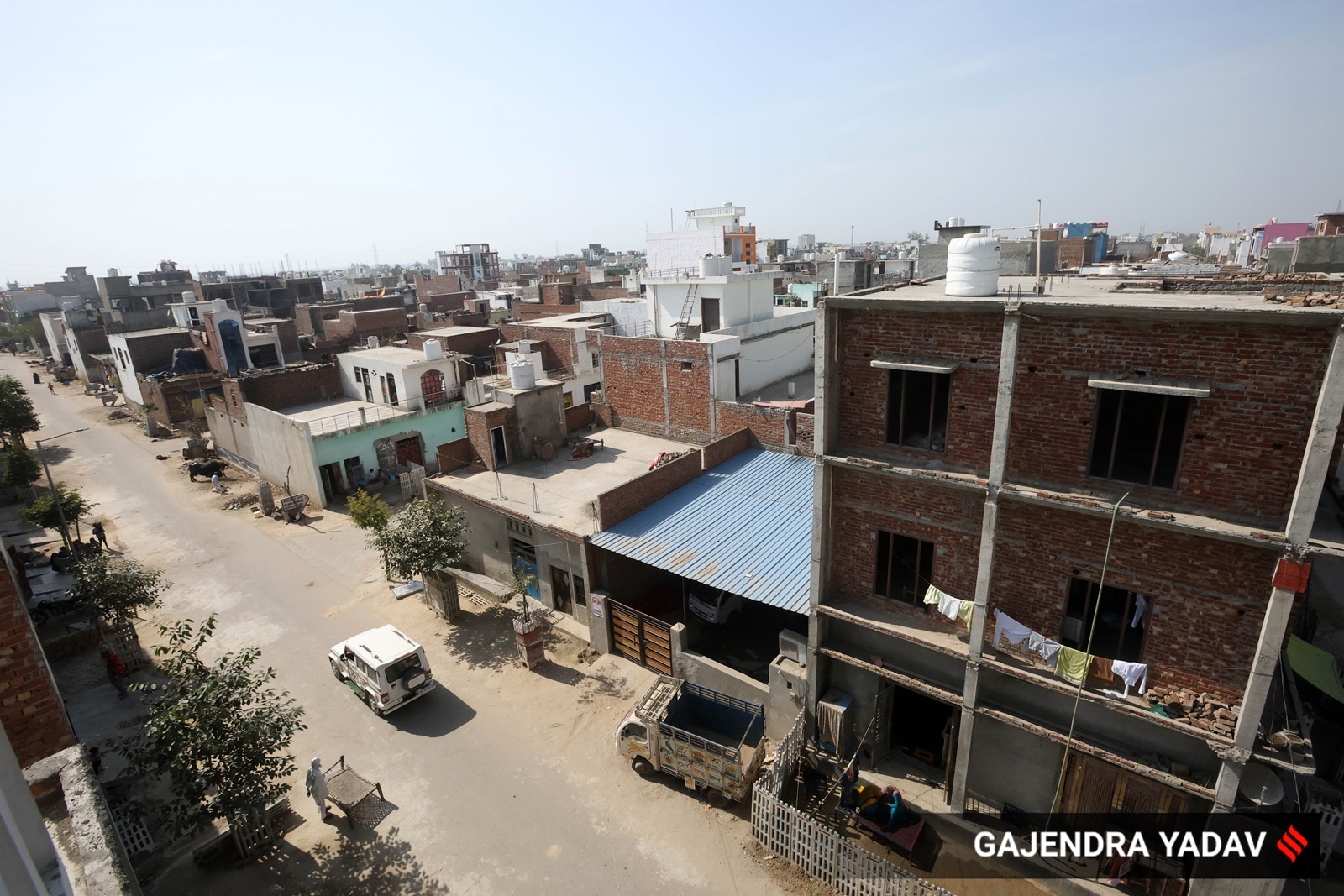 Rehabilitation and resettlement (R&R) colony in Jewar Bangar. (Express Photo by Gajendra Yadav)
Mona said she pays Rs 500 as bus fees and Rs 550 as school fees every month. “We are not very rich. But I do not want a life like mine for my daughter. We will work hard for her.”
Nangla Ganeshi resident Nandini’s (28) son studies in Class 5 at the composite school. “Nobody is there to keep an eye on the children… There is neither cleanliness nor discipline at the school. The playground is full of bricks and stones, there is no tap for drinking water. Construction work has been going on for two years,” she said.
At Nangla Sareefkha, Mohammad Iqbal asked his son, a student of Class 5, to recite the table of 2 but he could not. “This is the quality of education. All he does is play marbles. We have complained to the teachers but they blame us,” he said.
Teachers blamed the situation on the lack of facilities. “The playground is full of stones and pebbles. Construction is going on. What activity can be carried out for children on a ground like this?” asked one of them.
Maintaining that the school doesn’t even have a proper boundary, the teacher claimed: “From the park, which is behind the school, anyone can jump and enter the campus. Wine bottles are lying everywhere… people party here once we leave.”
The teacher further said it was only last December when the school informed the Basic Shiksha Adhikari (BSA) about the requirement for more benches as well as the general condition of the school. “We get a Google form every month, where we mention our requirements. But nothing happens.”
Teachers further said the situation is worse during the monsoon. “The school gets flooded. Last season, a worker fell while distributing mid-day meals and injured her leg,” said another teacher.
She added that there is no water in the washrooms. “There was a submersible pump, but someone broke it. Most of the time, the girls go home to relieve themselves.”
What happens when they menstruate? “They don’t attend classes on those days. There are no proper doors in the washroom. Girls cannot use them and so we send them home,” the teacher said.
When contacted, Gautam Buddh Nagar BSA Rahul Panwar said, “We will inspect the school at the earliest and ensure that the infrastructure is developed within a month.”
“There are 636 students registered with the school. The school also has 15 teachers, including two shiksha mitras. On most days, almost 70% of the students attend classes,” Panwar claimed.
He added that it is not possible to maintain the school without the support of the villagers.
A senior YEIDA official blamed the BSA and the district administration for the situation. “The school was developed and handed over to the administration. It is the responsibility of the BSA and the district administration to look after it… However, if the administration feels they need financial allocation, we will provide all assistance.”
Gautam Buddha Nagar District Magistrate Manish Kumar Verma said an inspection will soon be carried out at the school. “YEIDA had constructed the school and handed it over to us, but if the condition is such, we will ensure that it is checked.


 Share


