The open burning of biomass was found to be the largest contributor to haze in Delhi, both in the post-monsoon period between late October and November, and in winter from November to January, according to a recent analysis.
Scientists from IIT-Kanpur, IIT-Delhi, Indian Institute of Tropical Meteorology, Central Pollution Control Board (CPCB), University of Birmingham, Physical Research Laboratory at Ahmedabad, and School of Public and International Affairs at Virginia Tech were part of the analysis.
The composition of PM2.5 was studied at two sites from October 2019 to January 2020 to identify the sources behind the haze. One site was at IIT-Delhi, Hauz Khas, while the second site was at the Indian Institute of Tropical Meteorology, near Pusa forest.

The study identified four periods of haze in the post-monsoon and winter seasons, with different compositions of PM2.5. These periods were classified as agricultural burning (post-monsoon), and haze-1, haze-2, and haze-3 in winter.
Organic aerosols from biomass burning were dominant in all four haze periods. But, the post-monsoon (end of October to around mid-November) haze was largely affected by biomass burning particles likely from “agricultural residue burning emissions in the upwind states of Delhi”, the study notes.
Haze in the winter (end of November to early January) was also affected by biomass burning, but “likely from the local burning of wood, coal and/or roadside trash for heating and/or cooking purposes,” it adds.
During the agricultural burning phase, the study estimated that around 44% to 53% of total PM2.5 measured in Delhi was influenced by long-range transported biomass burning emissions. In this phase, ‘aged’ or oxidised aerosols were higher in concentration, which indicates that they were likely to have been transported over a distance. This, along with the transport pathways and the presence of polycyclic aromatic hydrocarbons, indicates that the aerosols were generated through low temperature burning, as is seen in agricultural fields, said Sachchida Nand Tripathi, professor at IIT-Kanpur, who was part of the study.
During haze-1 as well (early December) aged organic aerosols were high, indicating that the “air masses originated largely from long distances (from the north, and north-west direction) but also from surrounding areas, that is the NCR, according to the study.
In haze-2 (mid to late December) and haze-3 (early January), local biomass burning emissions were found to have a higher influence than regional ones. Primary biomass burning aerosols were more significant than aged ones. This could be due to an increase in the heating activities during the winter season, the study noted. In haze-2, secondary aerosols were high, since high relative humidity levels at night resulted in the formation of sulfates and nitrates from primary emissions.
In the winter haze, the ‘aged’ inorganic material includes aerosols of ammonium nitrate, ammonium sulfate, and ammonium chloride. In these episodes, secondary inorganic aerosols constituted around 48% to 55%. These inorganic constituents include ammonium nitrate (19-25%), ammonium sulfate (27-38%).
“This is the first time that we have used observational tools to pinpoint biomass contributions vis-à-vis other contributions to haze formation,” Tripathi said. “In mid-December, the haze is linked to industrial emissions since it has high ammonium nitrate and ammonium sulfate. In early January, the biomass component is not so aged, and is therefore driven by localised burning,” he said.
Organic components dominated PM2.5 at both sites, constituting around 55% of the particulate matter, followed by black carbon (22.8% at Hauz Khas and 12.5% at Pusa forest), nitrate (7.9% at Hauz Khas and 10.8% Pusa Forest), sulfate (6.9% at Hauz Khas and 8.3% at Pusa forest), and ammonium (6.2% at Hauz Khas and 8.8% at Pusa Forest).
The study concluded that “local and regional air pollution sources influenced the haze during winter, whereas, regional agriculture residue burning was the key responsible for haze pollution during the post-monsoon season.”

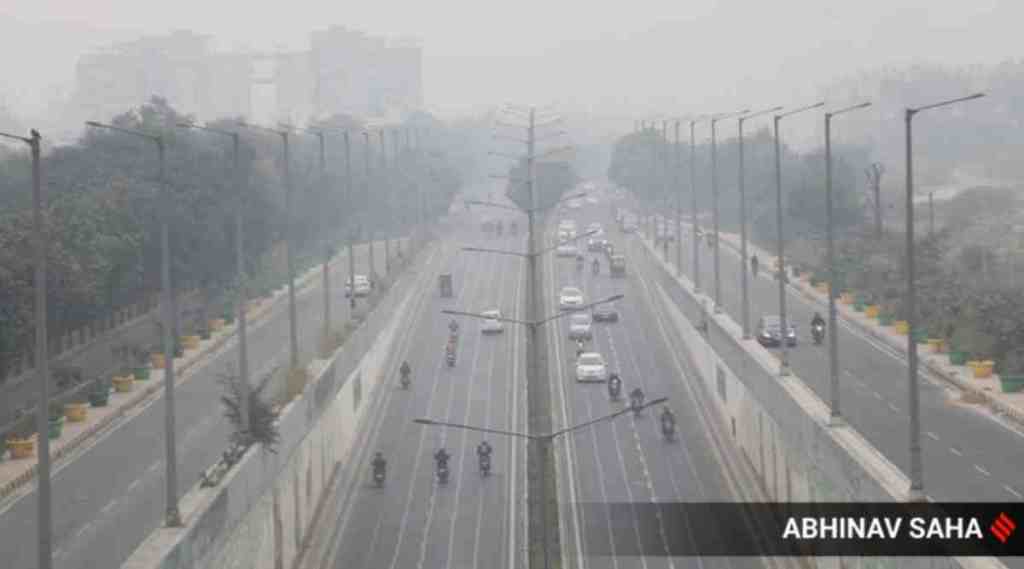 Construction sites of 500 square metres and above are required to register on the Delhi Pollution Control Committee (DPCC)’s dust assessment portal and do a self-audit of the mitigation measures that they have taken. (File)



 Share


