
Aravalli Range: This is what is left of a forest
Spread across four states, the 692-km-long Aravalli range has been assailed by a host of problems over the years — deforestation, mining and now encroachment. The Indian Express looks at how development in Haryana dealt a blow to the ecosystem and the animals living in it
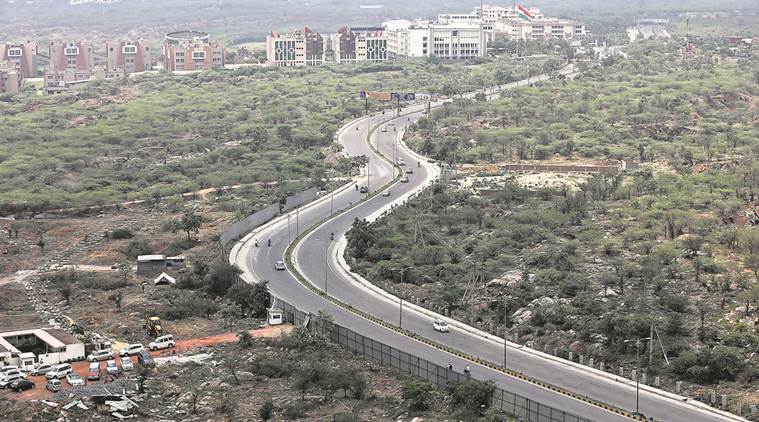 The Surajkund-Badkhal Road cuts through the Aravalli range in Faridabad. Until the 1960s, Aravalli land was considered common village land and utilised for grazing and other such purposes. (Express Photo/Abhinav Saha)
Anil Hansana, a resident of Faridabad’s Mangar village, remembers a time when people would refrain from harming the ecosystem of the Aravalli hills — with even little children afraid to pluck a leaf — as it would “anger” the spirits and bring misfortune. “We were told that anyone who plucks a leaf from a tree will die immediately, or their house would catch fire. And we believed it,” said Hansana, now in his mid-30s.
The Aravalli area located near the village — better known as Mangar Bani (forest) — is protected by legislation. A 2016 notification by the Haryana government’s Town and Country Planning Department declared the area a “no-construction zone”, demarcating a 500-metre buffer zone around the core area which measures 656 acres.

Several sections of the hills, however, have not had the same good fortune and continue to be threatened by real estate and encroachment. Even Mangar Bani — considered sacred and protected by the residents — is yet to be officially notified as a forest, leaving it open to several dangers.
Spread over an area of 692 km, the Aravallis cover the states of Gujarat, Rajasthan, Delhi and Haryana. In the latter, they are found in the southwest part of the state, covering five divisions — Gurgaon, Faridabad, Mewat, Mahendargarh, and Rewari. It is also the most “degraded” forest range in India, according to a study of the Aravalli hills in southern Haryana by the Wildlife Institute of India (WII).
Conducted between January and April 2016, the study found that “most of the indigenous plant species have disappeared… and the most serious threat to wildlife and forests is developmental activities, which are gradually destroying the remnants of the Aravallis”.
Sacred no more
According to locals, mostly Gujjars, who live in the villages near the Aravalli hills, the settlements arose several decades ago during the time of the Mughals. Naveen Gujjar (60), a resident of Pali village, said, “We have not only conserved the forest, but also nurtured it and brought it up. The growth has happened together.”
Over time, however, environmentalists believe these two factors — fear or sensitivity towards the forest — that allowed the Aravallis to thrive, have reduced their hold on those who live near it.
“With urbanisation, people have become more practical; they realise there will be no retribution even if they take from the forest. When mining came along a few decades ago, things became even worse as the temptation of money came in,” said Jitender Bhadana, a Faridabad-based environmentalist who is associated with the NGO, Save Aravallis.
He added, “Earlier, residents of these villages would earn Rs 10,000-Rs 15,000 in a month through sustainable development. Now, they have the opportunity to earn the same amount in a day just by selling their land.”
Visits to villages located at the foothills of the Aravallis are a testament to this statement. Those who remain speak of others who sold their land when the time was ripe and moved to the cities, “where they live in luxury”.
“Sensitivity to the needs of animals or the forest is a far-fetched idea in today’s world, where the focus is on earning as much as possible. What we need is airtight regulation and its strict enforcement. At this point, fear of the law is the only thing that can save the Aravallis,” Bhadana said.
Encroachment a major issue
Environmentalists blame four primary factors — encroachment being the major one — for the degradation of the Aravallis, all of which, they said, are yet to be resolved by the state and central governments.
*Issue of ownership: Until the 1960s, Aravalli land was considered common village land and utilised for grazing and other such purposes. But in the 70s and 80s, the process of privatisation came in, wherein land was apportioned among landowners and sold off at low prices. This, environmentalists believe, forms the basis of the real estate market’s interest in the Aravallis, since it has created scope for resale of the land.
*Definition of forest: There is no clarity on how much of the Aravalli range is included under the legal definition of “forest”, which is to be notified as per sections 4 and 5 of the Punjab Land Preservation Act (PLPA), or as per the dictionary definition of forest.
Following a 2006 Supreme Court order, all state governments were required to identify forests as per the dictionary meaning of the word, apart from lands which were demarcated in records as forest. But the Haryana government has been dilly-dallying on the definition of the term “forest”. As a result, while some areas in Haryana — around 25,000 hectares — are currently notified as forests under PLPA, the status of others — estimated to be around 12,000 hectares — is “yet to be decided”.
*NCZ: There is also contention regarding the classification of around 60,000 acres of the Aravallis as a Natural Conservation Zone (NCZ) — an area yet to be officially notified.
As per the Regional Plan 2021 of the National Capital Regional Planning Board, formulated in 2005, the NCZ category includes Aravallis, forests, rivers, major lakes and water bodies, as well as groundwater recharging areas. These are seen as environmentally or ecologically “sensitive” and there are major restrictions on their uses.
Construction is only allowed in 0.5 per cent of the area, and its purpose is also specified — “regional recreational activities”.
Chetan Agarwal, a Gurgaon-based environment analyst, said: “As per the Forest Conservation Act, you can still apply to divert the use of the land, but in NCZ there is no such option. The Haryana government has the option of stringent regulation in the form of NCZ, if only it is implemented properly.”
He added, “If they roll back privatisation and declare the Aravallis a forest area, the threat to the forest will be neutralised to a large extent. They will have the protection of the Forest Conservation Act. If they cannot construct in the area at all, then real estate giants would see no point in procuring land there.”
Encroachment: “This is the biggest problem. The mafia and property dealers control the government and administration, and get approvals… Many leaders own land in the hills, so why would they take a call that can work against them?” said Bhadana.
“Somewhere, these encroachers are in agreement with the authorities. What happened with the whole kikar tree issue recently is proof,” he added. Bhadana was referring to the recent debacle wherein the Haryana government added kikar and mesquite, the dominant species of trees in the Aravalli range, to the list of trees exempted under the PLPA — including them in the category of trees that can be felled without permission. The order was later called “a mistake” and revoked.
Officials from the forest department, however, defended themselves, stating that they have better technology and supervision to clamp down on encroachers. “We use thermo-sensing technologies and have digitised boundaries for this purpose. As a result, we can compare the condition of a specified area of forest over a period of time to identify any alterations, and take action accordingly. We also identify areas that are vulnerable to encroachment,” said Vinod Kumar, Conservator of Forests (Wildlife), Gurgaon.
“It is possible that sometimes guards do not report encroachment… but the technology we use leaves no scope for such errors,” he added.
Man vs wild
According to environmentalists, the impact of all these factors is felt most strongly by the animals that reside within the Aravallis, as their habitat shrinks each year.
The increased instances, in Gurgaon for example, of wild animals venturing into human habitations and creating chaos — often harming themselves or the people around them — is further evidence of this fact.
Earlier this month, employees at the Maruti Suzuki plant in Manesar received an unexpected visitor when a leopard ventured into the premises. The animal was captured by the forest department — 36 hours after it sought refuge in the engine room.
This is the seventh sighting of leopards in villages and areas bordering the Aravallis since 2016. While neither humans nor the animal were harmed in the Maruti incident, another instance of a leopard wandering into Mandawar village last year, proved much more chaotic — the animal was beaten to death, even as forest department officials and police personnel looked on.
According to a study conducted by WII between January and April 2016 — wherein 51 sites were sampled in the five forest divisions of Aravallis in Haryana — the hills were found to have several animal species, including 10 species of carnivores. (see box)
Recording “signs such as pugmarks, scats and territory markings as a measure for the presence of a particular species”, the study found 31 signs of leopards, 166 of jackals and 126 signs of hyenas. The final report, however, acknowledged that “wildlife is now limited to certain patches and protected areas owing to biotic interference and deforestation”.
“Increase in human population adjacent to the forest, and feral dogs, have become a threat to biodiversity… Highways passing through wildlife habitat are also a threat to the movement of animals… especially at night,” it added.
Acknowledging the threat that development poses to animals, Conservator of Forests (Wildlife), Gurgaon, Vinod Kumar, said: “Some amount of human-animal conflict will always be there since the two species reside in such close proximity. But there are certain measures that need to be taken to ensure that wildlife flourishes along with development of cities. For example, roads and highways are a threat to animals, so we need to build corridors that enable them to cross these areas safely. We are working on such plans.”
Last straw
The Supreme Court, in the matter of M C Mehta vs Union of India and Others in 2004, had acknowledged the sad state of the Aravalli hills. “In the early part of this century, the Aravallis were well-wooded. There were dense forests, with waterfalls and one could encounter a large number of wild animals. Today, the changes in the environment at Aravalli are severe… It cannot be questioned nor has been questioned that to save ecology of the Aravalli mountain, the laws have to be strictly implemented,” the apex court had said.
Environmentalists, however, believe the situation is more dire than the authorities realise. Bhadana went as far as to classify the current plight of the Aravallis as the last stage before its total decline. “There have always been issues for the Aravallis — earlier it was deforestation, then mining, now there are a different set of problems. But this is the last stage for the hills. It is a do-or-die situation. If people cut trees and build structures there, what can anyone do? Fines may be imposed, but there will be no point. It will all be over,” he said.
 Share


