


Stay updated with the latest - Click here to follow us on Instagram
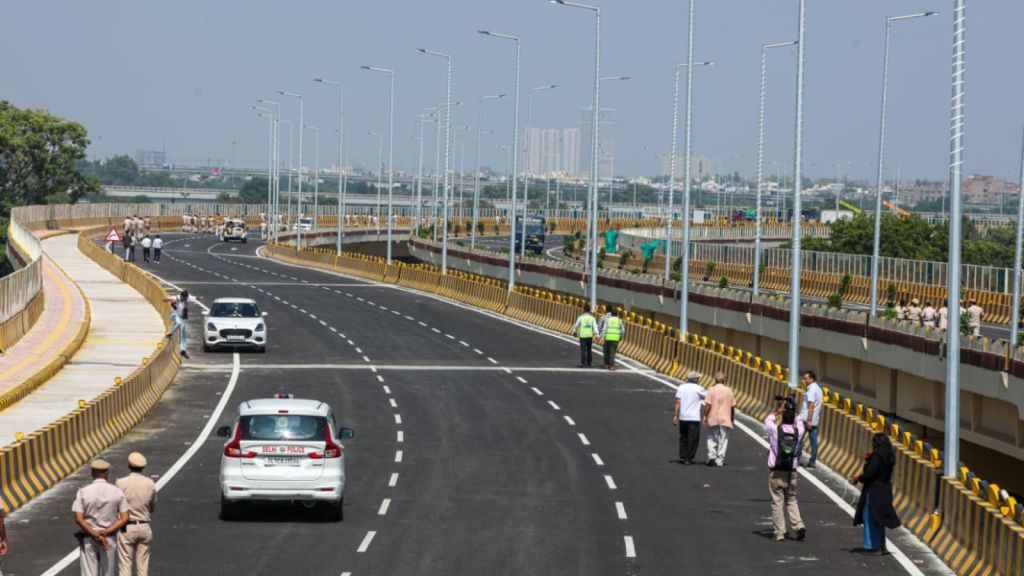 View of Barapullah Face-3, after the inauguration, in New Delhi (Express Photo by Praveen Khanna)
Union Home and Cooperation Minister Amit Shah on Tuesday inaugurated the long-pending Barapullah Phase III elevated corridor, which is expected to reduce travel time between East and South Delhi. He also inaugurated the Mukarba Chowk Underpass and laid the foundation stones for two more projects — the Modi Mill-Savitri Cinema Flyover and the Loni Underpass — while dedicating road infrastructure projects worth Rs 1,941 crore to Delhi.
Shah inaugurated the projects at a function attended by Chief Minister Rekha Gupta, her Cabinet colleagues Ashish Sood, Manjinder Singh Sirsa, Kapil Mishra and Pankaj Kumar Singh, as well as Union MoS for Road Transport Harsh Malhotra, among others.
The 3.5-km Barapullah Phase III corridor was originally approved in 2014. Work began in 2015. It was initially scheduled for completion in 2017 but faced multiple delays, leading to a significant escalation in its cost.
The flyover, which will merge with the existing Barapullah flyover at Sarai Kale Khan, completing a stretch of 10.9 km, has nine loops. It will provide signal-free connectivity between Mayur Vihar Phase I, Sarai Kale Khan and South Delhi, with separate facilities for pedestrians and cyclists.
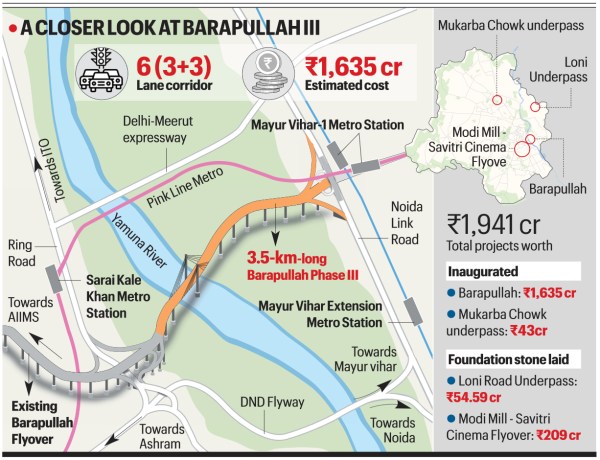 The 3.5-km Barapullah Phase III corridor was originally approved in 2014.
In a post on X in Hindi, Shah said the Rs 1,635-crore elevated road would provide signal-free connectivity between East and South Delhi, ease traffic congestion and reduce commuting time.
Hitting out at the previous AAP government, Gupta said that when she and PWD Minister Parvesh Sahib Singh initially visited site of the project, land had not been acquired, permission not taken for felling trees and no work was done to remove high tension wires. “Work was started in a hurry, but not completed for 11 years,” she said.
Gupta attributed the launch of the projects to what she called the “power of a double engine government”. She said that the cooperation between the two governments at the levels of policy, planning and implementation was “directly benefiting” Delhi residents.
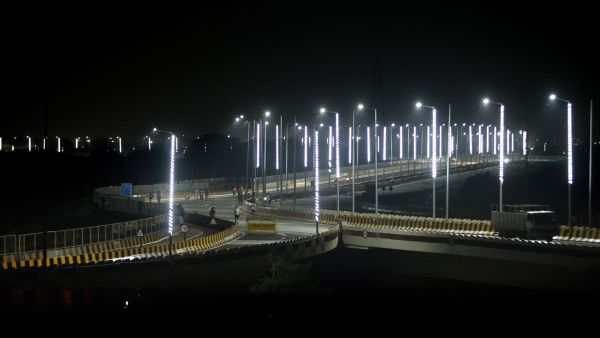 Barapullah Phase-3, elevated corridor, Illuminated after the inauguration, in New Delhi (Express Photo by Praveen Khanna)
The other projects include two flyovers in South Delhi, an underpass at Mukarba Chowk on the Outer Ring Road in North Delhi, and an underpass at the Loni Road roundabout in Northeast Delhi.
PWD Minister Parvesh Sahib Singh said Tuesday was an important day for Delhi’s infrastructure. The inauguration of Barapullah Phase III and Mukarba Chowk Underpass, along with the two new projects, would help improve daily commuting and save travel time, he added.
The Mukarba Chowk project, constructed at an estimated cost of Rs 43 crore, is set to make traffic movement on the Outer Ring Road smoother. It is expected to benefit around 15,800 vehicles daily. The government said that it will provide direct access for traffic travelling from Badli and Rohini towards Azadpur and Jahangirpuri without entering the Mukarba Chowk interchange.
The proposed Loni underpass will be four lanes wide. Its construction will reduce the need for vehicles travelling to and from Loni to stop at the roundabout and help make movement towards Shahdara smoother, according to officials. It will cost an estimated Rs 54.59 crore.
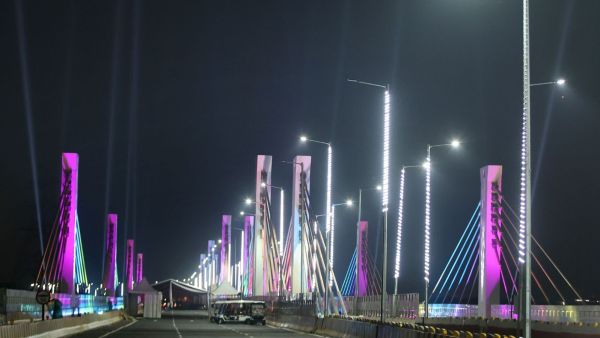 Barapullah Phase-3, elevated corridor, Illuminated after the inauguration, in New Delhi (Express Photo by Praveen Khanna)
The flyover at Modi Mill will strengthen signal free movement from Modi Mill towards Kalkaji and further in the direction of the IIT Gate. Officials said it will help reduce pressure at major traffic junctions in South Delhi, including Captain Gaur Marg-Outer Ring Road, and make movement between Nehru Place, Kalkaji, Greater Kailash and surrounding areas more convenient.
The Savitri Cinema flyover aims to reduce traffic pressure around the Outer Ring Road and GK 2 Road and provide a smoother route for vehicles travelling towards Nehru Place, Okhla and surrounding areas.
Stay updated with the latest - Click here to follow us on Instagram