
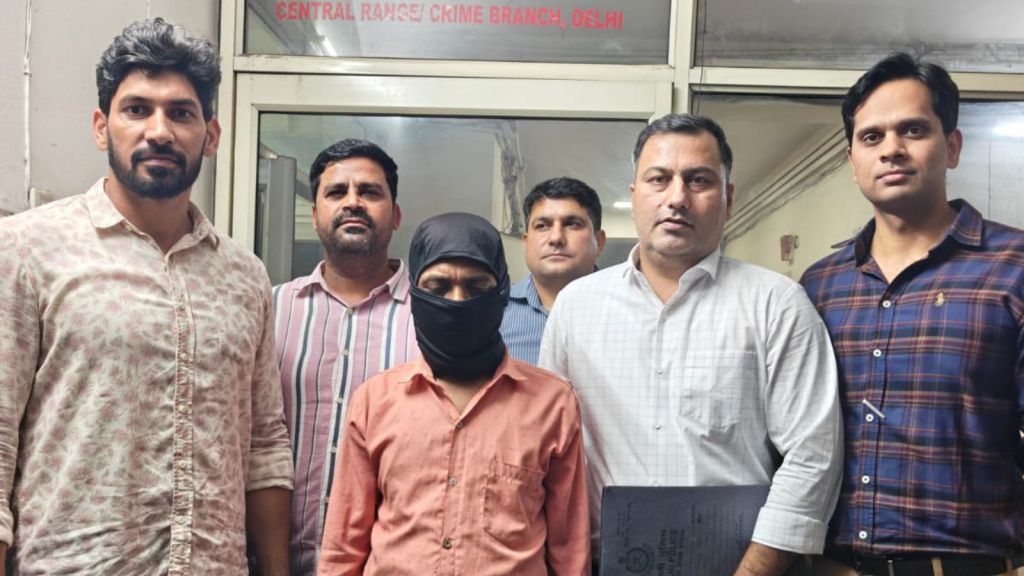
Last month, a team from the Delhi Police Crime Branch arrived in Janardanpur village in Bihar’s Samastipur district. They were looking for a man who had been on the run for three decades in a brutal double murder and dacoity case in East Delhi.
But there was a problem, very few people knew him by the name in the police records: Lalit Some knew him as ‘Chotu’, others as ‘Bhola’, nicknames that stayed with him since childhood, partly because he was barely five feet tall.

Even Lalit’s family members who still lived in the village could tell investigators little about where he was. He rarely returned home, police said.
Officers kept asking around and found one detail mentioned frequently: Lalit’s wedding. In 2017, he married a woman with an intellectual disability.
“In small villages, such news travels fast and remains a subject of conversation for years. People might not know where Lalit had gone, or what he had been doing for years, but they remembered the woman he had married,” officials privy to the investigation said.
For the police team, this seemingly inconsequential piece of village gossip became the clue they needed.
Investigators began tracing his wife, eventually finding her address and contact details. It led them back to Delhi; police discovered that Lalit was still in the city and had been working at different places.
The trail finally ended at a factory in Mangolpuri Phase II. Lalit, now 48, was working there as a packaging labourer. Police discreetly verified his identity before arresting him last week. His Aadhaar card, they said, carried the name Lalit but he never told his employers his real name.
Five men from Janardanpur
The story began in 1994 with five men from Janardanpur who came to Delhi looking for work.
According to investigators, one of the men, Sunil Kumar, had earlier worked as a helper and cleaner at the Nirmal Sadhana Ashram in Shakarpur. He returned to his village and suggested that his friends — Sushil, Dilip, Gangadhar and Lalit — come with him to the national capital.
Since Sunil already knew people in the ashram, the five stayed there for two nights while they looked for jobs and accommodation.
The men then noticed something: devotees regularly made offerings, including cash, jewellery and other valuables, to the two sadhvis who headed the ashram.
Investigators said the five men gradually began discussing the possibility of robbing the ashram.
The women, they felt, were vulnerable targets: one was in her late 60s, the other in her early 40s.
According to police, the men had believed this would be an easier and quicker way to make money than the menial work they had originally come to Delhi to find.
Robbery to murder
Police investigation showed that the five men allegedly attacked the two sadhvis and strangled them with an electrical wire. They then allegedly fled with cash, jewellery and other valuables from the ashram.
A case was registered at Shakarpur police station under charges of punishment for murder, dacoity with murder, and common intention of the Indian Penal Code (IPC).
“Lalit was one of the main accused… who participated in the strangulation of the two women. Investigators further said he received some cash and jewellery as his share of the alleged loot,” said Special CP (Crime) HGS Dhaliwal.
The first arrests came about eight months later. Sushil, Sunil and Dilip were nabbed, according to police. The case went to trial and the court subsequently awarded them life imprisonment, investigators said.
“Gangadhar and Lalit, however, remained on the run. Lalit was declared a proclaimed offender on October 26, 1995. Gangadhar was never arrested. Police later learnt that he died around three years ago,” Dhaliwal added.
Police said Lalit remained in Bihar until around 2000 before moving back to Delhi.
He lived a low-profile life, working as a packaging labourer at different manufacturing units to conceal his past. He married in May 2017 and had a five-year-old son, according to police.
Earlier this year, Lalit popped up on the police radar when the Crime Branch’s Central Range began revisiting old cases and proclaimed offenders who had remained untraced for years.
The operation was carried out by the Central Range Crime Branch team, including Inspector Vinay Kumar, Sub-Inspectors Vikas Solanki, Ritesh Kumar and Jai Kumar, and Head Constables Gaurav and Bijendra Singh. The team worked under ACP Satender Mohan, ACP/CR, Crime Branch, and under the supervision of DCP Harsh Indora.
For the investigators, the arrest was the culmination of a trail that had stretched across three decades from an ashram in Shakarpur to a village in Samastipur and finally back to an industrial neighbourhood in Northwest Delhi.
An official privy to the investigation said, “The breakthrough had not come from a new witness to the 1994 killings, a document, or a sophisticated change of identity trail but it came from something far more ordinary — a village that remembered a wedding.”


 Share


