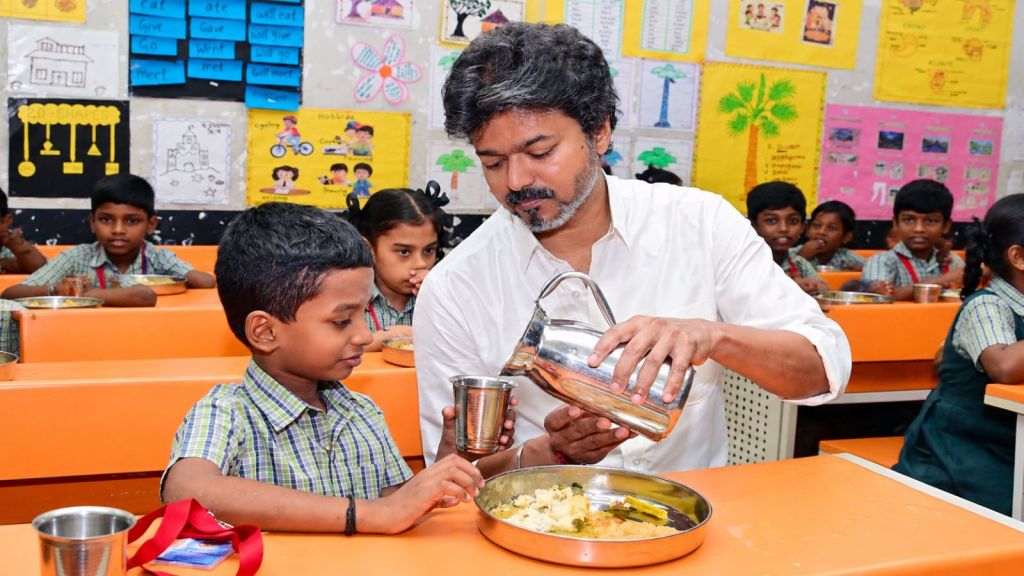
Tamil Nadu Chief Minister C Joseph Vijay on Tuesday expanded the state’s free breakfast programme to include students from Classes 6 to 8 in government and government-aided schools in the scheme.
With this, about 15.30 lakh children have joined the welfare programme that began four years ago with primary school students.
With the latest expansion, about 34.64 lakh students in Classes 1 to 8 across 44,984 government and government-aided schools will receive breakfast, at a total allocation of Rs 724 crore.
The government said the expansion was intended to improve children’s nutritional status, prevent students from attending classes hungry, and enable them to concentrate better on their studies. It described the programme as one that brings together nutrition, attendance and learning, while providing support for children’s education and social advancement.
The programme has grown substantially since 2022, when the then DMK government under CM M K Stalin introduced the Chief Minister’s Breakfast Scheme for children in Classes 1 to 5.
Announced by Stalin on May 7, 2022, on the first anniversary of his government, the scheme’s first phase covered about 1.14 lakh children in 1,545 schools at a cost of Rs 33.56 crore. The programme was launched that September, with a rotating menu including upma, kichadi, pongal and, on some days, rava or semiya kesari.
Story continues below this ad
The stated rationale was straightforward: Government studies had found that some children were reaching school without having eaten, either because they travelled long distances or because of economic difficulties at home.
The programme subsequently expanded — to corporation and municipal schools in February 2023, all government schools in August 2023, rural government-aided schools in July 2024, and government-aided primary schools in urban areas in August 2025. By then, the government said 17.53 lakh children across 34,987 schools were covered. More recently, coverage of Classes 1 to 5 had reached about 19.34 lakh students.
An early evaluation by the Tamil Nadu State Planning Commission also recorded changes in attendance. Of 1,543 schools examined after the scheme began in September 2022, 1,319 recorded increased attendance in January and February compared with the preceding June-July period. In 1,086 schools, attendance increased by up to 20%, while 22 schools recorded increases exceeding 40%.
All beneficiary schools studied in Tirupathur, Perambalur, Ariyalur and Tiruvarur districts recorded gains. A comparison involving 414 neighbouring schools located within one to two kilometres also found a stronger positive attendance trend among schools covered by the breakfast programme.
Story continues below this ad
History of free school meals in state
The breakfast scheme is the latest chapter in a much longer history of state-supported school meals in Tamil Nadu.
Its roots go back to 1922, when P Theagaraya Chetty, then president of the Corporation of Chennai and a Justice Party leader, introduced meals for underprivileged children in selected Chennai schools. About 800 students benefited between 1922 and 1925 before the programme was discontinued under the British administration; it was reintroduced in 1927.
In 1956, Congress Chief Minister K Kamaraj expanded the idea across Tamil Nadu, providing midday meals to children from poor families for 200 days a year.
CM M G Ramachandran substantially expanded the programme in 1982 as the Nutritious Meal Programme, initially targeting malnourished children aged 2 to 9 in rural preschools and primary schools before widening its reach to urban areas and older students.
Story continues below this ad
Successive governments added to the meal. In 1989, the M Karunanidhi government introduced one boiled egg every fortnight. Eggs were progressively increased until children aged 5 to 15 were provided one on every school working day, with a 100-gram banana offered to children who did not eat eggs. In 2013, the J Jayalalithaa government introduced variety meals, including vegetable biryani; tomato, lemon and tamarind rice; and masala eggs.
Nutrition interventions have also included local experiments. Primary school children in Ariyalur were provided 50 grams of millet ladoo twice a day while malnourished children in Perambalur received 100 grams of cookies and chikki daily. Such programmes improved Body Mass Index among participating children, the government said.
The programme has also been linked to broader nutritional concerns. NFHS-5 data for 2019-21 showed that 57.8% of Tamil Nadu children aged six to 59 months were anaemic, while studies cited in earlier assessments found high anaemia prevalence among school-age children as well. Research has associated poor dietary diversity with micronutrient deficiencies, including iron, vitamin A and zinc.