


Stay updated with the latest - Click here to follow us on Instagram

Journalism of Courage
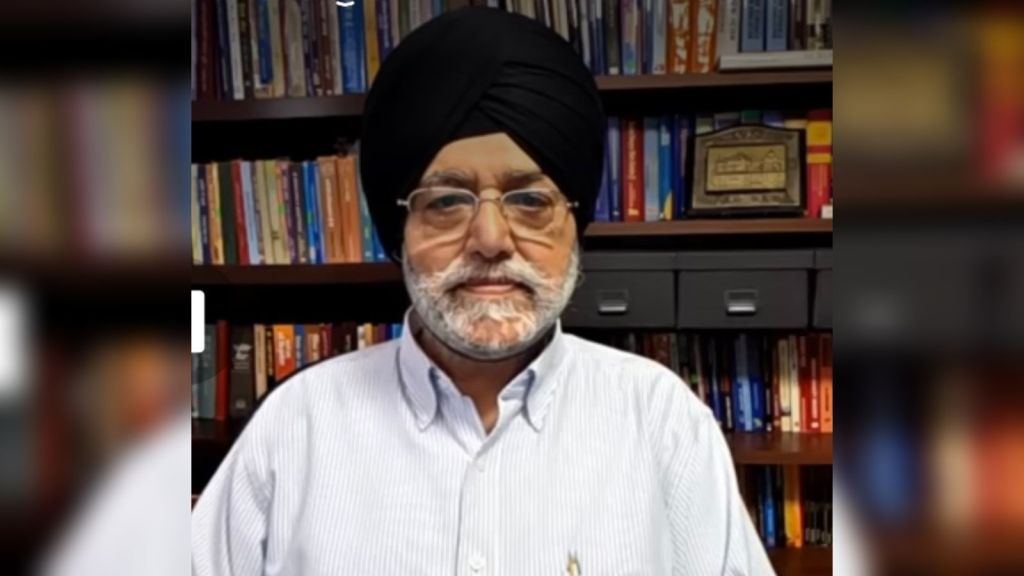 US-based Sikh scholar Gurcharanjit Singh Lamba explains why the distinction matters in Sikh theology. (Photo by special arrangement)
The Vande Mataram debate has reached the doors of the Akal Takht with several Sikh organisations seeking a clear Panthic position on the singing of the national song.
The demand comes amid renewed discussion over the song’s 150-year history and its full rendition, which have brought back an old question: can reverence for the motherland be separated from the religious imagery in which it is expressed?
The question is not only how much of the song should be sung, but also what the words mean to people of different faiths. A US-based Sikh scholar, writer, and former editor of Sant Sipahi, Gurcharanjit Singh Lamba explains why the distinction matters in Sikh theology.
While sharing his perspective with The Indian Express, he says the love for the country and worship of the country as a deity are two different questions. He argues that loving and respecting one’s country is fundamentally different from worshipping it as a deity.
What is the Sikh perspective on the debate over Vande Mataram?
Gurcharanjit Singh Lamba: The issue needs to be understood by distinguishing between love for one’s country and religious worship. Sikhism does not oppose love for the homeland. A Sikh can serve the country, respect it, and make sacrifices for it. The question is different when the motherland is presented as a deity and worship is directed towards that representation.
For Sikhs, the Supreme Being is formless and cannot be confined to any physical representation. Therefore, the idea of worshipping a personified form of the country is a theological question that has to be viewed differently from patriotism.
So is the Sikh objection to Vande Mataram an objection to patriotism?
Gurcharanjit Singh Lamba: No. Patriotism and worship should not be equated. Sikh history itself has numerous examples of sacrifice for the country and its people.
The distinction is between vatan, the homeland, and Bharat Mata as a divine or goddess-like representation. One can have deep affection for one’s homeland without regarding the homeland as a deity.
Why does the religious imagery in Vande Mataram become significant in the Sikh context?
Gurcharanjit Singh Lamba: The issue is not merely the expression Vande Mataram. The song, particularly in its later portions, contains imagery associated with Hindu goddesses and divine forms.
What does Gurbani say about the nature of God in this context?
Gurcharanjit Singh Lamba: Gurbani describes the Supreme Being as beyond physical form, colour, and appearance. It does not present God as a being who can be represented through a physical form and worshipped as such. The Sikh understanding of the Supreme Being is of the One, formless God.
Therefore, a Sikh can acknowledge the song’s historical and patriotic significance while having a religious objection to its devotional imagery.
This understanding is central to the Sikh faith. That is why the distinction between the country as a homeland and the country as a deity becomes important.
But Vande Mataram has an important place in India’s freedom struggle. How should that history be viewed?
Gurcharanjit Singh Lamba: Its historical role should be acknowledged. Vande Mataram became associated with India’s freedom struggle and inspired people during the movement against British rule.
Recognising that history, however, does not necessarily mean that followers of every faith must accept every religious element associated with the song. Historical significance and theological acceptance are two different matters.
Does Sikh history offer examples of patriotism without turning the country into an object of worship?
Gurcharanjit Singh Lamba: Yes. Sikh history is deeply connected with sacrifice, resistance, and service. Master Tara Singh’s account from his imprisonment in Almora, for instance, reflects the importance attached to the motherland and the struggle for freedom.
The reference to the motherland in such a context is about love for one’s country and willingness to sacrifice for it. It should not automatically be interpreted as worship of the country as a deity.
Besides, Bhagat Namdev’s verses, which are included in the Guru Granth Sahib, reinforce the Sikh understanding of devotion to the One Supreme Being rather than worship of physical forms.
What relevance does Bhagat Namdev’s bani have to this discussion?
Gurcharanjit Singh Lamba: His bani is part of the broader spiritual tradition represented in the Guru Granth Sahib, where the emphasis remains on the One God. Bhagat Namdev was coerced by the Nawab to say Khuda and Tam.
There is also a Bharat Mata Temple in Varanasi. Does such a representation raise a different question for Sikhs?
It highlights the distinction between a symbolic representation of the country and its treatment as a divine figure. The Bharat Mata Temple has just a map of Bharat and no deity.
If Bharat Mata is used simply as a symbolic expression of the nation, people may understand it in that manner. But when the representation becomes an object of religious worship, it enters a different category.
The issue has also been discussed by Sikh institutions. What has been the nature of that discussion?
Gurcharanjit Singh Lamba: The issue has figured in Sikh institutional discourse as well. The Shiromani Gurdwara Parbandhak Committee took a position on Vande Mataram in 2006, and the matter was also discussed at the Sri Akal Takht Sahib.
The concern was related to Sikh religious principles and the question of worship. It should not be reduced to an allegation that Sikhs are opposed to patriotism or national feeling.
Why is this distinction important in today’s debate?
Gurcharanjit Singh Lamba: Because India has people belonging to different religious traditions. National unity does not necessarily require religious uniformity.
A Sikh can be completely committed to the country and remain faithful to the basic principles of Sikh theology at the same time. These positions are not contradictory.
What according to you should be the larger takeaway from the controversy?
Gurcharanjit Singh Lamba: The debate should not become a test of who is more patriotic. Patriotism can be expressed through service, sacrifice, responsibility, and commitment to the country and its people.
The important distinction is between love for the homeland and worship of the homeland as a deity. Different communities can share a common national identity while retaining their own religious beliefs and practices.
Unity, therefore, need not mean uniformity.
Stay updated with the latest - Click here to follow us on Instagram