8-year deadlock ends as six states sign Kishau pact; Amit Shah says 10th water dispute resolved

Other beneficiary states to bear Rs 2000 cr of Himachal's power component: Sukhu

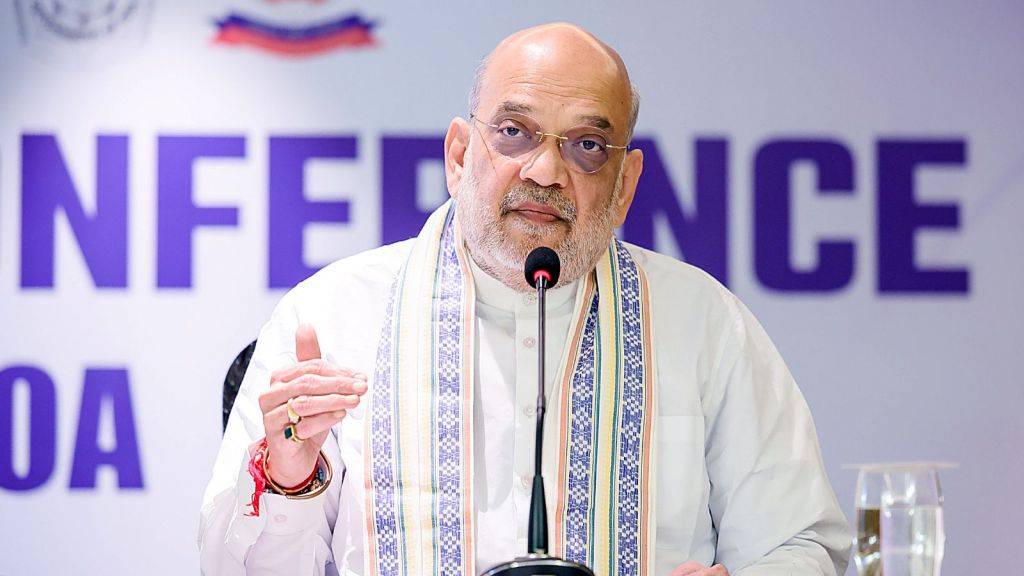
Union Home Minister Amit Shah terms agreement among six Yamuna basin states on long-pending Kishau Multipurpose Project "historic", noting it as the 10th water dispute resolved under PM Modi.Union Home Minister Amit Shah terms agreement among six Yamuna basin states on long-pending Kishau Multipurpose Project "historic", noting it as the 10th water dispute resolved under PM Modi. (ANI/ File)

The long-pending Kishau Multipurpose Project moved closer to implementation on Tuesday with six Yamuna basin states signing an agreement, which Union Home Minister Amit Shah termed “historic” and claimed that it was 10th water dispute to be resolved since Narendra Modi became Prime Minister.

The agreement, signed in New Delhi in the presence of Shah and Union Jal Shakti Minister C R Patil, involves Himachal Pradesh, Haryana, Uttarakhand, Uttar Pradesh, Delhi and Rajasthan. The chief ministers of respective states — Sukhvinder Singh Sukhu, Nayab Singh Saini, Pushkar Singh Dhami, Yogi Adityanath, Rekha Gupta and Bhajanlal Sharma — signed the pact.

Shah said the agreement would benefit all six states. The Centre and the Yamuna basin states are committed to completing at the earliest the 422-MW project, which had remained stalled for more than eight years. He said a formal agreement had been reached on June 16 after the Ministry of Jal Shakti secured the consent of all states and examined the technical and economic aspects of the project.

Shah said that since Modi became prime minister, initiatives had been undertaken to resolve serious disputes that had continued for decades and this project will be the “tenth water dispute that is now set to be resolved.” He cited agreements relating to the Lakhwar Multipurpose Project, Shahpur Kandi Dam Project, Renukaji Multipurpose Dam Project, Ken-Betwa Link Project and other water-related disputes.

He said the period from 2018 to 2026 would be remembered for resolving almost all major water disputes, from Kashmir to Uttar Pradesh.

The Kishau project envisages a 232.6-metre-high concrete gravity dam on the Tons river along the Uttarakhand-Himachal Pradesh border. It will have a storage capacity of 1,562 million cubic metres, irrigate about 97,000 hectares and generate 1,476 million units of hydropower, according to Shah. Delhi, he said, would be the biggest beneficiary.

The project is estimated to cost Rs 15,624 crore. Under the agreement, the Centre will bear around 90 per cent of the financial burden for the water component, with the remaining 10 per cent to be shared by the participating states in accordance with the 1994 Yamuna water agreement.

Story continues below this ad

The project’s financial implications for Himachal Pradesh, however, became a key issue, with Chief Minister Sukhvinder Singh Sukhu claiming that his government had secured a major concession for the state by refusing to accept the arrangement agreed to by the previous government.

Sukhu said the Centre had, in principle, agreed that the estimated Rs 2,000-crore power component falling on Himachal Pradesh would be borne by the beneficiary states of Delhi, Rajasthan and Haryana.

“The previous government had agreed to give Rs 800 crore of the state’s share, which the present government refused in the interest of Himachal,” Sukhu said, describing the agreement as a major victory in the state’s fight to secure its legitimate share from hydropower projects.

He said Himachal had argued that while the Centre was providing a 90 per cent grant for the water component, it was unfair to impose a financial burden on the state for the power component, particularly when people in Himachal would face displacement and the state would bear the environmental and social costs of the project.

Story continues below this ad

Sukhu said Himachal would receive about 1,000 million units of power annually from the project, which, according to current estimates, could translate into around Rs 1,200 crore in annual revenue for the state. Earlier calculations had put the annual income at around Rs 600 crore, he said.

“This is yet another addition to the state’s financial resources,” Sukhu said, adding that the government had prioritised the interests of Himachal Pradesh and its people.

The chief minister said comparatively fewer villages in Himachal would be affected than in Uttarakhand and assured that affected families would be adequately compensated under applicable land acquisition provisions.

Meanwhile, Shah said the Kishau agreement would also have an environmental dimension. He said the Yamuna’s environmental flow had not been accounted for when its waters were originally allocated among states, leaving little water for the river itself.

Story continues below this ad

He said 25 per cent of the water would become available through the Kishau agreement, benefiting both Delhi and the Yamuna and helping environmental conservation.

Shah said work to clean the Yamuna was continuing and expressed confidence that the goal of a clean Yamuna would be achieved by 2029, stressing that cleaning the Yamuna was essential to fulfilling the objective of a clean Ganga as the two rivers meet at Prayagraj.

Delhi CM Rekha Gupta said the national capital will receive around 110 million cubic metres (MCM) of water from the project, boosting supply in the city and improving environmental flow in the Yamuna. She said that the project will provide long-term support for Delhi’s water needs.

Uttar Pradesh CM Yogi Adityanath, in a post on X, said the agreement was a “strong” expression of “cooperation for solution” and cooperative federalism. He said the project would help expand irrigation facilities in Uttar Pradesh, strengthen drinking water availability and give a fresh impetus to the uninterrupted flow and cleanliness of the Yamuna.

Story continues below this ad

Rajasthan CM Bhajanlal Sharma said the project will resolve the issues of irrigation and drinking water,” he said.

Sukhu, meanwhile, used the occasion to reiterate Himachal’s broader demands over its hydropower resources, saying the state contributes significantly to the country’s energy and ecological needs but continues to bear the economic and environmental costs.

He said large public sector undertakings were benefiting from around 14,000 MW of hydropower and renewable energy potential in Himachal, while the state currently received 12 per cent free power royalty and 1 per cent under the Local Area Development Fund.

The state, he said, was demanding that once a project became free from cost after 12 years, Himachal should receive 30 per cent free power royalty between the 12th and 30th year, with the project transferred to the state after 40 years. If an organisation continued to operate it thereafter, Himachal should receive 50 per cent free power royalty, he said.

With PTI

Saurabh Parashar is an Assistant Editor at The Indian Express, primarily responsible for the publication’s coverage of Himachal Pradesh. He is a seasoned journalist with over 17 years of experience in print media, specializing in crime, legal affairs, and investigative reporting. Professional Background Education: He holds a Master’s degree in Mass Communication from Guru Jambheshwar University of Science & Technology (Hisar) and a Law degree from Himachal Pradesh University (HPU), Shimla. This legal background significantly informs his reporting on complex judicial and administrative matters. Career Path: Before joining The Indian Express in 2017, he spent 12 years with The Times of India. Core Beats: His primary focus is the socio-political landscape of the hill state, with a specific emphasis on the environment, forest conservation, drug menace (specifically "Chitta"), affairs related to tribal and archaeology and the unique challenges of governance in high-altitude regions. Recent Notable Articles (Late 2025) His recent reporting highlights the critical intersection of policy, law, and social safety in Himachal Pradesh: 1. "Himachal’s battle against Chitta: Why the border areas are most vulnerable" (Late 2025): An investigative look at the transit routes from Punjab and the impact on local youth. 2. "Shimla ropeway clears key hurdle as 820 trees face the axe :According to the Forest Survey of India’s 2021 assessment, 47.21 percent of Shimla’s 5,131 sq km geographical area is under forest cover (Nov 17, 2025). 3. "Himachal to handover 2.7427 ha of non-forest land for Shimla Ropeway: Given the land’s non-forest nature, RTDC and the state will not require permission from MoEFCC" (Nov 18, 2025) 4. "How the centuries-old Jodidara tradition is fading in Himachal’s Trans-Giri region: Jodidara: a form of fraternal polyandry—has long been part of Hatti tribal culture in the Trans-Giri region of Himachal Pradesh and adjoining Uttarakhand. It is believed to have evolved to prevent division of ancestral land and maintain unity among brothers in the harsh, mountainous terrain" (Aug 18, 2025) Legal & Agricultural Affairs "Kisan Sabha hails SC’s setting aside Himachal HC order to remove orchards from forest land" (Dec 18, 2025): Covering a major Supreme Court victory for farmers, where a High Court order to remove fruit-bearing apple orchards was overturned. "Himachal Cabinet nod to new tourism policy; focus on home-stays in tribal areas" (Dec 11, 2025): Detailing the legislative push to decentralize tourism and bring economic benefits to Lahaul-Spiti and Kinnaur. 3. Governance & Environment "Forest rights and development: Why Himachal is seeking more leeway from Centre" (Dec 19, 2025): Reporting on the legal hurdles faced by the state in infrastructure projects due to the Forest Conservation Act. "Cloudbursts and resilience: How Himachal’s remote villages are building back better" (Nov 2025): Following up on the long-term rehabilitation efforts after monsoon-related disasters. Crime especially cyber crimes, crypto currency etc: crypto currency: "Agents in uniform, motivational speeches, lavish parties: How a Himachal crypto con went unnoticed:A serial conman, a ‘Nelson Mandela Nobel Peace Award winner', and retired policemen got together to pull off a Rs 1,740-crore fraud" (Nov 10, 2023) Signature Beats Saurabh is recognized for his tenacious reporting on the state's drug epidemic. His deep familiarity with the topography and tribal culture of Himachal allows him to report from remote locations like Spiti, Pangi, Shillai, which are often overlooked by national media. His legal expertise makes him a primary choice for covering the Himachal Pradesh High Court on issues ranging from local body elections to environmental PILs. X (Twitter): @saurabh_prashar . ... Read More

Stay updated with the latest - Click here to follow us on Instagram

Advertisement
Loading Recommendations...
Advertisement
Advertisement
Latest Comment
Post Comment
Read Comments