The morning of August 24 saw multi-storey buildings fold like a pack of cards in Kullu district as heavy rain triggered another round of landslides in Himachal Pradesh. About 200 km away, state capital Shimla had witnessed similar scenes between August 14 and 17. Twenty-seven deaths were reported during this period from Shimla, including seven from one family in a cloudburst incident at Shiv Bawadi temple. Nine buildings and a section of the Kalka-Shimla railway track had also collapsed during this time.

This was an admission — at the highest levels of the government — of a problem that has stared in the face of every visitor to Shimla and every resident of the hill town since late 2000s. While the CM blamed faulty structural design and indiscriminate construction work for the recent destruction faced by his state, much of the blame for Shimla’s unchecked growth lies at the doors of governments past and present.
Red flags ignored
When the British built Shimla on the grasslands they had retained after the 1814 Gurkha War, the hill town was a place where the troops rested. However, its cool climate and picture-postcard beauty made it popular as a summer resort. Being declared the country’s summer capital from 1865 to 1939 led to Shimla’s exponential growth.
Ashwani Kumar, an assistant professor in the Department of Architecture and Planning at Jaipur’s Malaviya National Institute of Technology (MNIT), said, “The structural destruction of the hills was evident in 2009, when I did my first study on Himachal Pradesh. There are many reasons why Shimla is sinking — weak implementation of building bylaws, regularisation of violations, cutting of slopes at 90 degrees and lack of scientific studies of sites where construction is planned.”
Kumar, who has guided at least three studies on architectural aspects in Himachal Pradesh and Uttarakhand, added, “The authorities and the locals are both at fault here. Over half the structures being constructed in Shimla have architectural faults like building design, height, etc. Serious corrective measures are required to help Shimla. Of course, the rain has added to the town’s problems.”
Geoscientist Sreedhar Ramamurthy agrees, “Shimla falls under seismic zone IV. This leaves its nearly 1.50 lakh residents vulnerable to earthquakes. Since micro earthquakes happen in the region daily, there is a need to change structural design across the state. We should learn from Japan, an earthquake-prone country that uses light construction materials. Instead of concrete walls inside a house, we can make walls using hardboards and use cupboards to demarcate rooms. The institutes in Shimla should be relocated elsewhere to decrease pressure on the township. The state can also think on the lines of Andhra Pradesh’s three capitals proposal.”
Former Shimla Deputy Mayor Tikender Singh Panwar, a vocal critic of urbanisation of the town and its Shimla Development Plan (SDP), terms its current growth “planned destruction”.
“The township is built on extensive grasslands. The locals never intended to make permanent structures on them, and used them in summer and retreated before winter. The British altered that by building structures like the eight-storey Indian Institute of Advanced Study, Ridge, Christ Church and even a rail line. Though they built these after thorough analysis, we cannot romanticise the urbanisation of the grasslands. The region was better off before the British. It is witnessing a systematic dismantling now,” he said.
For a city built by the British for a maximum of 25,000 people, its population touched 55,368 by 1971. It went up to 1.69 lakh in 2011 and is nearly 2.34 lakh today.
To meet their demands and those of the hordes of tourists who descended on the hill town every summer to escape the heat of the plains, Shimla grew alongside. Today, the town has 236 hotels and over 100 bed and breakfast accommodations. Its rural areas have nearly 1,000 homestays at present. According to a 2018 Household Survey, the town’s three bus terminals see a footfall of around 49,633 on a usual working day. And all this has stretched the town’s resources thin.
The first warning signs of this overburden were seen in the early 2000s, in the form of cracks on the sprawling Ridge, which houses landmarks like Christ Church and State Library. Efforts to repair the Ridge, which covers a British-era 10-lakh gallon water reservoir, have been on since then. Taking a serious note of the situation, the National Green Tribunal (NGT) had implemented a comprehensive construction ban in 2017 across Shimla’s core and green areas. Of the nearly 100 hectares under Shimla’s 17 green belts, 75.83 hectares fall on government land.
A review plea by the state seeking relaxation on the construction ban was dismissed by the NGT in July 2018. In response, the state moved the Supreme Court. In February 2022, the Town and Country Planning Department notified the draft SDP, titled ‘Vision 2041’. The plan permits concrete construction in 17 green belts with “restrictions” and also opens the door for new satellite towns around Shimla, particularly near the four-lane highway, to ease congestion in the core area.
Eight months on, the NGT passed orders quashing the SDP. In May 2023, the apex court allowed the state to notify the SDP but with “restrictions”, including no felling of trees in green areas; and no construction beyond two floors with attics and parking in core zones, and more than three floors with parking and attics in non-core regions.
A senior Town and Country Planning Department officer said, “The apex court allowed us to notify the SDP. We have assured full protection of Shimla ecology and environment in the plan. Construction in green belts will be restricted and be done without felling trees.”
Between July 7 and August 17, when monsoon fury was at its peak in Himachal Pradesh, Shimla Municipal Corporation received at least 300 applications urging the authorities to axe “vulnerable trees” across town. “We received around 300 applications from locals pertaining to (felling or cutting of) cedar (deodar) trees that abound in Shimla. Since, tree felling is restricted in Shimla, the applications have been referred to the Tree Authority Committee (TAC). Considering the current situation, the applications will be processed shortly,” said Bhuwan Sharma, Joint Commissioner, Shimla Municipal Corporation.
Shimla’s civic oversight is vested in the Shimla Municipal Corporation, while the rural region falls under the purview of the Town and Country Planning Department.
Environmentalist Yogendra Mohan Sengupta, who took the state to the NGT, said, “Shimla has been ‘overloaded’ for about three decades now but construction is increasing, more tourists are pouring in and rocks are being smashed to make a four-lane highway. The NGT had in 2017 ordered a study by a committee from the Wadia Institute of Himalayan Geology (WIHG), Dehradun. The study had suggested that land should be zoned based on slope stability and mass movement. It found that many Shimla buildings were in landslide-prone spots.”
He added, “Shimla saw a terrible water crisis in 2018. People were angry, tourist bookings cancelled and visits by relatives postponed. The same worries, frustrations and fears are back — just for a different reason. Landslides are claiming lives, and destroying buildings and roads. It won’t be long before the locals hit the streets again, demanding action.”
‘Can’t just blame the rains’
Local voices expressing concern over Shimla’s recent catastrophes have grown louder.
“Shimla is in trouble. Landslides are common in Shimla during monsoon. The rain has been heavier this year, but we can’t blame everything on the rain,” said BN Nanta, a retired IAS officer and a regular at the usually crowded Indian Coffee House, as his friend TG Negi, the former state additional secretary, nodded in agreement.
Retired IAS officer BN Nanta (right) said Shimla’s current destruction and condition cannot be blamed on rains. (Express photo)
Richa Minocha, an academic and Shimla resident who now teaches environmental science at a Pune-based institute, said, “Various studies have repeatedly stated that Shimla simply can’t handle more stress. Even the British were alarmed when the population touched 25,000. Signs of destruction were evident before 2000, after which construction was banned in green areas but not enforced strictly. The Town and Country Planning Department, which insists on implementing SDP now, had imposed the ban. Around the same time, cement plants and dams — Koldam Dam on the Satluj in Bilaspur and Sawra-Kuddu Dam on the Ravi in Shimla’s Jubbal — were established. These played a major role in destroying the hills.”
“I recall my childhood in Shimla, when just Upper Shimla, Lower Shimla, Mall Road, Summer Hill and Cart Road defined the town. The numerous constructions make it hard to pinpoint where Shimla starts and ends now. The government should focus on promoting agriculture, instead of fixating on real estate and tourism projects around Shimla under the SDP,” Minocha cautioned.
Photographer Vinod Dayal, who had used his drone to help rescue teams pinpoint the location for targeted excavation at Shiv Bawadi temple, said, “The government says poor drainage is a factor behind landslides. People dump wastewater on the hills instead of the drain because the civic body doesn’t give drainage connections till a structure is regularised. And obtaining that regularisation certificate takes years in Shimla. Where else is one supposed to dump the wastewater?”
Between August 14 and 17, 27 deaths were reported in Shimla, including seven from one family in a cloudburst incident at Shiv Bawadi temple. (Express photo)
Sitting on a bench at Annadale Road market, which faces the British-era Vidhan Sabha, forest department employee Dilip Thakur said, “Look at what the Smart City Project has done to Shimla: digging trenches or embedding heavy iron bridges and stairs at every corner. They’ve laden the hills with more iron than they can bear. It’s becoming riskier to live here in the monsoon.”
Blaming the relentless rain for the recent landslides in Shimla, Mayor Surinder Chauhan said, “Although we cannot undo what has already been done, we are reviewing forthcoming structural proposals.”
Manshi Asher of Himdhara, an environmental research collective based in Himachal Pradesh, said, “The recent destruction didn’t come as a surprise. The government, politicians and media use the term ‘natural disaster’, but what happened in Shimla was a disaster that we caused. Any local will tell you that landslides have been happening for a while, but that they have turned into disasters now. Multi-storey buildings have been built on areas prone to landslides, right under the authorities’ noses. So we can’t use terms like ‘climate change’, ‘global warming’, ‘heavy rains’ or ‘cloudbursts’ to disguise our carelessness.”
The way ahead
Emphasising the need to alleviate the population pressure on Shimla, Panwar, the former Deputy Mayor who is a vocal critic of the urbanisation of Shimla and the recent notified Shimla Development Plan, suggested, “The High Court and the Directorate of Urban Planning Department, which attract a significant footfall daily, can be partially relocated out Shimla.”
Activist Dimple Oberoi Vahali said, “SDP provisions on environment protection in Shimla are mere eyewash. It states that it will not allow felling of trees in green areas, but it allows construction. What happens when trees pose a threat to these houses? I am sure it will be amended to allow the cutting of vulnerable trees. Similarly, it talks about planting trees on an area that is the same in size as the one on which construction has taken place in green areas. How will planting on land located far from Shimla make up for the loss in green areas?”
Himdhara’s Asher said, “I’m worried the losses next time will be much worse if we don’t take real and strict action soon. Plenty of research and talking has been done on Shimla. It’s time to do something about it now.”

 For a city built by the British for a maximum of 25,000 people, Shimla's population touched 55,368 by 1971. It went up to 1.69 lakh in 2011 and is nearly 2.34 lakh today. (Express photo)


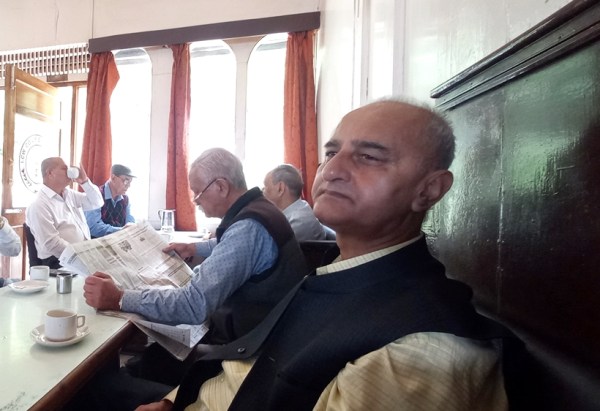 Retired IAS officer BN Nanta (right) said Shimla’s current destruction and condition cannot be blamed on rains. (Express photo)
 Between August 14 and 17, 27 deaths were reported in Shimla, including seven from one family in a cloudburst incident at Shiv Bawadi temple. (Express photo)


 Share


