


Stay updated with the latest - Click here to follow us on Instagram

Journalism of Courage
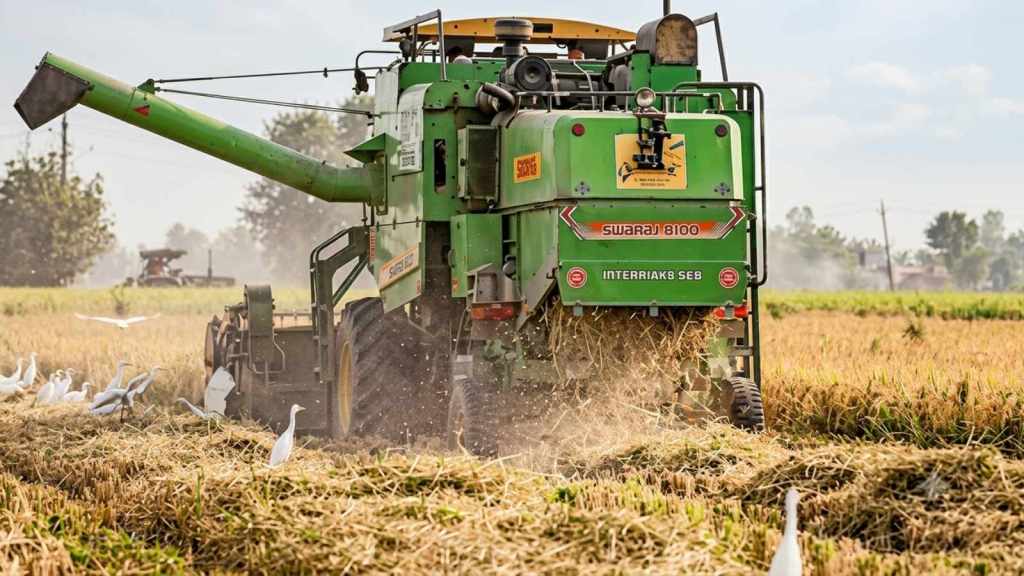 The state has distributed around 67,000 crop resIdue management machines since 2018. (File photo/ enhanced by AI)
PUNJAB is heading into this year’s paddy harvest with a record rice area to cover and a sizeable part of the crop-residue management machinery supplied during the initial years of the anti-stubble-burning programme having reached the end of its operational life.
The Agriculture Department expects around 1.25 lakh crop residue management (CRM) machines to be operational this season, even as nearly 67,000 machines distributed since the scheme was launched in 2018 have completed about five years and are now considered non-functional or scrap.
The distinction is significant: the 67,000 machines that have reached the end of their life are not part of the state’s projected 1.25 lakh operational fleet for this season.
To replenish the fleet, around 22,000 new CRM machines are being added this year under the scheme at an expenditure of about Rs 600 crore, with funding shared between the Centre and state in a 60:40 ratio. Around 2,000 additional machines are also expected to come through other schemes and grants. The CRM scheme has been integrated with the national agricultural mechanisation framework on the 60:40 Centre-State funding pattern since 2023-24.
“Punjab has distributed around 1.65 lakh CRM machines since 2018. Of these, about 67,000 have now completed their roughly five-year operational cycle, leaving around 98,000 machines from previous years that are considered functional. The department, however, expects the total operational availability this season to be around 1.25 lakh after fresh additions and machines sourced through other schemes,” said Director Agriculture Gurjit Singh Brar.
Punjab has more paddy to manage than ever before. Rice, including Basmati and non-Basmati varieties, has touched a record 32.86 lakh hectares, accounting for more than 92 per cent of the state’s kharif crop area.
More than 70,000 of the operational machines are expected to be Super Seeders, making the machine the most sought-after CRM equipment in the state after the Happy Seeder dominated the early years of the programme.
A Super Seeder allows farmers to manage standing paddy residue and sow wheat in the same operation, cutting and incorporating the residue while preparing the field for the next crop and sowing the seed. Its growing use has shifted the focus towards machinery that can combine residue management with timely wheat sowing.
Punjab now has around 6,100 Custom Hiring Centres (CHCs) from where farmers can hire CRM machinery instead of purchasing it. Out of these, around 600 centres are being added this year, expanding access to machines particularly for farmers who cannot afford individual ownership.
Punjab generates over 20 million tonnes of paddy stubble, out of which the state is expecting to manage around 8 million tonnes through ex-situ utilisation, including by making bales of the stubble through balers, which have also been in high demand in the state over the past three to four years.
These bales are used in several biomass plants and compressed biogas plants, as well as in pellet-making units, with a number of such units coming up in Punjab and neighbouring areas.
Punjab is expecting to incorporate the remaining around 12 million tonnes of stubble in the earth through in-situ management, experts said. Incorporating stubble into the soil not only enhances soil fertility but can also reduce the requirement for fertilisers in such fields, they added.
The state is also planning to put around 8,000 agriculture and field-level personnel, including nodal officers, on the ground during the paddy harvesting period to monitor residue management and farm-fire incidents.
Director Brar said the department is making efforts to bring stubble burning down to an almost zero or negligible level this season.
The challenge, however, is no longer simply one of making machinery available. The state has to ensure that enough functional machines reach fields at the right time, particularly as the harvesting window remains compressed between paddy harvesting and wheat sowing.
Official paddy procurement is scheduled to begin from October 1, although short-duration paddy varieties have already started reaching mandis in parts of Punjab.
Punjab recorded 5,114 farm-fire incidents during the 2025 paddy harvesting season, according to the Commission for Air Quality Management (CAQM) and the Centre. This was 53 per cent lower than the 10,909 incidents recorded in 2024 and 93 per cent lower than the 2021 figure.
The reduction has coincided with the large-scale deployment of CRM machinery, greater monitoring and enforcement, and a gradual expansion of ex-situ utilisation of paddy straw alongside in-situ management. CAQM has also stressed that states need to strengthen both in-situ and ex-situ mechanisms for the 2026 season.
This year, therefore, the test for Punjab is two-fold: whether the state can sustain the downward trend in farm fires and whether its CRM network can cope with a record rice acreage while thousands of machines from the first few years of the programme have aged out.
The Centre has also proposed a fresh regulatory framework. A September 8, 2026 draft notification provides for red entries in land records of farmers found violating the stubble-burning provisions, with such entries to remain for 15 months.
To feature this story on high-visibility platforms (e.g., Google Discover or news feeds), the main photo from the article has been cropped, straightened, color-corrected, and upscaled to meet standard 16:9 ultra-wide web publishing guidelines:
Stay updated with the latest - Click here to follow us on Instagram