The simple act of sipping tea as the dappled sunlight filters into the verandah of their sprawling 300-square-yard house in Ludhiana is set to become a thing of the past for Sadhu Singh, 76, and Manjit Kaur, 68. With their two sons having become permanent residents of Canada a few years ago, the couple are in the process of selling their ancestral property to move abroad permanently.
In the past, landowners divided their time between tending to their fields and businesses in India, and staying with their children abroad. However, many aged farmers in Punjab are now selling their massive parcels of land and shifting abroad — lock, stock and barrel — to stay close to their children who are settled in countries like Canada and Australia. That’s a significant shift for a population defined by their emotional attachment to their “zameen” (land), even as many of them lived abroad or shuttled between their adopted countries and “home”.

Sadhu, who lives in Ludhiana’s Punjab Mata Nagar, said, “My wife and I became permanent residents of Canada in early 2016, but divided our time between the two nations. While we were in Canada, some thieves broke into our house. We decided to sell the house after that and move abroad. Our sons and their families have no plans to return to India. We plan to shift to Canada in two months. Our children worry about us since we stay alone in India. Whenever we come to India next, we will rent a house for a month.”
There are many others like Sadhu and Manjit. Talking about his family, Bhagh Singh, a 66-year-old who worked with the Punjab State Power Corporation Limited, said, “My three cousins, Dilbag Singh, Jaija Singh and Kamaljeet Singh, came to India in January to sell off 14 acres of their family land. Their father had shifted to England in the early 1960s and their mother joined him later with two of the boys. Kamaljeet was born in England.”
Bhagh, who lives in Barnala’s Chananwal village, added, “Their paternal aunt used to take care of the land in India. However, both she and their father are no more now. Dilbag and Jaija are almost in their 70s. Their children work in England and have no interest in their ancestral farms in India. This is the story of many families in Punjab today.”
Varinder Sharma, a patwari in Ludhiana and the president of the Ludhiana Revenue and Patwari Union, said, “Though we don’t have the numbers, a number of NRIs have started selling their land in Punjab over the years.”
Satish Kumar, who retired two years ago from the Ludhiana Revenue Department, told The Indian Express, “While working as kanungo (a revenue official), I would see many NRIs come to the department in connection with selling their land. Most of them were old and their children were not interested in coming back to India. My son is also settled in Canada and not keen on returning to India. I too have been thinking about selling my property.”
Seventy-year-old Harcharan Singh Channa, a farmer in Barnala, said, “My nephew is settled in the US. On his last visit to Punjab, he sold nearly 4 acres of his family land. My uncle who resides in Barnala too sold his residential plot and moved to the US. The new generation is not interested in returning to India. Since many NRIs have suffered land frauds in the past, they prefer to invest their money in the country they reside in.”
In a village in Mansa district, a farmer couple involved in fertilizer and pesticide business on their family’s 30 acres recently sold off nearly 25 acres and left for Canada on May 15. A close friend said the remaining land has been leased out and their house in the village locked up. He said their children, who migrated to Canada over a decade ago, are permanent residents of the North American nation.
Manpreet Singh Ayali, the Akali Dal MLA from Dakha constituency in Ludhiana district, said he had come across many such instances while visiting villages in his constituency. He added that people whose children had migrated abroad are now severing their ties with India permanently by selling off ancestral land. “In the past, people who shifted abroad would use their earnings to acquire more land in their villages here. But all that is changing now,” Ayali said.
Mansa-based advocate Gurlabh Singh Mahal said, “Many well-off individuals are selling portions of their land, either to be with their children or to dispose of their property in their lifetime as their children have no plans to return to India. Many are using proceeds from the sale of their property to purchase houses in Canada, Australia, etc.”
On March 25, 2021, data on Indians going abroad from all states was presented in Parliament by V Muraleedharan, Union Minister of State for External Affairs, in reply to a question. According to this data, 1.37 crore Indians had left the country from January 1, 2016, to March 18, 2021. During the same period, 4.68 lakh people from Punjab left India for employment opportunities in other countries and 2.62 lakh left on student visas. During the same period, 1.26 lakh people left Chandigarh for employment opportunities abroad.
Talking about the trend of NRIs in Punjab selling their land, Bathinda Deputy Commissioner (Administrative) Showkat Ahmed Parray said, “There are many aspects to consider here, besides the lack of emotional connect of the new generation (brought up outside India) with the land in Punjab. Encroachment is a big issue for most NRIs. Any encroachment takes years to clear and involves a rather lengthy legal process. While land prices have somewhat stagnated in purely rural areas, rates in semi-urban areas or villages with development potential are rising. And it is this land that is prone to encroachment — by relatives in many cases. Any form of encroachment means lack of interest by real estate brokers.”
A wealthy landowner, who shifted to Canada about 30 years ago, said he was in the process of selling 60 acres of his ancestral land in Jagraon constituency of Ludhiana district since his Canada-born son has no plans to return to India.
Stating that his two sons live in Australia, 70-year-old Channa said, “My elder one went to Australia on a student visa over 15 years ago and now has permanent residency. The younger one’s application is under process. My wife and I take turns to visit them as my 93-year-old mother requires continuous care in India. The elder one has no plans to return but the younger one is undecided. If he decides to stay in Australia permanently, I will consider selling my land.”

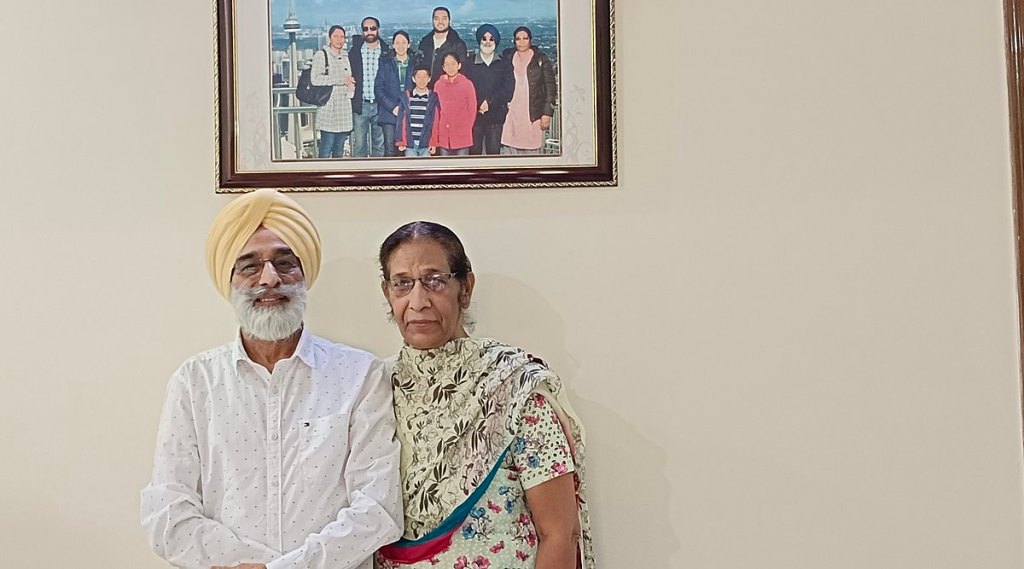 Sadhu Singh and Manjit Kaur at their house in Punjab Mata Nagar, Ludhiana. Their two sons are permanent residents of Canada and the couple too got their citizenship in early 2016. However, they kept shuttling between India and Canada. They are now selling their property and shifting abroad soon. (Express photo/Raakhi Jagga)


 Share


