


- Tags:
- agriculture
- mandi
- paddy
- Punjab
- Rain
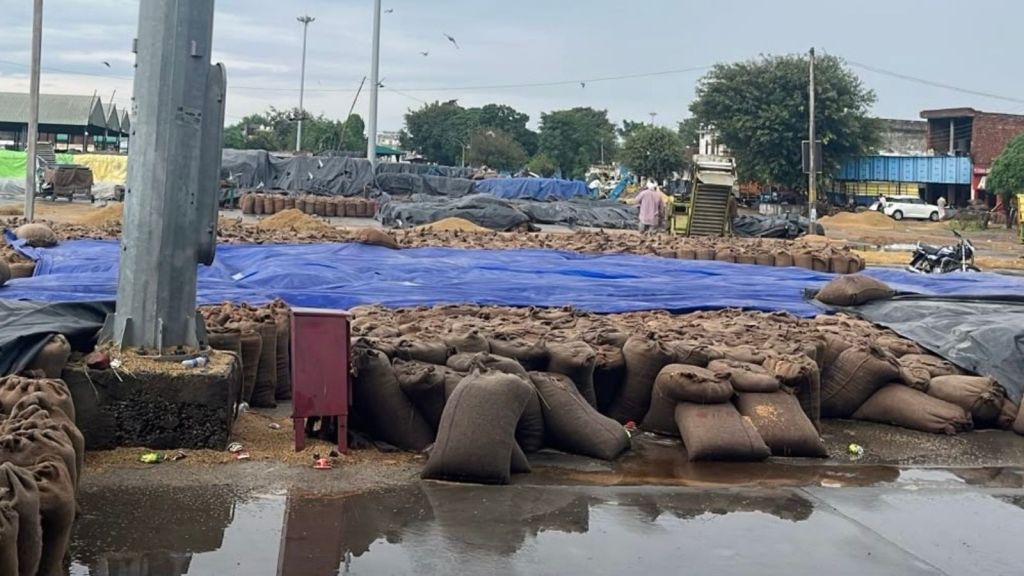 Heavy rain across Punjab on October 11 disrupted the paddy procurement season, flooding parts of Fazilka grain market (Express photo).
Heavy rain since Sunday morning has dealt a major blow to Punjab’s paddy procurement season, flooding parts of the Fazilka grain market, submerging sacks of paddy and drenching produce lying in the open at several mandis, including Khanna, Batala and Wadala Granthi.
With the India Meteorological Department (IMD), Chandigarh, warning of adverse weather in several districts on October 11, farmers fear that harvesting operations in affected areas could be delayed by at least a week, adding to concerns over grain quality and potential losses.
The situation at Fazilka was particularly alarming, with water reportedly accumulating to around three feet in parts of the mandi.
“Paddy sacks were submerged, loose grain was seen floating in standing water, and some produce was reportedly washed away from its original stacks. Farmers and others were forced to move through deep water, while areas around the mandi office were also affected by waterlogging,” said Vinod Gupta, a commission agent from the Fazilka green market, adding that such a blizzard and rain were hardly seen in Fazilka earlier.
The damage was not confined to Fazilka. At Khanna grain market in Ludhiana district, the region’s largest green market, large quantities of paddy lying in the open were drenched, with some produce packed in gunny bags and other stocks exposed to the rain. Similar scenes were reported at Batala and Wadala Granthi mandis in Gurdaspur district, where harvested paddy kept outdoors was caught in the downpour.
The rain has struck at a critical point in the agricultural calendar, as farmers bring harvested paddy to procurement centres even as large areas of standing crop await harvesting. The immediate challenge is to protect grain already delivered to mandis while ensuring that waterlogged fields dry sufficiently for combine harvesters to resume operations.
At Fazilka, the reported accumulation of around three feet of water created a difficult situation for farmers and those handling the produce. Paddy sacks were surrounded by or submerged in water, while loose grain floated across waterlogged sections of the market.
The concern extends beyond the immediate disruption. Paddy that remains wet for prolonged periods can deteriorate, while grain that has come into direct contact with standing water needs careful assessment before it can be dried, stored or taken through procurement. The extent of the losses will depend on how much produce was submerged or washed away, how quickly the water can be drained and whether further rain follows.
The situation has also highlighted the vulnerability of grain stored in the open during the procurement season. Clearing drainage channels, protecting stocks and separating damaged produce from grain that can be salvaged will be crucial in the coming days.
“At Khanna mandi, large quantities of paddy could be seen lying in the open, partly packed in gunny bags and partly exposed. The downpour drenched the stocks, raising concerns over the time and effort required to dry the grain and protect it from further rain,” said Darshan Lal, the chairman of the Labour Union Punjab at Khanna Mandi.
At Batala grain market, Sunny Shergill, president of the labour union, said around 70,000–80,000 sacks of paddy had arrived on Saturday, much of it lying in the open when the rain lashed the area.
“The paddy has been drenched and will now have to be dried properly. If it remains wet, there is a risk of sprouting, which can adversely affect the quality of the grain and create problems during procurement,” Shergill said.
 Heavy rain has flooded Punjab’s Fazilka grain market and drenched paddy stocks in several mandis (Express photo).
At Wadala Granthi mandi in Gurdaspur district, a farmer said even paddy that had already been weighed was caught in the rain. A commission agent had stacked the weighed produce in a large heap, but it was also drenched.
Across these markets, the immediate concern is the same: preventing further exposure, drying wet grain and assessing whether its quality has been affected. Prolonged moisture can increase the risk of sprouting and deterioration, potentially complicating procurement and storage.
According to the IMD, warning details supplied for October 11, a red alert was reported for Jalandhar, Hoshiarpur, Sangrur, Patiala, Kapurthala, Shaheed Bhagat Singh Nagar and Fatehgarh Sahib. Several other districts were under an orange warning.
The district-wise weather information also flagged parts of Patiala, Rajpura, Dera Bassi and Mohali for thunderstorms with gusty winds of 40–60 kmph and hail. A separate thunderstorm warning covered parts of Fatehgarh Sahib, Amloh, Bassi Pathana, Khanna, Kharar, Khamanon, Ludhiana East, Chamkaur Sahib, Samrala, Rupnagar, Balachaur, Phagwara, Jalandhar I and II, Nawanshahr, Anandpur Sahib, Garhshankar, Nangal, Hoshiarpur and Dasua. Light rain was forecast over parts of Lehra, Sunam, Sangrur, Dhuri, Malerkotla, Moonak, Patran, Samana, Patiala and Nabha.
The rain has also disrupted harvesting in fields where paddy is ready to be cut. Waterlogged or excessively soft ground prevents combine harvesters from operating efficiently, forcing farmers to wait for better conditions.
Parampreet Singh, a farmer from Jalandhar, said his crop was ready for harvesting before the rain arrived. “My crop was ready to be harvested, but after this heavy rain, I will not be able to run a combine machine in the field for at least four to five days, and possibly up to a week. That too will depend on whether there is any more rain,” he said.
His estimate points to the wider uncertainty facing farmers. In affected areas, harvesting could be delayed by four to seven days, depending on rainfall, soil conditions and the time required for fields to dry. Any further rain could prolong the delay, leave mature paddy standing in the fields and slow fresh arrivals at procurement centres.
Despite deficient rainfall earlier in the season, canal irrigation and favourable conditions until recently had helped paddy develop well in many parts of Punjab, raising hopes of a promising harvest. The latest rain has now put both standing crops and harvested stocks at risk.
The next few days will be critical. A return to dry weather would help water recede from mandis, allow farmers and commission agents to dry exposed stocks and enable combine harvesters to return to the fields. Further rain could deepen the disruption and increase the risk of losses.