Out of every 100 students studying in Punjab government schools, in classes III to VIII, only 47 can read a full story in their mother tongue (Punjabi). As many as 21 of them can read up to a paragraph, 17 can read a sentence, nine can only read words while nine others can barely do the same and six can only identify letters.
Similarly, only 25% of students in these classes can read a full story in English. Among them, 33% are in Class VIII, 25% in Class VII, 18% in Class VI, 37% in Class V, 24% in Class IV and 13% in Class III.
In maths, up to 39% students were not able to solve sums of division, 31% could not do subtraction, 18% were unable to recognise numbers from 11 to 19, while 8 per cent were not able to recognise numbers from 1 to 9. The survey was conducted on over 20,000 students.
These are startling revelations of a baseline survey conducted by Punjab government in government schools before the state launched its Mission Samarth on December 1, last year, to improve standards of education in the state.
The government had launched Mission Samarth to enhance the learning outcomes of the students along the lines of Mission Buniyaad in Delhi, in which the focus is on basic reading, writing and mathematics. Mission Buniyaad was launched by the Arvind Kejriwal-led Delhi government in 2018.
A functionary of the Punjab government told The Indian Express, “This was an exercise we undertook to find out the learning outcomes of the students. The teachers were asked to conduct this survey and give a report from every class.”
There are 12,880 primary, 2,670 middle, 1,740 high and 1,972 senior secondary schools in the state. “We started the baseline survey in July. It took us about five months to compile the data thus collected. Earlier, it was on a physical format and then we created a software. We had asked the teachers to prepare a database of the learning outcomes of the students and then upload it digitally. At the headquarters (school education department), we have been able to analyse it,” said another government functionary.
Speaking to The Indian Express, K K Yadav, Administrative Secretary (School Education), said: “We started the Mission Samarth from December 1, 2023. This was aimed to equip students to strengthen their learning foundation so that they can perform better academically. We are getting full support from the teachers.”
The department has identified students who need basic learning skills. “During their half day at school, they are given lessons in basic learning. Unless they have good reading skills, they cannot fare well in higher classes. So, the emphasis is on making them recognise words, numbers, read sentences and solve basic arithmetic problems,” Yadav said.
Interestingly, Punjab was the top performer among the states in National Achievement Survey (NAS), 2021, report released by the Union government in 2022. NAS is a national-level assessment survey conducted to obtain information about the learning achievement of students. It is used for chalking out new educational policies.
A total of 1,17,601 students and 16,972 teachers from 3,656 schools in Punjab had participated in the NAS. While the average performance of Class III students in language across the country was rated at 323 mean score out of total 500, Punjab students scored 355. In mathematics, Punjab Class III students got the highest, 339, average performance score when the average national performance of students in the subject was only 306.
However, the report stirred up a controversy when Chief Minister Bhagwant Mann told the Vidhan Sabha during the AAP-led government’s first Budget session in 2022 that “Punjab’s top rank in Centre’s NAS was fake and they would uncover the reality in the days to come”.
Mann had said, “You cannot just paint the schools from outside and claim them to be number one. The catch is in the education standards. When the schools are without staff and amenities they cannot be number one. There is no staff, no water, no benches. How can they (schools) top the performance table? We will show you how schools are made top class.”
The Opposition had then taken a dig at the government stating that they were selling the model of Delhi schools to Punjab, but ironically, the state’s (Punjab) schools were adjudged the best.
Dr Pyare Lal Garg, a medical educationist said that not one but several surveys have exposed the current state of affairs. “I recently vetted a survey report of learning outcomes in the schools carried out by an agency. The state of affairs is quite bad. As many as 55.5% students of Class VIII were not able to divide with a single digit, 17.5% were not able to read Punjabi book of Class II.”
“How can we blame the students? It is up to the teachers. They just want holidays. If the weather is cold, they start seeking holidays but at the same time, go to hill stations to enjoy the snow. There is no accountability. They do not work to impart education but to get salaries. They know poor performance of students would not cause them any harm. Their salaries would not be deducted and their children do not study in government schools. So, their future is not at stake,” he added.

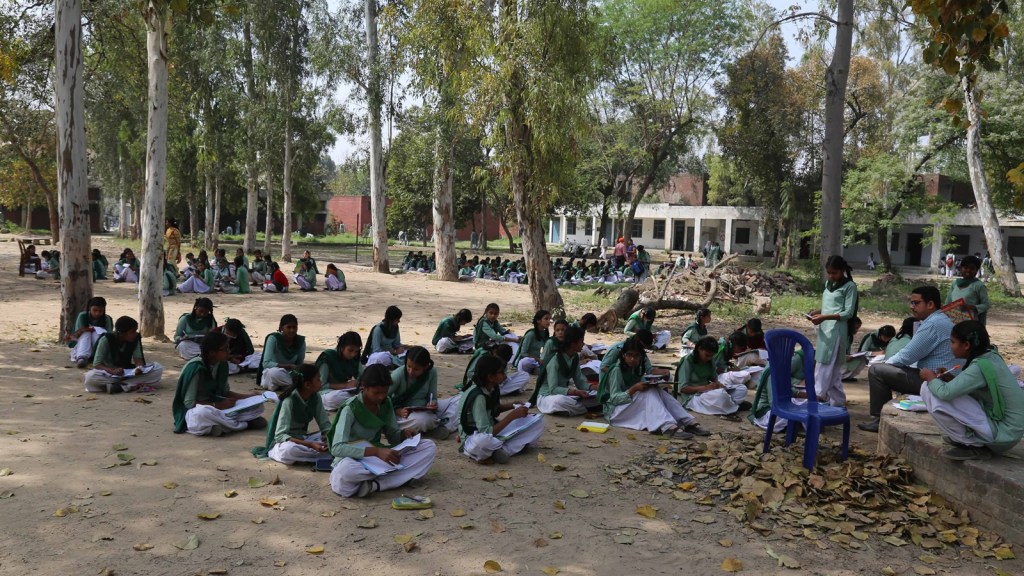 There are 12,880 primary, 2,670 middle, 1,740 high and1,972 senior secondary schools in the state. (Express Photo)



 Share


