Journalism of Courage



 By 2012 they converted all their land into organic farming and also shifted to sugarcane farming entirely by turning away from wheat and paddy. (Express Photo)
While farmers across the country are demanding a Minimum Support Price (MSP) to secure a guaranteed market for their crops, a farmer from Jalandhar has created his own assured market.
Amarjit Singh Bhangu (54), from Charke village, has converted his entire farm to organic cultivation. He built a consumer base — that now stretches across Punjab— so strong that his products, mainly jaggery, shakkar (jaggery powder) and turmeric, have been booked up to March 2027, and he still cannot meet the growing demand.
At a time when farmers are compelled to sell their lands to meet family expenses, Amarjit has expanded his family’s landholding from 12 to 17 acres with income from farming alone.
Amarjit spent six years in Abu Dhabi during the 1990s after completing his intermediate education. He later received his visa for a third time but refused to go. He says, “I saw enough of the world. My father needed me and farming needed attention. So I stayed.”
 He and his younger brother Karamjit Singh jointly look after the entire farming, processing and poultry operations. (Express Photo)
It was his father, Avtar Singh Bhangu, who inspired his shift to organic farming. After Amarjit’s cousin passed away in 2004 due to blood cancer, Avtar established a vermicompost (organic manure) unit.
Of their 12 acres of farmland, the family began their journey of organic farming on 2.5 acres in 2006. By 2012 they converted all their land into organic farming and also shifted to sugarcane farming entirely by turning away from wheat and paddy.
However, Amarjit recalls that marketing was a struggle for the first 4-5 years. He recalls, “There was no social media then. Whenever we visited a town, we would take a few pieces of jaggery as a sample for the kirana shopkeepers to make tea. Most jaggery curdles tea. We wanted them to know that our jaggery is pure — when boiled with milk for tea, it will not split. We asked the shopkeepers to sell a small portion of our jaggery to consumers.”
According to the 54-year-old farmer, they do not market their products as it is through consumer-to-consumer marketing; people come to their outlets at the farm itself. Initially, sometimes there were profits, while sometimes there was no market at all for the products.
 He uses cane varieties like COJ 85, COJ 118 (PAU) and 15023 (UP), which he also propagates for seeds. (Express Photo)
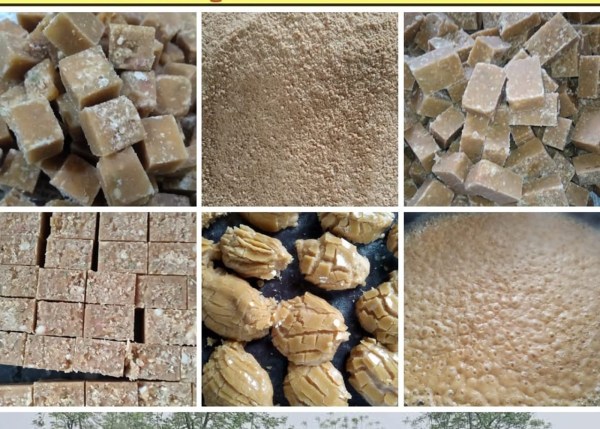
“But we persisted… started making our own jaggery of different flavours, shakkar (jaggery powder) and jaggery candy, using an electric crusher,” he said. The crusher, though has a capacity of 200 quintals, they used it for only 60 quintals daily during the season, starting around mid-November and ending in March. They sell jaggery at the rates decided by them — Rs 130/kg, shakkar at Rs 150/kg and jaggery candy at Rs 270/kg.
“Our strength is local families, not wholesale buyers. People from Canada often ask us to supply in bulk, but we do not do that,” said Amarjit.
The locals also book in advance — between February and March — mostly for storage for consumption throughout the year.
“We never take advance money. If someone cancels pre-booked orders, we don’t mind. There is a long waiting list,” said Amarjit.
One acre yields around 200–250 quintals of cane, depending on the variety, and they are able to make 25–30 quintals of jaggery/shakkar per acre of sugarcane. This generates approximately Rs 3.50–3.90 lakh revenue per acre. His profit margin, after all the input costs, still remains more than half.
If one sells cane from one acre to the mill, they can generate around Rs 1.60 lakh of revenue at the State Assured Price (SAP). “Why run after SAP when you can create your own market through quality?”
He uses cane varieties like COJ 85, COJ 118 (PAU) and 15023 (UP), which he also propagates for seeds.
Of the five acres that he bought between 2015 and 2024, he grows turmeric on two, and fodder crops, basmati, and runs dairy and poultry on the remaining three, making all his 17 acres of land completely organic. Cane and turmeric are year-long crops. Cane is harvested from November to March and turmeric from mid-January, basmati is grown just for consumers on demand.
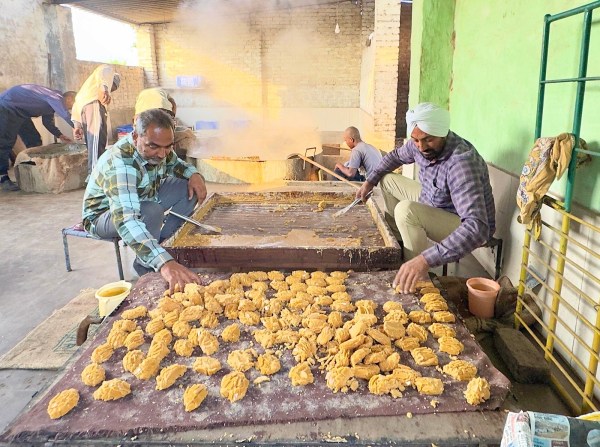 One acre yields around 200–250 quintals of cane, depending on the variety, and they are able to make 25–30 quintals of jaggery/shakkar per acre of sugarcane. (Express Photo)
Turmeric, sown from late March to mid May using the mulching method and harvested in mid-January. He grows all the crops on beds as this method doesn’t need flood irrigation. After peeling and drying, the turmeric is put in cold storage to retain its quality and curcumin oil, and is later ground on a chakki. The powder sells for Rs 400/kg. One can generate revenue of Rs 6-7 lakh per acre, and after expenses, the profit margin is more than half. Employing 15 permanent workers, including locals, he has generated employment as well.
“We keep rates reasonable so more people can buy pure food,” he says.
For his efforts, he got the State Award twice for Organic Farming from the two former Chief Ministers of Punjab, an award from Punjab Agricultural University, another from Hyderabad for his organic basmati and several at district level.
Amarjit also manages a fully automatic poultry unit, which he started in a traditional way with 300 birds in the late 1990s, and now has 50,000 birds.
He and his younger brother Karamjit Singh jointly look after the entire farming, processing and poultry operations.
Amarjit speaks with pride about his parents: “My parents lived in the village throughout their life, but they were very forward-looking, and they gave us the same values. After the death of my father in 2017, we fulfilled his last wish, donating his entire body to Punjab Institute of Medical Sciences (PIMS), Jalandhar, for medical research. In 2022, when my mother Gurmeet Kaur passed away, we donated her body also to PIMS.”
“We don’t just sell food,” he says. “We want people to know what they should eat and what they shouldn’t. When consumers demand quality, producers will be forced to grow quality.”

 6 min read