3 min readChandigarhMar 8, 2026 05:01 PM IST
First published on: Mar 8, 2026 at 05:01 PM IST
On International Women’s Day, the Punjab Government unveiled Budget 2026-27 that fulfills a defining 2022 campaign promise, but with a strategic twist. The direct cash transfer scheme, Mukh Mantri Mawan Dhian Satikar Yojna, aims for near-universal coverage, distinguishing itself from more restrictive schemes in other states.
While the scheme offers Rs 1,000 per month to most adult women, it provides a higher tier of Rs 1,500 for women from the Scheduled Caste (SC) community, a demographic that constitutes over 32.5 per cent of Punjab’s population.

Finance Minister Harpal Cheema said the scheme is a rejection of “targeted” welfare, which he labelled as political jumlas (empty promises). The Punjab model is designed to be nearly universal, covering 97 per cent of adult women, barring government employees and income tax payers. Women receiving other social security pensions, like old-age, widow, destitute, or disability pensions, will now receive a total of Rs 2,500 per month.
Neighbouring Haryana’s Deen Dayal Lado Lakshmi Yojana offers a higher monthly sum of RS 2,100, but it is capped at households earning less than Rs 1 lakh annually. This restricts coverage to roughly 20–22 lakh women.
Himachal Pradesh offers Rs 1,500 under the Indira Gandhi Pyari Behna Sukh-Samman Nidhi Yojana, but only to non-taxpayers, while Karnataka limit benefits to one female head per household under its Gruha Lakshmi scheme. West Bengal’s Lakshmir Bhandar scheme provides assistance primarily to women from low-income households. In Madhya Pradesh, the Ladli Behna Yojana is available only to women within specified age groups and income brackets.
Economic independence of women
The AAP government has earmarked Rs 9,300 crore for the scheme in the 2026–27 financial year, describing it as one of the largest women-centric financial assistance programmes undertaken by a state.
Cheema said the initiative aims to promote economic independence among women and strengthen their role in household decision-making. The government also linked the programme to broader social goals, including improved health and nutritional outcomes and greater support for women pursuing education or employment.
Cheema said other states have limited their schemes to a small section of women, ignoring the vast majority of women who are financially dependent on men for their most basic needs.
Targeting the BJP government in Haryana, he said, “For example, one of our neighbouring states announced a similar scheme but limited it only to households with an annual income under Rs 1 lakh, covering only 20 per cent of all adult women. But Punjab will not do such jumlas.”
“Chief Minister Sardar Bhagwant Singh Mann Ji is not a Chief Minister for 20 per cent women of Punjab, but to all the women of Punjab. That is why we have decided to become the first state to ensure all adult women are covered under the scheme.”
“Whether it’s a college student needing books, or a grandmother buying a toy for her granddaughter, or a woman wishing to watch a movie in a cinema hall, they won’t have to ask anyone for money,” he said.
“Their elder brother, Bhagwant Singh Mann, will deposit Rs 1,000 to Rs 1,500 every month into their bank account directly.”

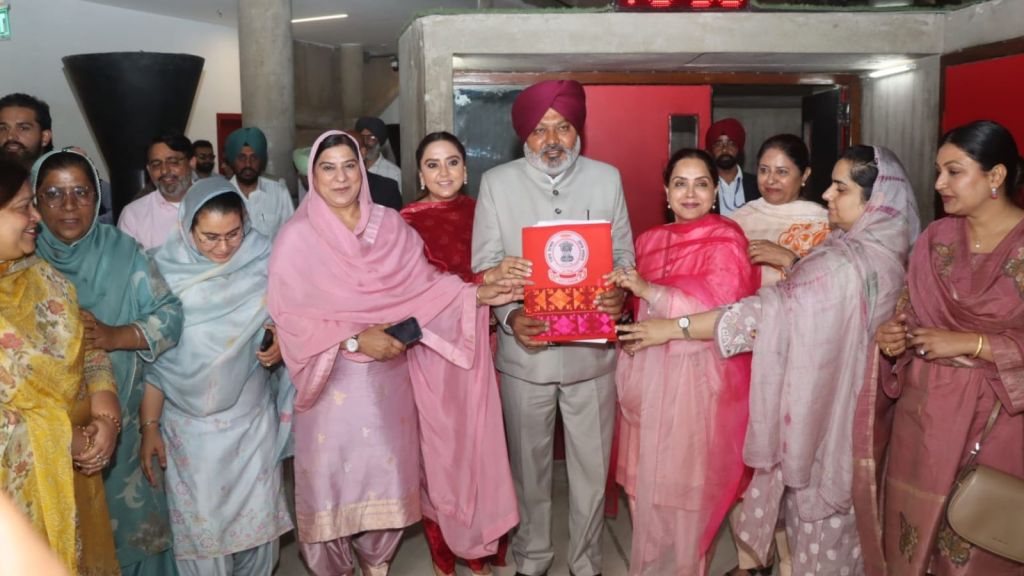 Punjab Finance Minister Harpal Cheema with women MLAs before presenting Punjab Budget 2026.
Express photo by Kamleshwar Singh


 Share


