Journalism of Courage



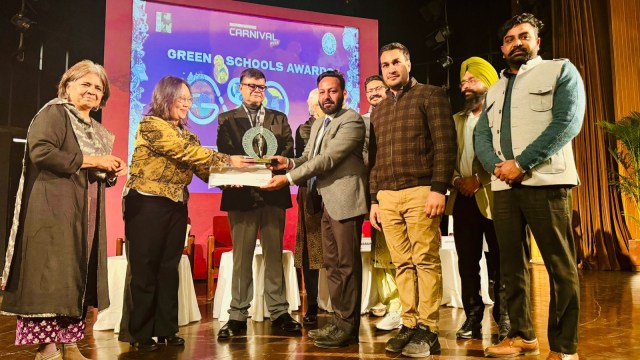 Preetinder Ghai, Deputy district education officer ( DEO) of Sangrur while receiving ' Best district ' award from CSE at New Delhi
In the prestigious annual green school awards presented by the Centre for Science and Environment (CSE), Punjab bagged the coveted title of the Best State. This recognition was achieved by setting an exemplary standard with
the highest audit registrations and report submissions. A total of 4,734 schools from the state diligently submitted their audit reports, with 70 schools earning the esteemed ‘green’ rating. Sangrur, in Punjab, was honored with the Best District Award, having recorded the maximum submissions at 503. The awards were presented in New Delhi by CSE Director General Sunita Narain.
Dr. Kulbir Bath, State Nodal Coordinator of Punjab State Council of Science and Technology (PSCST), the nodal organization coordinating with schools in Punjab, remarked, “Punjab CM Bhagwant Mann mentioned these results on his
social media handles.”
These accolades are bestowed annually through CSE’s Green Schools Programme (GSP), a 19-year-old initiative. This year, Punjab’s enthusiasm soared, with a total of 7,200 schools initially registering with CSE. Out of this,
an impressive 4,734 schools submitted their green audit reports, a level of participation unprecedented in the program’s history.
Bath highlighted the significance of Punjab receiving the Best State award, stating, “A total of 199 schools in India were given green school awards, and 70 of them are from Punjab, constituting 35% of the total list. The 4,734 entries from Punjab alone are monumental.”
Out of the 4,734 schools, only 70 in Punjab earned the coveted ‘green school’ title by fulfilling the criteria set by CSE. Ludhiana had the highest number of green schools at 30, while Sangrur had one – Government Primary Smart School in Bhattiwal Khurd village.
Satya Bharti School Lakhowal, Ludhiana, received the Changemaker Award.
Bath emphasized, “It doesn’t matter if only one school in Sangrur received the Green school award. The fact is 503 of them are making significant efforts. Ludhiana had the maximum green schools, but the total number of submissions was far less than Sangrur.”
In the green audit report, schools submitted evidence in the form of pictures and videos, showcasing their handling of solid waste. The evaluation also considered green practices related to conserving water, soil, food, energy, and air.
Sangrur Deputy Commissioner Jitendra Jorwal expressed his commitment to making every primary and upper primary school in the district a leader in various aspects of environmental conservation.
Providing additional insights, Sangrur’s Deputy District Education Officer Preetinder Ghai said, “Apart from the environment-friendly government schools, efforts in Sangrur district focused on conserving air, energy, food, soil, water, as well as electricity, proper maintenance of plants, use of bicycles instead of petrol and diesel vehicles, disposal of biodegradable and non-biodegradable waste, solar systems, mid-day meal systems, the standard of food served to students, and the number of teaching and non-teaching staff.”
According to CSE’s statement, over 5,300 schools from 29 states and Union territories participated in the audit, with government schools contributing the majority at 93%, followed by private schools at 6%, and government-aided schools at 1%. Of these, 20 schools received the top awards, and 199 were recognized as ‘green.’
What is a Green School?
A green school is an environmentally conscious institution that adheres to
the following criteria:
– Window to floor ratio (WFR) surpassing 5%, facilitating ample daylight and ventilation.
– Predominant use of sustainable or non-polluting modes of transport, such as public transport, e-rickshaws, cycling, and walking.
– Extensive utilization of energy-efficient lighting to conserve energy, coupled with exploration of alternative energy sources. The Green Schools Programme (GSP) Audit advocates minimizing conventional lights while ensuring sufficient illumination for students.
– Maintaining a substantial green cover within and around the school campus, promoting biodiversity through the planting of native plant species.
– Adoption of a policy to serve only cooked meals, steering clear of packaged foods high in fats, sugar, and salt, to ensure healthy food
consumption.
– Implementation of rainwater harvesting (RWH) systems to collect rainwater and the responsible reuse of treated wastewater.
– Regular pre- and post-monsoon cleaning of RWH systems is crucial.
– Efficient segregation of waste at the source and responsible disposal practices, with a recommended recycling rate of at least 90%.
– Composting of wet waste.
– Strict prohibition of waste burning practices.

 4 min read