


Stay updated with the latest - Click here to follow us on Instagram

Journalism of Courage
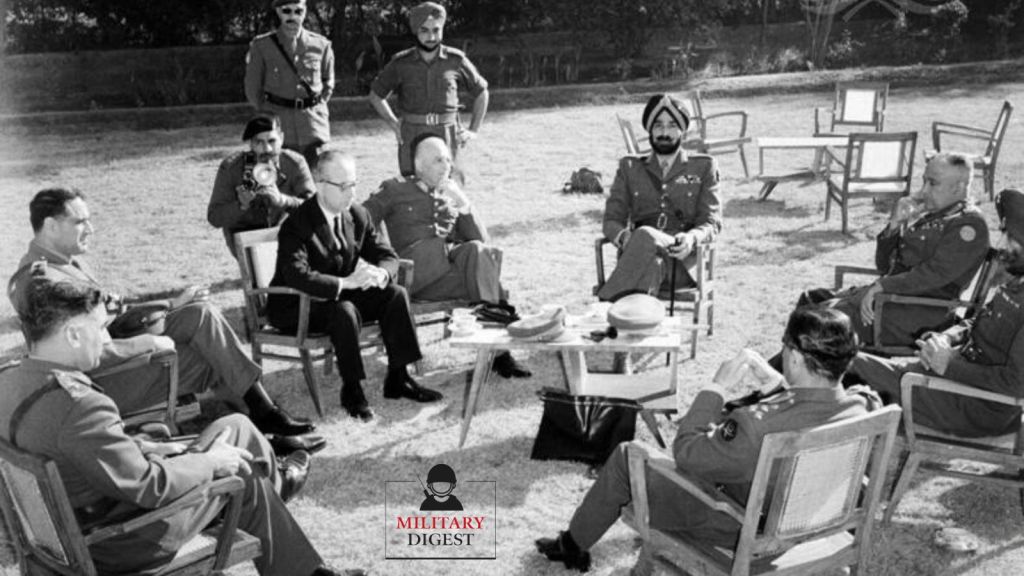 Indian and Pakistani military delegation in Amritsar cantonment during talks after the 1965 war. (United Nations photo).
An interesting postscript to the 1965 India-Pakistan war was the series of joint military meetings held in Lahore and Amritsar, where delegations from both nations discussed the fine print of the ceasefire and coordinated the withdrawal of forces.
Held under the auspices of the United Nations and in accordance with the Security Council resolution of November 5, 1965, the talks alternated between the two cities and were coordinated by Brigadier-General Tulio Marambio, the UN Secretary-General’s representative.
The Indian delegation was led by Lt Gen Harbaksh Singh, General Officer Commanding-in-Chief of Western Command, accompanied by Lt Col TS Padde (GSO-1, Western Command) and Captain Amarinder Singh, ADC to the Army Commander. The Pakistani side included Lt Gen Bakhtiar Rana (GOC 1 Corps), Lt Col SA Hasan, Lt Col Riaz Azim, and Brigadier Gul Hassan Khan.
Initially, the UN representative proposed meeting at a neutral camp midway between Lahore and Amritsar. However, Lt Gen Harbaksh rejected the site as barren and inhospitable, suggesting instead that the Indian team visit Lahore first, followed by the Pakistani delegation visiting Amritsar. When the UN envoy asked whether he had the Indian government’s permission to go to Lahore first, Harbaksh replied that he did not need to seek permission and that his decision was final, as he wrote in his book In the Line of Duty-A Soldier Remembers.
The Indian delegation arrived in Lahore in February 1966 aboard a UN aircraft with General Marambio. Upon arrival, Lt Gen Harbaksh inspected a Pakistan Army guard of honour. At the airfield, a personal connection surfaced: the Indian Army Commander recalled seeing his ADC, Captain Amarinder Singh, scion of the Maharaja of Patiala, embracing the young Pakistani Captain commanding the Guard of Honour. Amarinder later explained that the officer was the son of Colonel Majeed, his father’s former Military Secretary, and that the two had played together as children on the Patiala palace grounds.
While guiding Lt Gen Harbaksh through Lahore to refresh his pre-partition memories, Pakistani officials attempted psychological one-upmanship. Banners in Urdu were put up across the road advertising rides in a captured Indian vehicle for eight annas. The vehicle was the Jonga jeep of Maj Gen Niranjan Prasad, GOC 15 Infantry Division, which had been captured in a sugarcane field on Lahore’s outskirts after the officer narrowly escaped an ambush, leaving behind his starred plate, flag, and personal papers.
Lt Gen Harbaksh objected to the provocative banners and urged his hosts to turn the car around. When the Pakistani counterpart mentioned making over Rs 10,000 from the rides, Harbaksh denied losing a Jonga jeep and warned that if such trickery continued, he would produce ten Jongas adorned with Pakistani flags for inspection when the Pakistani delegation visited Amritsar.
When the Pakistani delegation made its reciprocal visit to Amritsar, Lt Gen Harbaksh arranged a tour of the Golden Temple. The visit occurred while Akali leader Sant Fateh Singh was staging a protest inside the shrine premises, preparing for a fast unto death and self-immolation to demand Punjabi Suba (a separate Sikh-majority state).
Despite the political tension, locals were informed in advance. “The reception given to us was tremendous. The shopkeepers of Amritsar were all standing in front of their shops and showered us with flowers. On arrival at Harmandir Sahib’s gate, we were received by the whole Prabandhak Committee (Shiromani Gurdwara Prabandhak Committee), which had lined up with garlands of flowers, to be presented to every member of the delegation, and the United Nations officers,” wrote Lt Gen Harbaksh.
Towards the end of the tour, the Pakistani General requested a meeting with Sant Fateh Singh, expecting the leader to make critical remarks about the Indian government. Instead, speaking in Punjabi, Sant Fateh Singh stated that the people of India and Pakistan should not fight each other, offered a discourse on the principles of the Sikh faith, and presented sets of Punjabi religious books to the leaders of the Pakistani and UN delegations.
Stay updated with the latest - Click here to follow us on Instagram